A host sits at the kitchen table with a spreadsheet open, a half-finished cup of coffee nearby, and a growing sense that addressing invitations should not feel this complicated. One line seems easy enough. Then questions pile up. Should an unmarried couple go on one line or two? Do adult children living at home get their own invitation? Is “and Guest” polite, or lazy? What happens when the invitation is digital instead of printed?
That little envelope, or email subject line, carries more weight than people expect. It tells guests whether they’re included, how formal the event will feel, and whether the host took care with the details. For weddings, showers, birthdays, and graduations alike, the invitation is the first welcome.
That’s why addressing invitations etiquette still matters. Not because hosts need to perform old-fashioned perfection, but because clear wording helps people feel seen.
A modern celebration can still borrow the best parts of tradition. A black-tie wedding in London, a baby shower in Sydney, a birthday dinner in São Paulo, or a graduation party in California all benefit from the same core idea: name people clearly, respectfully, and consistently. Even couples planning smaller gatherings can apply the same care, especially if they’re inspired by intimate celebrations like these micro wedding ideas for 2026.
The Joy of Gathering Starts With the Invitation
The happiest hosts often worry the most about invitations. They want every guest to feel welcomed, and they know names carry meaning.
A couple planning a wedding might pause over whether to write “The Patel Family” or list each person individually. A parent organizing a baby shower may wonder if one envelope to a household feels warm enough. A friend planning a milestone birthday may stare at a digital guest list and think, “I know exactly who I want there. I just don’t know how to phrase it.”
That uncertainty is normal.
Etiquette, at its best, isn’t about making celebrations feel stiff. It’s about reducing confusion before it starts. A well-addressed invitation tells guests who is invited, what tone to expect, and how carefully the event has been planned.
Good invitation etiquette feels less like rule-following and more like thoughtful hosting.
That shift makes the topic much easier to approach. Instead of asking, “What’s the most proper thing possible?” it helps to ask, “What wording will make this guest feel respected and informed?”
For a formal wedding, that may mean full names and titles. For a casual birthday brunch, it may mean first names and a cheerful digital invite. For any event, it means being intentional.
When hosts understand the reasoning behind the conventions, the choices start to feel simple. The names, lines, titles, and envelopes begin to work together like place settings at a beautifully prepared table. Each one subtly says, you belong here.
Invitation Etiquette Foundations
The backbone of addressing invitations etiquette is simple: clarity and respect. Every traditional rule makes more sense when viewed through those two words.
One household usually means one invitation
Traditional wedding invitation etiquette grew out of 18th and 19th century European aristocratic norms and settled into a practical rule of one invitation suite per household. That approach helped with cost, mailing clarity, and delivery reliability. It still shapes modern practice today, and it has a practical side for hosts managing guest counts.
According to a summary of etiquette guidance and wedding planning data, the average U.S. guest list is 131 people, and 72% of couples send fewer invitations than guests by grouping families (Lupine Letters).
That doesn’t mean every person under one roof should always be grouped together. Some guests should receive their own invitation if they’re invited as primary guests.
Common exceptions include:
- Adult children over 18 living at home: If they’re invited in their own right, they receive a separate invitation.
- Unmarried couples not living together: Each person gets their own invitation.
- Adult roommates: If both are invited, each should receive a separate invitation unless the event style clearly calls for a different approach.
Often, hosts get tripped up when they assume one address equals one invitation, but etiquette cares more about social unit than street address.
Full names feel respectful, not fussy
Formal invitations traditionally spell out names, titles, street names, and address elements in full. That style can look old-fashioned at first glance, but its real purpose is honor.
Writing “Doctor Elena Rivera” or “The Reverend Samuel Greene” acknowledges a guest’s identity with care. Writing out “Street” instead of “St.” gives the envelope a polished, complete look. It also keeps the invitation aligned with formal mailing conventions.
Practical rule: If the event is formal, the envelope should sound a little more polished than everyday life.
That doesn’t mean a host must use the most outdated wording available. Modern etiquette increasingly favors naming both people fully rather than subsuming one person into the other’s name. Respect now often looks more inclusive.
Consistency matters more than perfection
A guest list feels elegant when it follows one clear style all the way through. If one envelope says “Mr. and Mrs. David Chen” and another says “Ava + Ben,” the overall impression gets muddy.
Hosts usually make better decisions when they choose a tone first:
- Very formal: full names, formal titles, full address wording.
- Warm but polished: full names, fewer titles, clean formatting.
- Casual: first names or family names, especially for birthdays or showers.
For gift-related events, this same spirit of clarity applies beyond the envelope too. Group giving works best when expectations are clear, which is why hosts often appreciate guidance like this piece on group gift etiquette and how much to give.
The strongest foundation isn’t memorizing every rule. It’s understanding that invitation wording should help guests know exactly where they stand, and feel happy about it.
Your A-Z Guide to Addressing Every Guest
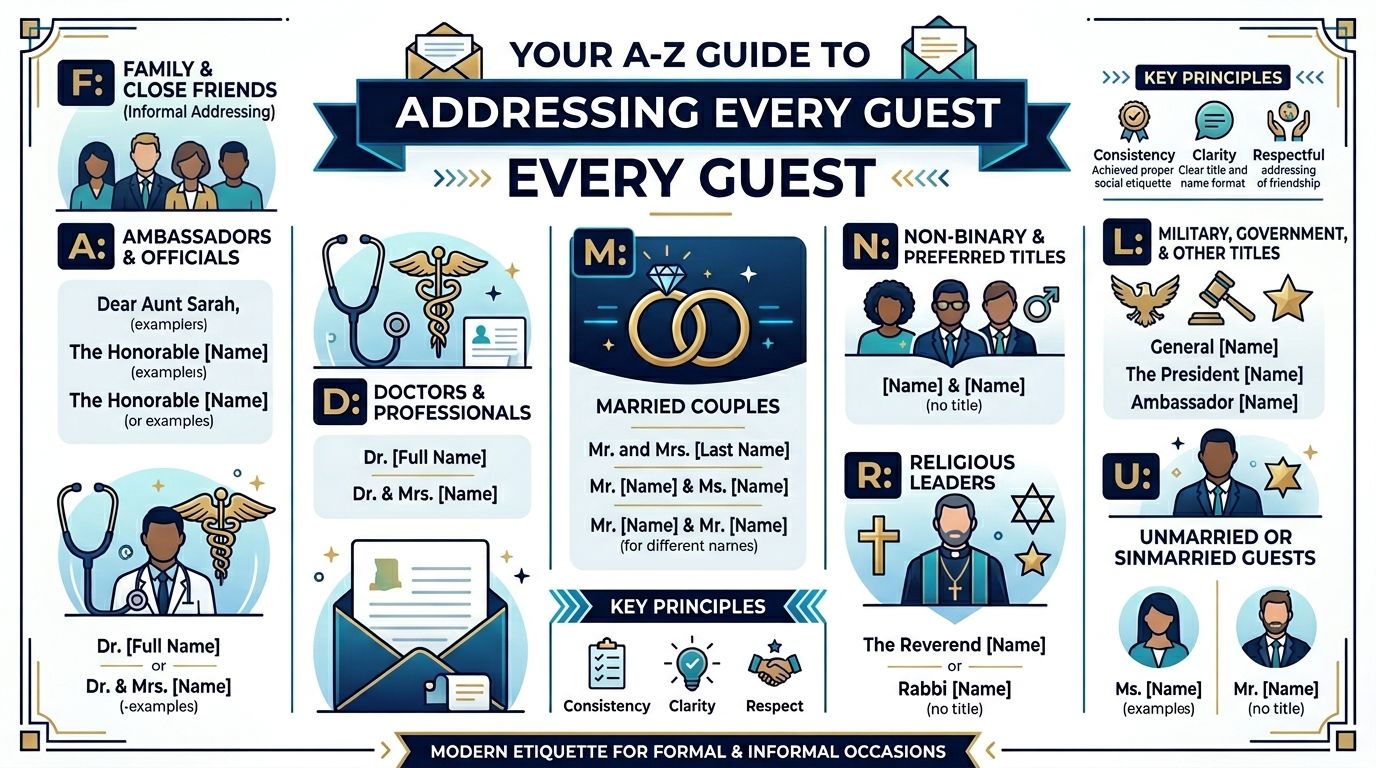
Addressing invitations etiquette becomes wonderfully specific. Names tell guests how they are known to the host, and wording tells them how the event is being framed.
One of the clearest modern principles is this: relationship status should be reflected accurately, not guessed at. Guidance summarized from etiquette experts notes that unmarried couples who live together should be addressed with separate full names on distinct lines, such as “Ms. Olivia Brooks” and “Mr. James Patterson.” The same guidance warns against using “and Guest” when the companion’s name is already known, because it can feel indifferent. It also recommends ordering names by closeness or alphabetically rather than defaulting to male-first conventions (Nerissa B Calligraphy).
Married couples
For married couples with the same last name, many hosts now choose a modern full-name format.
Formal outer envelope
- Mr. Daniel Lee and Mrs. Priya Lee
- Mr. Daniel Lee and Mr. Marcus Lee
- Mrs. Hannah Carter and Mrs. Elise Carter
Informal outer or inner envelope
- Daniel and Priya Lee
- Daniel and Marcus Lee
- Hannah and Elise Carter
If the couple has different last names, list both full names.
Examples:
- Ms. Sofia Alvarez and Mr. Thomas Reed
- Mrs. Nina Patel and Mrs. Claire Morgan
If one name should come first, use the person the host knows best. If the host knows both equally, alphabetical order is a clean choice.
Unmarried couples living together
This is one of the most misunderstood categories.
For a cohabiting unmarried couple, etiquette favors separate names on separate lines for formal addressing. That distinguishes the relationship from marriage while still honoring the shared household.
Example:
Ms. Olivia Brooks
Mr. James Patterson
An informal version can soften the tone:
- Olivia Brooks and James Patterson
- Olivia and James
Hosts sometimes worry this looks cold. It doesn’t. It’s one of the clearest and most considerate ways to address the envelope.
Same-sex couples
Same-sex couples should be addressed with the same care given to any couple. If married, full names on one line work beautifully. If unmarried and living together, separate lines remain the cleanest formal option.
Ordering is often easiest when done alphabetically or by closeness to the host. That fits current guidance and avoids imposing a dated hierarchy.
Examples:
- Mr. Adrian Cole and Mr. Ethan Brooks
- Ms. Laura Green and Ms. Maya Foster
- Ms. Laura Green
Ms. Maya Foster
Single guests and plus-ones
A host should always use the companion’s actual name if it’s known.
That means:
- Ms. Rachel Kim and Mr. Owen Park
Not:
- Ms. Rachel Kim and Guest
“And Guest” is still acceptable when the plus-one has not been identified. It’s a placeholder, not a shortcut to use when better information is available.
If the host knows the partner’s name, using it shows care. That one detail often matters more than any fancy calligraphy.
For very casual events, a digital invitation might read:
- Rachel Kim + Guest
That can be perfectly fine for a birthday dinner or graduation party, as long as the host uses the same tone across the list.
Guests with professional or official titles
Titles still matter on formal invitations. If one person holds a distinguished title such as Dr., Reverend, Judge, or Captain, that person is generally listed first.
Examples:
- Dr. Elena Rivera and Mr. Lucas Rivera
- Judge Amara Collins and Ms. Tessa Blake
- Captain Noah Bennett and Mr. Eli Foster
If both partners hold titles of equal rank, alphabetical ordering is a sensible approach.
A title isn’t decoration. It’s recognition.
Families with children
Families can be addressed in a few ways, depending on the event’s style and whether children are invited.
If the whole household is invited
- The Robinson Family
- Mr. and Mrs. Aaron Robinson and Family
If only the adults are invited
- Mr. Aaron Robinson and Mrs. Mia Robinson
That second option implicitly communicates that the children are not included, without adding an awkward explanatory note on the envelope.
For more family-centered celebrations, parents often compare invitation wording with broader planning etiquette from resources like BabyCenter.
Adult children and roommates
Adult children living at home who are invited as primary guests should receive their own invitation. The same goes for adult roommates.
Examples:
- Ms. Chloe Nguyen
- Mr. Evan Price
This can feel surprisingly important. Separate invitations signal independent inclusion, not add-on status.
Quick Guide to Addressing Common Guests
| Guest Scenario | Formal Outer Envelope | Informal Outer Envelope / Inner Envelope |
|---|---|---|
| Married couple, same last name | Mr. Daniel Lee and Mrs. Priya Lee | Daniel and Priya Lee |
| Married couple, different last names | Ms. Sofia Alvarez and Mr. Thomas Reed | Sofia Alvarez and Thomas Reed |
| Unmarried couple living together | Ms. Olivia Brooks / Mr. James Patterson | Olivia Brooks and James Patterson |
| Same-sex married couple | Mr. Adrian Cole and Mr. Ethan Brooks | Adrian and Ethan Brooks |
| Single guest with known plus-one | Ms. Rachel Kim and Mr. Owen Park | Rachel and Owen |
| Single guest with unknown plus-one | Ms. Rachel Kim and Guest | Rachel + Guest |
| One guest has a professional title | Dr. Elena Rivera and Mr. Lucas Rivera | Elena and Lucas |
| Family with children invited | The Robinson Family | Aaron, Mia, and family |
| Adults only in a household | Mr. Aaron Robinson and Mrs. Mia Robinson | Aaron and Mia Robinson |
| Adult child living at home | Ms. Chloe Nguyen | Chloe Nguyen |
A guest list doesn’t need to look old-fashioned to feel correct. It just needs to name people as they are.
Formal Weddings vs Casual Celebrations
Some events want a crisp, ceremonial tone. Others feel better with warmth and ease. Addressing invitations etiquette works best when the formality of the envelope matches the formality of the celebration.
When formality adds value
The formal wedding invitation still has a distinct rhythm. Much of that structure traces back to Emily Post’s 1922 Etiquette, which codified outer and inner envelope conventions. That format remains influential. One summary of current invitation practices notes that 68% of 2024 couples still use inner envelopes to clarify plus-ones and children under 18, and that this approach reduces “and guest” ambiguities by 40% versus single-envelope formats. The same summary notes that same-sex couples are often addressed alphabetically, reflecting a more adaptable modern approach (It’s A Yes).
For a formal wedding, that often means:
- Outer envelope: full names, formal titles, complete mailing address
- Inner envelope: clearer naming of invited household members, children, or plus-ones
- Tone: elegant, restrained, and consistent
A black-tie wedding in New York or a manor-house celebration in the UK often benefits from this structure because it removes ambiguity without making the host explain every detail separately.
When casual feels more gracious
A baby shower, birthday party, graduation celebration, or relaxed wedding weekend doesn’t need to sound like a royal announcement.
Single envelopes work well. So do first names. A family invitation can be simple and clear:
- The Morales Family
- Ava and Jordan
- Priya Shah + Guest
Casual doesn’t mean careless. It means the host chooses wording that fits the setting.
For example, a garden baby shower might use:
- Emma and Theo Walker
A graduation party email might use:
- Maya Johnson and Guest
A formal version of either would feel oddly stiff.
The best invitation tone is the one that matches the event guests will actually attend.
A simple side-by-side test
Hosts who feel stuck can ask three questions.
| If the answer is yes | Lean more formal |
|---|---|
| Is the event black tie, religious, or highly traditional? | Yes |
| Are printed invitations a major part of the aesthetic? | Yes |
| Does the guest list include many older relatives or titled guests? | Yes |
| If the answer is yes | Lean more casual |
|---|---|
| Is the event relaxed, daytime, or family-centered? | Yes |
| Will guests RSVP online instead of by mail? | Yes |
| Do first names reflect the actual mood better than titles? | Yes |
For couples weighing modern choices, current planning conversations often blend etiquette with style, budget, and guest experience. Trend roundups like these wedding trends for 2026 can help sharpen that instinct.
For additional inspiration on tone and invitation style, many hosts also browse ideas from Brides.
Consistency is vital for success. A formal invitation suite should feel formal all the way through. A casual celebration should sound like the host, not like borrowed language from another kind of event.
The Art of the Physical Invitation Suite
Paper invitations still have a special kind of magic. They turn information into an object guests can hold, display, and remember.
Formal invitation guidance commonly uses a two-envelope system. The outer envelope carries the full mailing address and should center the recipient’s name and address on the front, with words like street names and state names spelled out. The inner envelope allows a slightly more relaxed presentation and helps clarify who, specifically, is invited. This dual-envelope approach preserves formality while also making room for clear guest naming (The Knot’s invitation etiquette guide).
What belongs in the suite
A traditional suite often includes several pieces:
- Invitation card: The main event details.
- RSVP card: A simple response card with return details.
- Details card: Extra information such as timing, attire, or directions.
- Reception card: Useful if ceremony and reception details need separation.
Not every event needs all of these. A baby shower might need only the invitation and RSVP details. A wedding weekend may need multiple inserts.
How to assemble it cleanly
The suite should feel intentional when the guest opens it.
A simple way to think about assembly:
- Put the main invitation card at the back.
- Layer smaller insert cards in front.
- Place the RSVP card and its envelope neatly within the stack.
- Slide the full set into the inner envelope, if using one.
- Place that into the outer envelope for mailing.
Hosts who love tactile details may choose letterpress, engraving, or soft cotton paper. Others prefer digitally printed cards with clean typography and a modern palette. Either path can look refined.
Small details guests notice
These choices create a polished impression fast:
- Centered addressing: It gives the envelope balance.
- Spelled-out address elements: “Road,” “Apartment,” and state names look more formal than shortened versions.
- Readable ink and contrast: Beauty should never make the envelope hard to read.
- Proofread names first: Misspelling a guest’s name cancels out a lot of visual elegance.
Paper invitations can also align with thoughtful planning choices around printing volume, recycled stock, and minimal inserts. Hosts exploring lighter-impact celebrations often enjoy ideas like these on sustainable celebrations and eco-friendly parties.
A physical invitation suite doesn’t need to be elaborate to feel beautiful. It just needs to feel composed, legible, and considerate.
Digital Invitations and Registry Integration
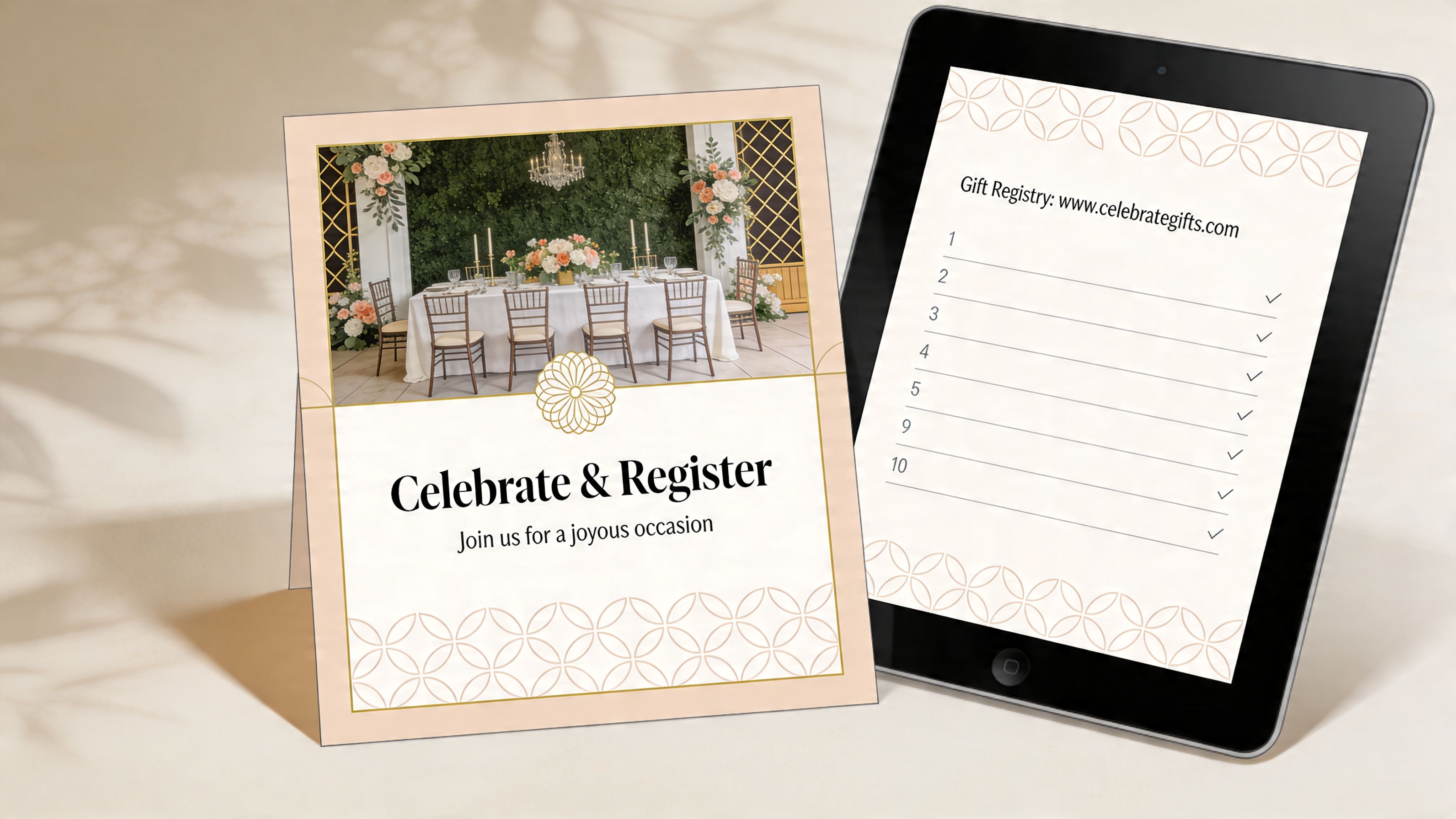
At this point, many modern hosts feel like the old rulebook goes quiet.
Traditional guidance focuses heavily on paper. One analysis of invitation etiquette content found that existing advice largely assumes physical envelope addressing and offers little guidance on how etiquette principles translate to digital invitations or hybrid methods. That leaves open practical questions about digital plus-ones, name preferences, and online RSVP wording (Minted’s envelopes guidance).
That gap matters because digital invitations are now part of everyday event planning across weddings, showers, birthdays, and graduations.
The same principles still apply online
The format may change, but the etiquette basics do not.
A digital invitation should still answer:
- Who is invited?
- What is the tone of the event?
- How should the guest respond?
- Where can they find key details?
A well-written digital invite replaces envelope precision with interface precision. Instead of relying on inner envelopes, the host uses the guest name field, RSVP settings, and event wording.
Examples of strong digital naming:
- Jordan Ellis and Taylor Reed
- The Okafor Family
- Maya Santos + Guest
Examples that create confusion:
- Jordan
- The Ellis Household
- RSVP for your party size
That last one is especially risky. If the host doesn’t define the invited group clearly, guests may make assumptions.
How to handle plus-ones gracefully
Digital platforms make it easy to hide ambiguity until RSVP time. That’s why explicit naming matters.
Good digital wording:
- Reserved for: Priya Shah and Daniel Brooks
- Reserved for: Marcus Hill + Guest
- Reserved for: The Bennett Family
Less helpful wording:
- Priya Shah
- Marcus Hill
- Bennett Household
The first set tells guests exactly what the invitation includes. The second leaves room for guessing.
Digital etiquette is mostly interface etiquette. If the system leaves space for assumptions, guests will fill it.
For children, the same principle holds. If children are invited, include their names or use a clear family label. If the event is adults only, address only the adults and keep the RSVP count aligned with that invitation.
Name preferences matter even more online
Printed invitations are static. Digital invitations can be updated, which means hosts have a chance to get names right before the message goes out.
That includes:
- preferred first names
- correct surnames
- title preferences for formal events
- accurate spelling with accents or cultural naming structure where supported
A digital guest list should feel as respectful as a hand-addressed envelope. The medium is newer, but the courtesy is the same.
Sharing registry information without sounding awkward
Gift information is one of the most delicate parts of modern invitation etiquette. For weddings, showers, birthdays, and graduations, hosts often want a practical way to let guests contribute toward meaningful goals. The key is placement and tone.
For formal paper invitations, registry details are usually better placed on a wedding website or details card rather than the main invitation card. In digital invitations, hosts have more flexibility, but the wording should stay warm and optional.
Tasteful examples:
- Your presence means so much. For those who’ve asked about gifts, registry details are available on our event page.
- We’re grateful to celebrate with you. If you’d like to contribute to a gift, you’ll find our registry link below.
- For friends and family who prefer gifting, we’ve added a registry to make things simple.
For showers and birthdays, the same rule applies. Keep the language invitational, not transactional.
A digital-first registry can fit naturally into this setup because guests are already clicking to RSVP, view details, and access event information online. Hosts who want one simple destination for contributions can explore Zelo to understand how a modern registry page can support weddings, baby showers, birthdays, and graduations.
A clean hybrid approach
Many hosts now use paper for the announcement and digital for the logistics.
That can look like:
- printed invitation for the emotional first impression
- event website for RSVP management
- digital reminders closer to the date
- online registry page linked through the event site
This blend often works beautifully, especially for guest lists spread across the US, UK, Europe, Brazil, and Australia, where digital convenience matters but many hosts still want the ceremony of a paper invitation.
Addressing invitations etiquette doesn’t disappear online. It moves from the envelope to the user experience.
Frequently Asked Questions
These last-minute questions come up often, especially when the guest list gets complicated.
| Question | Answer |
|---|---|
| Should adult children living at home get their own invitation? | Yes, if they’re invited as primary guests. A separate invitation recognizes them individually. |
| Is “and Guest” rude? | Not by itself. It’s acceptable when the host genuinely doesn’t know the companion’s name. If the name is known, use it. |
| Can a host skip titles entirely? | Yes, especially for casual events. The key is using the same style consistently across the guest list. |
| How should a host address an unmarried couple living together? | For formal invitations, use separate full names on separate lines. That’s clear and respectful. |
| How does a host show that children are invited? | Use a family label, include children by name, or name them on the inner envelope if using a formal suite. |
| How does a host show that children are not invited? | Address only the invited adults. Don’t add “and Family.” |
| Are inner envelopes still worth using? | Yes, if the event is formal or if the host wants extra clarity around children and plus-ones. |
| Can digital invitations still be etiquette-compliant? | Absolutely. Clear naming, thoughtful wording, and accurate RSVP settings matter more than the medium. |
| Where should registry details go? | On a wedding website, details page, or digital event page. Keep the wording warm and optional. |
| What matters most if a host forgets every rule? | Clarity, respect, and consistency. Guests should know whether they are invited, who is included, and how to respond. |
A host doesn’t need aristocratic training or perfect penmanship to get this right. Thoughtful wording does most of the work.
If you're ready to make gifting feel as polished as the invitation itself, create your gift registry with Zelo. It’s a modern, mobile-friendly way to build a beautiful registry page for weddings, baby showers, birthdays, graduations, and other meaningful celebrations.
Enjoyed the article? Share it!