Most cash registries run on card networks, and that means most transactions carry a processing cost somewhere in the chain. Typical per-transaction fees vary by platform and payment method, usually including a percentage somewhere in the low single digits plus a small fixed fee per transaction, with costs either added to the guest’s payment or deducted from the host’s received amount. Bank transfers, Venmo, and PayPal Friends & Family sidestep those costs almost entirely.
TL;DR:
- Card transaction fees typically range from 0.5% to 5%, with an additional fixed fee, and are paid by the guest, host, or split depending on the platform’s policy.
- Fee-free options like bank ACH transfers or PayPal Friends & Family usually take longer to process and may not be suitable for international guests or those unfamiliar with peer-to-peer apps.
- Platforms that disclose all fees upfront regardless of payment method help hosts accurately calculate net proceeds and avoid surprises after guests contribute.
- Using a platform like Zelo offers transparent, flat percentage-based fees with no hidden tiers, making costs clear before creating a registry.
- For cost-conscious hosts, direct bank transfers or linked accounts can significantly reduce fees but may introduce inconveniences such as slower processing times.
Table of Contents
- What Are Cash Registry Fees and Who Actually Pays Them?
- What Transaction Fees Pay For: Interchange, Network, and Processor Costs
- Fee-Free and Low-Fee Ways to Collect Gifts
- How to Evaluate a Cash Registry Based on Fees and Payout Timing
- Zelo’s Approach to Fee Transparency and Host Control
- Balancing Fee Savings Against Guest Experience
- Try Zelo for a Fee Structure You Can See Before You Commit
- Primary Sources on Fees and Gift Amounts
- Sources
- FAQ
What Are Cash Registry Fees and Who Actually Pays Them?
A cash registry fee is the processing cost that gets charged whenever a guest sends money through a digital gifting platform. The money doesn’t move for free. Every card swipe, tap, or online checkout triggers a chain of payment processing that someone has to fund, and that someone is either the guest or the couple, depending on how the platform structures its checkout.
Two billing models dominate the space right now:
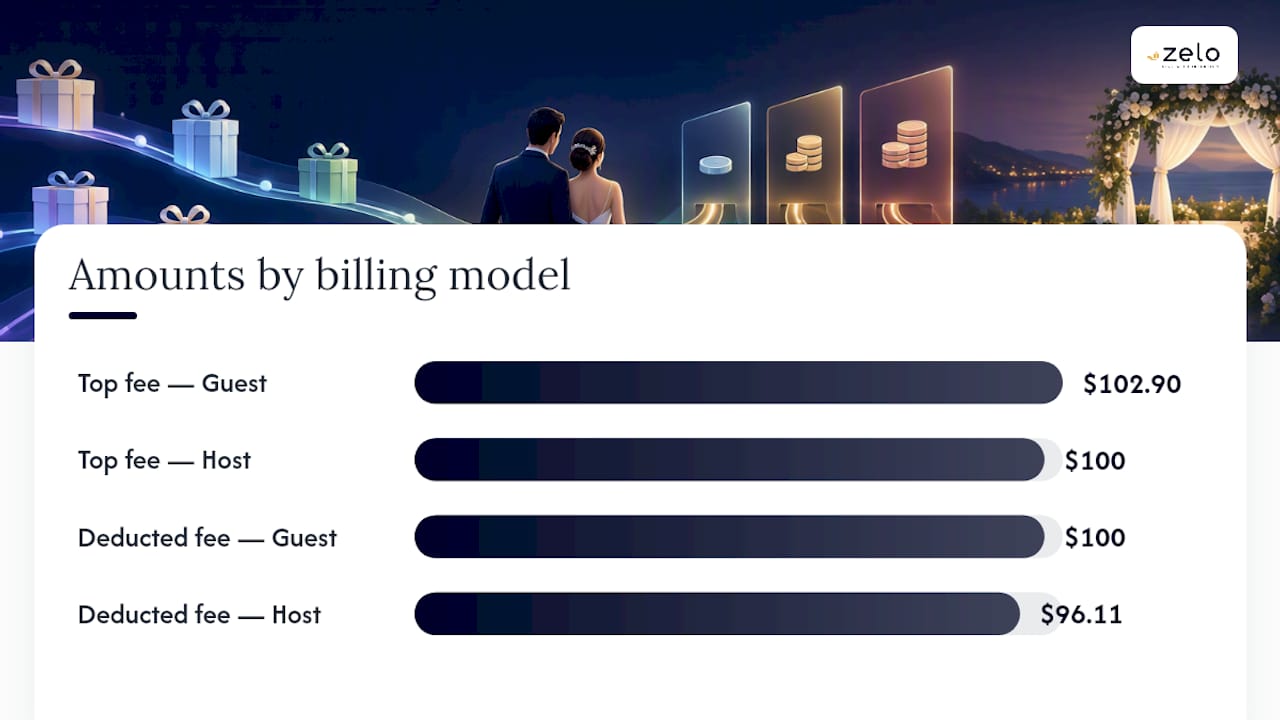
- Fee added on top of the gift. The guest sees a line item at checkout, something like “processing fee: $2.90 on a $100 gift,” and pays the total. The host receives the full intended amount.
- Fee deducted from the contribution. The guest pays exactly what they intended to give, but the platform subtracts its cut before the host ever sees the money. A $100 gift might arrive as $96.11 after fees.
The difference matters more than most engaged couples realize before they start comparing registries. A platform that deducts fees quietly can make a generous guest list look less generous on the back end, even though nothing about the giving changed. Clear fee disclosure at checkout is the detail to look for: if a platform shows guests exactly what they’re paying and why, before they hit submit, that’s a sign the business isn’t hiding its math.
Some platforms let hosts choose who absorbs the cost. If that option exists, take it seriously, because it changes both your net proceeds and how your guests experience the checkout. A host who opts to cover fees signals generosity but takes a haircut on total funds received; a host who passes the fee to guests keeps full proceeds but adds a small charge guests will notice.
What Transaction Fees Pay For: Interchange, Network, and Processor Costs
Card transactions aren’t a single fee. They’re a stack of three, and understanding the stack explains why rates vary from platform to platform.
Interchange goes to the bank that issued the guest’s card. Network assessments go to Visa, Mastercard, or the relevant card network for running the rails the transaction travels on. Processor markup goes to whichever company handles the actual transaction on the platform’s behalf. Stripe’s breakdown of transaction fees explains these as the fundamental variable cost of moving money digitally, and none of the three is optional once a guest chooses to pay by card.
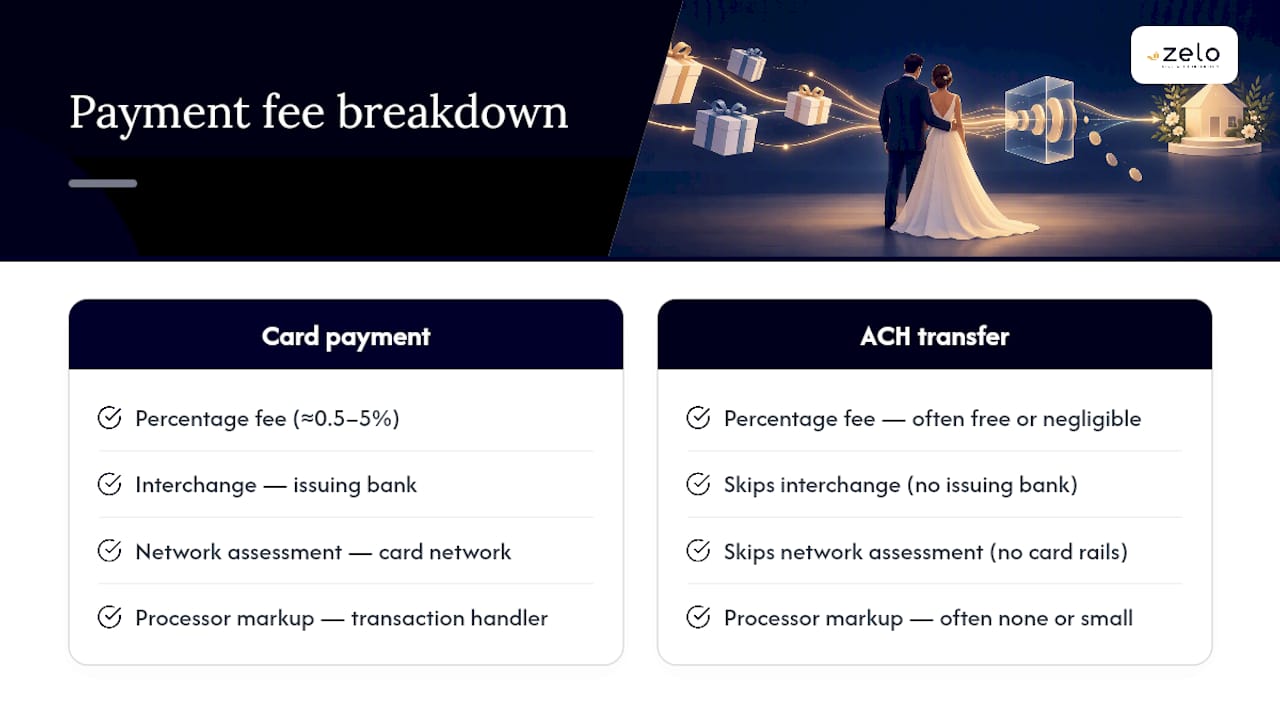
On top of the percentage, most processors also charge a fixed fee, often around $0.30 per transaction. That flat fee barely registers on a $500 gift but eats a meaningfully larger share of a $20 one. According to Investopedia’s explanation of per-transaction fees, rates typically fall between roughly 0.5% and 5% depending on the payment method and provider, with fixed cents layered on top.
The pattern to remember: credit cards cost more to process than bank transfers because they involve more intermediaries. A bank-to-bank ACH transfer skips the card network and issuing bank entirely, which is exactly why it tends to be free or nearly free. That single structural difference is the reason fee-conscious hosts steer guests toward ACH whenever they can.
Fee-Free and Low-Fee Ways to Collect Gifts
Card payments aren’t the only option, and for cost-conscious hosts, they shouldn’t be the default.
- Bank ACH or linked-account transfers. Money moves directly between bank accounts with no card network involved, which usually means no fee at all. The trade-off is speed: ACH transfers can take a few business days to clear, compared to instant card processing.
- Venmo. Fast and familiar to most guests, with no fee when funded by a bank account or debit balance. Guests using a credit card through Venmo may trigger a small fee on their end.
- PayPal Friends & Family. Free when funded by a bank account, though using a credit or debit card typically adds a percentage charge the sender absorbs.
None of these are universally practical. International guests, older relatives unfamiliar with peer-to-peer apps, or anyone paying with a corporate card may find fee-free methods more friction than they’re worth. It’s reasonable to offer a mix rather than force one method on everyone.
Stripe’s own guidance on payment processing notes that platforms advertising “zero fees” often haven’t eliminated the cost. They’ve shifted it to the guest or built it into pricing elsewhere, so read the fine print before assuming free means free.
Pro Tip: If your registry lets you add a note near the payment options, a short line like “bank transfer helps us receive the full gift” nudges fee-conscious guests without ever feeling like you’re asking for a favor.
How to Evaluate a Cash Registry Based on Fees and Payout Timing
Run any registry you’re considering through the same short list of questions before you commit.
- Who pays the transaction fee: guest, host, or a shared split?
- Which payment methods does the platform actually support?
- How fast does money reach your bank account, and is that payout instant or does it queue for days?
- Is the fee disclosed clearly at checkout, before the guest confirms payment?
- What happens if a guest disputes a charge or requests a refund?
- Is the checkout simple enough that non-technical relatives won’t abandon it halfway through?
Before you commit to a platform, ask its support team three things directly: what the payout timeline looks like, whether fees differ by payment method, and what recourse exists for a disputed charge. The answers tell you more about a platform’s honesty than its marketing pages do.
Here’s what a 2.5% card fee actually costs compared to a fee-free ACH transfer, using the $150–$160 average cash wedding gift documented across large-sample surveys:
That $4.05 gap looks small on one gift. Multiply it across 100 guests, and it’s the difference between $14,595 and $15,000, which is real money for a honeymoon fund or a down payment goal.
Zelo’s Approach to Fee Transparency and Host Control
Zelo runs on a straightforward model: a percentage-based platform fee of 3.89%, combined with standard payment processor costs through PayPal, and nothing beyond that.
- No setup fees and no subscription charges, ever, on any event page.
- Hosts control payout timing and can withdraw directly without funds sitting in a holding account.
- Checkout runs through a secure processing system familiar to many guests.
- Fee terms are made available to hosts before checkout.
That combination, a single transparent percentage plus processor costs, with no hidden tiers, exemplifies good fee transparency in the category. Hosts comparing Zelo’s platform against other registries can check the exact fee structure before creating a page, rather than discovering the math after guests have already given.
Balancing Fee Savings Against Guest Experience
There’s a temptation to optimize registry choice purely around minimizing fees, and I understand the instinct. But a percentage point or two on a $100 gift is rarely worth alienating a guest who’s already navigating an unfamiliar app during a stressful travel week. Absorbing a modest fee to keep checkout simple is often the more generous move, even if it costs you a little on net proceeds.
Where the math changes is volume. If you’re expecting 150 or more guests to contribute, steering people toward ACH or Venmo, gently and without pressure, protects real money. A platform like Zelo can fit either approach, since the fee structure stays visible either way and you decide how to communicate it to guests.
— Rodrigo
Try Zelo for a Fee Structure You Can See Before You Commit
Zelo replaces guesswork with a fee policy you can read in full before you ever create an event page. It’s the same transparent approach couples and hosts wish every registry offered: one platform fee, standard PayPal processor costs, and no surprise tiers layered on top.

If you’re planning a wedding, Zelo’s wedding registry page walks through how the honeymoon fund and cash gift setup works from start to finish. Hosting something else, a milestone birthday or anniversary, works the same way through Zelo’s dedicated event pages. Either way, you can check the exact platform fee terms first, run the same net-proceeds math from the checklist above, and decide for yourself whether the numbers work for your guest list. Create your event page and see the fee breakdown before a single guest contributes.
Primary Sources on Fees and Gift Amounts
For deeper reading on how transaction costs work, Stripe’s guide to transaction fees and Investopedia’s breakdown of per-transaction charges cover the mechanics in more technical detail. For gift-size context, the large-sample wedding gift survey referenced above remains one of the more thorough datasets available.
Sources
- Transaction fees: what your business needs to know | Stripe
- Per-Transaction Fees: Definition, Components, Typical Cost | Investopedia
- Guests
FAQ
Is there a cash wedding registry without any fees?
No registry fully escapes payment processing costs when guests pay by card, since interchange and network fees are built into how card payments work. Bank transfer and peer-to-peer options like ACH or PayPal Friends & Family typically carry no fee, which is the closest thing to a truly free option.
What is the average cash wedding gift?
Large-sample surveys put the average cash wedding gift around $150 to $160, with the median closer to $100. Honeymoon funds have nudged that average up slightly as more couples request experience-based gifts instead of physical items.
Does The Knot charge a fee for a cash registry?
Fee structures vary by platform and change over time, so check the specific provider’s current published fee policy rather than relying on general assumptions. Zelo, by comparison, publishes a flat 3.89% platform fee plus standard payment processor costs, with no setup charges.
Does Honeyfund charge a fee for cash registry?
Fee policies differ across gifting platforms and are subject to change, so the most reliable answer comes from checking that provider’s current terms directly. Comparing published fee pages side by side, rather than relying on secondhand claims, is the fastest way to know what you’ll actually pay.
Recommended
Enjoyed the article? Share it!