A private-event donation receipt is a written confirmation that a guest gave a personal cash gift to a host for a specific celebration. It is not a tax-deductible charitable receipt and carries no IRS reporting obligation for the recipient. Every complete receipt needs six fields: payer full name, exact dollar amount, date of payment, event identifier, payment method, and a short statement confirming this is a personal gift for a private event.
Sample sentence hosts can copy: “This confirms that [Guest Name] contributed $[Amount] as a personal cash gift for [Event Name] on [Date], processed via [Payment Method]. This is a personal gift, not a charitable donation, and is not tax-deductible.”
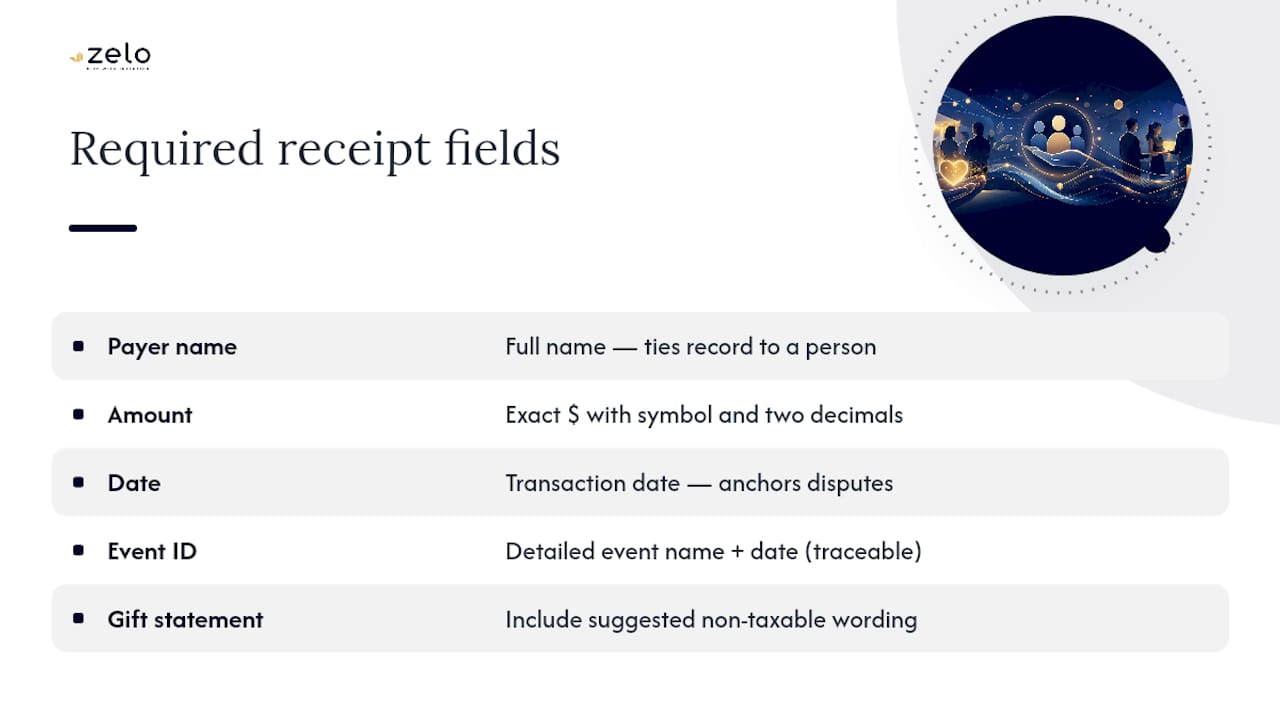
Required fields at a glance:
- Payer full name
- Exact amount (e.g., $200.00)
- Date of payment
- Event identifier (e.g., “Taylor & Alex Wedding, 08/14/2026”)
- Payment method (Venmo, Zelle, check, cash, platform transfer)
- Non-taxable personal-gift statement
- Host name and contact email
Table of Contents
- What should every private-event cash-gift receipt include?
- How and when should hosts deliver receipts?
- How should hosts manage recordkeeping and guest privacy?
- What are the etiquette norms for cash gifts at private events?
- Copy-ready receipt and thank-you templates
- Why use a platform like Getzelo to manage receipts?
- Key Takeaways
- The goal is celebration, not accounting
- Getzelo handles receipts so hosts can focus on the celebration
- Useful sources
What should every private-event cash-gift receipt include?
Each field on a receipt serves a specific purpose. The payer’s full name ties the record to a real person. The exact dollar amount, written with a currency symbol and two decimal places, prevents any ambiguity later. The date anchors the transaction to a specific moment, which matters if a dispute arises months after the event.
The event identifier does more than label the record. Writing “Jordan & Sam Baby Shower, 03/22/2026” instead of just “baby shower” makes the receipt traceable across multiple events a host might run in the same year. When the payment method is digital, add the last four digits of the transaction reference or check number. That single detail can resolve a chargeback in minutes.
The non-taxable personal-gift statement is the most overlooked field. Suggested wording: “This contribution is a personal gift for a private celebration and is not a charitable donation.” That sentence protects both parties. Guests keep it for household records; hosts keep it to show the funds were personal gifts, not income.
For large gifts or group contributions, add two optional fields: the purpose (e.g., “honeymoon fund”) and a group-contribution note listing each contributor’s share. For any returned or refunded gift, mark the receipt “Refunded” and note the refund date.
Pro Tip: Assign every receipt a unique ID (e.g., REC-2026-0042) and record the processor’s transaction confirmation number alongside it. That pairing makes reconciliation and dispute resolution straightforward.
Gift-tax context: The 2026 federal annual gift-tax exclusion is $19,000 per recipient. Donors, not recipients, handle any reporting above that threshold. Recipients never report personal gifts as income.
How and when should hosts deliver receipts?
Deliver receipts digitally within one to two weeks of receiving a contribution. For large gifts, send confirmation the same day. Digital delivery creates a timestamp, a delivery log, and a copy both parties can retrieve later. Paper alone offers none of that.
Three delivery methods, compared:
- Platform-generated email: Fastest, fully traceable, and automatically logged. Best for most hosts.
- Downloadable PDF on the event page: Useful when guests want a file they can save or forward to a partner.
- Mailed thank-you with an enclosed check stub: Appropriate for older relatives or guests who prefer physical records, but always pair it with a digital confirmation.
Timing guidance from etiquette authorities is consistent: send gifts before the event when possible, or within three months after. WeddingWire’s gift-giving guide confirms that within three months is the standard, with one year as a last resort. Receipts should follow the same rhythm.
Pro Tip: For a sizeable or sentimental gift, pair the digital receipt with a handwritten thank-you card. Paperlust’s 2026 etiquette guide notes that a physical card alongside a digital transfer is the modern standard for thoughtful giving.
Guest checklist for confirming receipt delivery:
- Save the PDF or screenshot the confirmation email
- Forward to a partner or household accountant if the amount is significant
- Check that all six required fields are present
- File under the event name and year
How should hosts manage recordkeeping and guest privacy?
Keep a single gift ledger, whether a spreadsheet or the platform’s built-in log, recording payer name, amount, date, payment method, receipt ID, and any purpose note. One ledger per event, updated as contributions arrive, prevents the scramble that happens when a guest asks about a gift six months later.
Retention is straightforward: keep records for at least three years for household accounting. Digital receipts are worth keeping indefinitely until all balances are reconciled and any dispute window has closed.
Privacy matters more than most hosts expect. Store only what you need. Avoid saving full card or bank account numbers. Limit access to the guest list and contribution amounts for surprise events. Platforms that use identity verification reduce the risk of fraudulent contributions and give hosts a documented audit trail without requiring hosts to collect sensitive data themselves. The agent-of-payee model used by some platforms routes payments through licensed processors, so the platform never holds funds and hosts never touch raw payment credentials.
Bookkeeping categories to track:
- Gifts received (amount, payer, date, receipt ID)
- Refunds or returns (amount, reason, refund date)
- Platform fees and processor fees
- Bank deposits and reconciled balances
What are the etiquette norms for cash gifts at private events?
Cash gifts are not only acceptable for modern private events; they are often preferred. Couples who already share a home, or hosts collecting toward a honeymoon or house fund, typically have little use for another set of kitchen appliances. Digital contributions through a platform or registry-linked cash fund are practical and increasingly common.
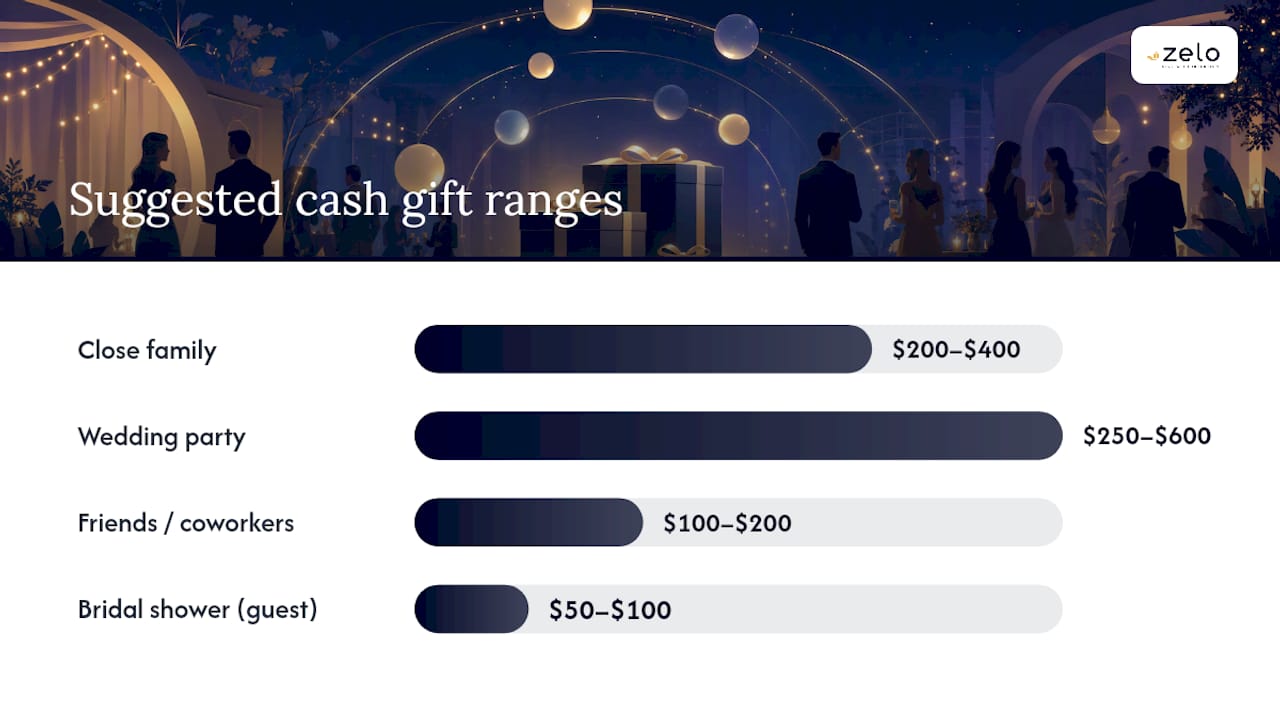
Suggested 2026 gift ranges by relationship for weddings:
| Relationship | Suggested Range | Rationale |
|---|---|---|
| Close family | $200–$400 | Reflects close bond; covers per-head cost and more |
| Wedding party | $250–$600 | Accounts for additional event expenses already incurred |
| Friends / coworkers | $100–$200 | Generous without straining personal finances |
| Bridal shower (any guest) | $50–$100 | Standard pre-wedding benchmark regardless of closeness |
| A wedding invitation is not an invoice. Gifts should reflect what a guest can comfortably give, not what the per-plate cost implies. |
Advice for guests: send money ahead of the event when possible, include a personal note, and mark any registry item as fulfilled once a contribution is made. For hosts: state clearly on the event page whether digital contributions are preferred and whether receipts will be issued automatically.
Sample guest note: “Wishing you both so much joy — this is for whatever makes your next chapter feel like home.”
Copy-ready receipt and thank-you templates
Use short, consistent templates for every receipt. Consistency protects hosts during disputes and makes guests feel the process is professional.
Template A: Platform-generated receipt (digital)
Gift Confirmation Payer: [Full Name] Amount: $[Amount] Date: [MM/DD/YYYY] Event: [Event Name & Date] Method: [Platform / PayPal / Venmo] Transaction Ref: [Last 4 or Confirmation #] Receipt ID: REC-[YYYY]-[####] This is a personal gift for a private celebration and is not a charitable donation. Questions? Contact [Host Name] at [Host Email]
Template B: Printed card receipt (mailed gifts)
Template C: Large-gift or group-contribution receipt
Group Gift Confirmation Contributors: [Name 1 — $X], [Name 2 — $X] Total: $[Amount] | Date: [MM/DD/YYYY] Event: [Event Name] | Purpose: [Honeymoon Fund / Home Fund] Processor Confirmation: [Full Transaction ID] Receipt ID: REC-[YYYY]-[####] This is a personal gift for a private celebration and is not a charitable donation. Reissued: [Date, if applicable]
Pro Tip: For digital publishing, add a “Copy” button next to each template field. Guests and hosts can grab the text without reformatting.
Small variations to keep on hand:
- Surprise events: omit the guest list from any shared document; use initials only until after the event
- Destination weddings: add the event location and local currency if a foreign guest contributed in another currency
- Group gifts: list each contributor’s share separately so every participant has a record
Why use a platform like Getzelo to manage receipts?
Platforms automate the three steps that trip up most hosts: receipt creation, delivery, and storage. The core workflow on a platform like Getzelo runs in five stages: create the event page, enable funds collection, activate receipt generation, reconcile deposits as they arrive, and export the ledger when the event closes.
The step-by-step contribution guide on Getzelo’s blog walks hosts through each stage, including how platform-generated logs simplify reconciliation. Key features that matter for receipts:
- Automatic receipt PDFs generated at the moment of each contribution
- Delivery logs showing when each receipt was sent and opened
- Identity verification for contributors, reducing fraud risk
- Direct bank transfers so the platform never holds funds
- Exportable ledger for post-event bookkeeping
Pro Tip: Keep the event page active for at least 90 days after the event. Late contributors and guests who need to retrieve their receipt will thank you for it.
One detail worth communicating to guests: platform fees and processor fees appear as line items on the contribution confirmation. Hosts receive the net amount; guests see the gross amount they sent. Stating this clearly on the event page, as part of transparent gifting practices, prevents confusion and builds trust on both sides.
Key Takeaways
A complete private-event cash-gift receipt requires six fields, a non-taxable personal-gift statement, and a unique receipt ID to be fully defensible and useful for household records.
| Point | Details |
|---|---|
| Six required fields | Include payer name, amount, date, event ID, payment method, and non-taxable statement on every receipt. |
| Deliver within two weeks | Send receipts digitally within 1–2 weeks; large gifts warrant same-day confirmation. |
| Keep records three-plus years | Maintain a gift ledger for at least three years; keep digital receipts until all balances reconcile. |
| Unique receipt ID | Assign every receipt a unique ID (e.g., REC-2026-0042) to speed up disputes and reissues. |
| Getzelo automates the process | Getzelo generates receipt PDFs, logs delivery, verifies contributors, and exports ledgers for hosts. |
The goal is celebration, not accounting
The paperwork around cash gifts exists to protect people, not to complicate a joyful occasion. A well-written receipt takes two minutes to produce and can prevent weeks of back-and-forth if a dispute ever arises. The etiquette side is equally simple: give what you can, include a personal note, and send it ahead of the event when possible.
What often gets missed is that clear receipts benefit guests as much as hosts. A guest who contributed $300 toward a honeymoon fund deserves a record of that, not because the IRS requires it, but because household finances deserve the same care as the celebration itself. Platforms that automate this step remove the friction without removing the warmth.
Getzelo handles receipts so hosts can focus on the celebration
Hosts who collect cash gifts manually spend more time chasing confirmations than they should. Getzelo solves that directly: every contribution through a Getzelo event page triggers an automatic receipt PDF, a delivery log entry, and a ledger update, all without the host lifting a finger.

The platform uses PayPal’s secure checkout, so contributors go through a familiar, trusted payment flow. Identity verification reduces fraud risk. Funds transfer directly to the host’s account without Getzelo holding them. And when the event is over, the full ledger is exportable for household bookkeeping.
Hosts who want a cleaner, more professional gifting experience can create an event page on Getzelo in minutes and start collecting contributions with automatic receipts from day one.
Useful sources
- How to Gift Money for a Wedding: Amounts and Tax Rules — LegalClarity
- The rules of wedding gift giving | WeddingWire
- Wedding Gift Etiquette 2026: Giving, Receiving & Thank-You Rules — Paperlust
- Transparency Center — How A Better Gift Handles Your Money
- Step by Step Gift Contribution Guide for Any Event | Zelo Blog
Recommended
Enjoyed the article? Share it!