
Over half of Americans believe experiences would make them happier in the long run, yet most gifts exchanged at milestone events are still physical products. This gap between what people know and what they do is striking. YouGov research confirms that while people often default to buying durable things, they privately believe experiences deliver greater long-term satisfaction. For hosts planning weddings, birthdays, graduations, and anniversaries, this insight opens a real opportunity. The evidence, the trends, and the practical strategies all point in the same direction: experience gifting is not just a passing preference. It is a meaningful shift worth leading.
Table of Contents
- The evidence: Why experiences make us happier than things
- Trends: Why experience gifting is on the rise
- Why experiences add meaning to milestone celebrations
- Addressing potential downsides and getting it right
- Why experience gifting is still misunderstood (and how to lead the way as a host)
- Make experience gifting effortless with Zelo
- Frequently asked questions
Key Takeaways
| Point | Details |
|---|---|
| Experiences create lasting happiness | Research shows experiences are remembered longer and bring greater satisfaction than material gifts. |
| Experience gifting is trending up | More Americans now choose experience gifts for milestone celebrations, with participation rising yearly. |
| Shared time boosts celebration value | Hosts and guests value shared experiences and memories over accumulated ‘stuff’ at key life events. |
| Personalized options reduce risk | Tailoring experience gifts to recipient interests and offering flexible choices prevents disappointment. |
The evidence: Why experiences make us happier than things
With the context set, let’s look at what research actually says about how experiences impact us compared to things.
The psychological case for experiences over material gifts is well established. Researchers call it the “experiential advantage,” and it rests on several interconnected factors. Experiences shape personal identity in ways that objects rarely do. When someone attends a cooking class, takes a group trip, or goes to a live concert, that event becomes part of how they describe themselves and their life. A new kitchen appliance, however useful, rarely makes it into a personal story.
Psychology research finds that experiences tend to produce longer-lasting satisfaction than material possessions, partly because people remember and anticipate them more vividly over time. Anticipation itself adds value. The weeks leading up to a planned experience generate positive emotion, while a physical gift typically delivers its peak satisfaction at the moment of unwrapping and then levels off.
| Factor | Experience gifts | Material gifts |
|---|---|---|
| Anticipation effect | High, builds over time | Low, mostly at unboxing |
| Memory longevity | Strong, often years | Fades within months |
| Social connection | Shared or shareable | Usually individual |
| Identity impact | Becomes part of personal story | Rarely referenced later |
| Satisfaction over time | Increases or stays stable | Declines as novelty fades |
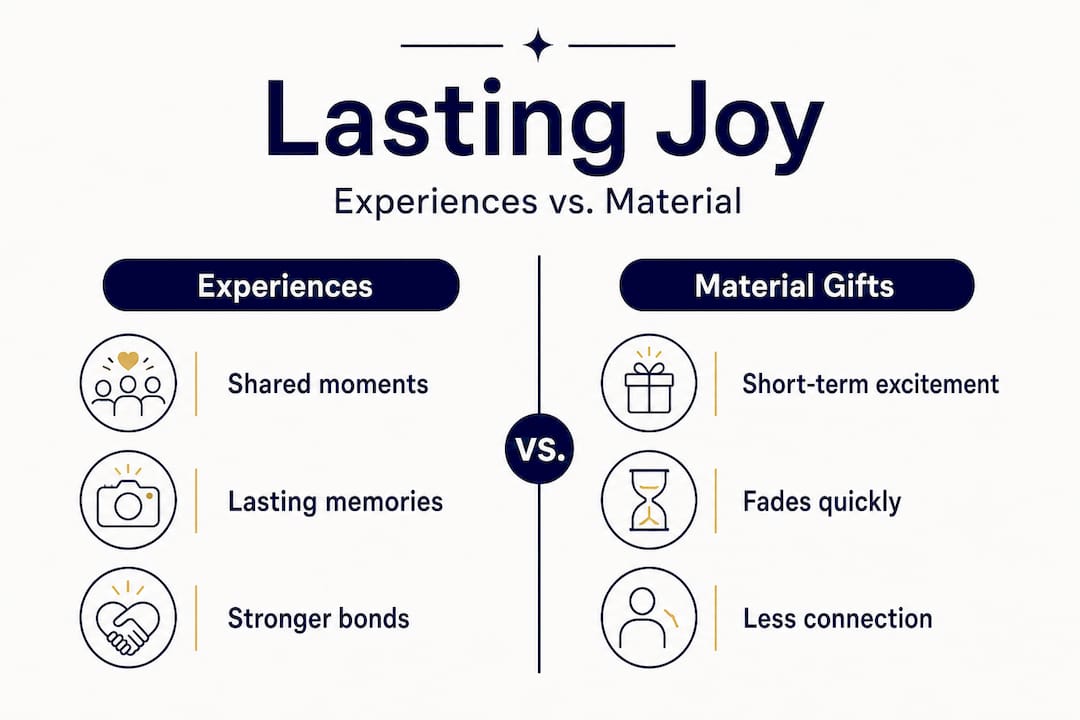
Social connection is another key driver. Experiences are often shared or described to others, which multiplies their emotional value. A spa day with a friend or a group dinner becomes a reference point in relationships. Material gifts, even thoughtful ones, tend to stay private.
Understanding the meaningful gifts psychology behind why certain gifts resonate more than others helps hosts design registries and requests that guests genuinely feel good about contributing to.
“Experience gifts often become part of our personal story in a way that material gifts simply cannot. The memory of a great concert or a shared adventure stays vivid and emotionally meaningful for years.”
Pro Tip: Encourage guests to pair an experience contribution with a short note or photo from a past shared moment. This amplifies the emotional connection and makes the gift feel even more personal before the experience even happens.
Choosing memories over material gifts is not just a trend. It is a decision backed by decades of psychological research and reinforced by what people report feeling years after receiving a gift.
Trends: Why experience gifting is on the rise
Knowing the science, it’s worth asking: Are experiences really becoming the new norm? Data says yes, and here’s why.
Consumer behavior has shifted noticeably over the past several years. Deloitte holiday research shows that a growing share of U.S. consumers now consider experiential gifts during the holidays, with categories like restaurants, event tickets, spa visits, and wellness experiences leading the way. This is not a niche preference. It reflects a broad cultural shift toward valuing time and shared moments over accumulating more stuff.
Circana data confirms that consumers planning holiday giving show measurable and rising interest in experiences as gift purchases, even as overall budgets face pressure from inflation and economic uncertainty. The fact that experiential gifting is growing despite tighter wallets says something important: people are choosing to prioritize meaning over volume.
| Year | Share considering experience gifts | Share choosing physical gifts only |
|---|---|---|
| 2022 | ~43% | ~57% |
| 2023 | ~50% | ~50% |
| 2024 | ~57% | ~43% |
The most popular experience gift categories in the U.S. right now include:
- Restaurant experiences: Group dinners, tasting menus, and chef’s table events
- Live entertainment: Concert tickets, theater performances, and sporting events
- Wellness and self-care: Spa days, massage packages, and yoga retreats
- Adventure and travel: Weekend getaways, guided tours, and outdoor experiences
- Learning and skills: Cooking classes, art workshops, and photography sessions
These categories span a wide range of budgets and personalities, which is part of what makes experiential gifting so practical. There is almost always an option that fits the recipient and the occasion.
Statistic callout: Up to 57% of U.S. consumers now plan to give at least one experience gift, and this figure has risen consistently year over year even as discretionary spending faces pressure.
Understanding future of gifting trends helps hosts stay ahead of the curve. When guests already lean toward experiences, a registry that reflects that preference removes friction and makes contributing feel natural.
Pro Tip: Use the mainstream popularity of experience gifting as social proof when sharing your registry. A short note explaining that “most of our guests are already planning experience gifts this year” can increase buy-in and reduce hesitation from guests who might feel uncertain about departing from traditional gift-giving.
The holiday giving trends landscape continues to evolve, and milestone celebrations are uniquely positioned to benefit from this momentum.
Why experiences add meaning to milestone celebrations
With rising trends established, it’s crucial to see why experiences make such a difference for milestone celebrations especially.
Milestone events carry emotional weight that everyday occasions do not. A graduation, a wedding, a 50th birthday, or a baby shower marks a transition. These moments invite reflection on what matters, who matters, and how the next chapter will look. Physical gifts can feel disconnected from that emotional context. Experiences, by contrast, extend the celebration itself.

StubHub newsroom research shows that 51% of Americans say they value shared time above other forms of giving, and 35% say experiences feel more “worth it” than physical items. For milestone hosts, these numbers are directly relevant. When guests contribute to an experience, they are not just buying a gift. They are participating in the next chapter of someone’s story.
Consider the range of experience options that work beautifully for milestone events:
- Group cooking class for a bridal shower or anniversary celebration
- Concert or theater tickets for a milestone birthday
- Wellness retreat or spa day for a graduation or career milestone
- Weekend getaway funded collectively by close friends and family
- Wine tasting or food tour for a housewarming or retirement party
- Adventure experience like a hot air balloon ride or sailing trip for a bucket-list birthday
Each of these options creates a story. They give the recipient something to look forward to, something to talk about, and something to remember. That is a fundamentally different kind of value than a physical object provides.
“The real value of a gift at a milestone event is not in the object itself. It’s in the shared time, the anticipation, and the memory that follows. Experiences deliver all three.”
Planning an experience-focused gift registry for experiences also increases the perceived value of contributions. When guests know their money is going toward a specific, meaningful experience rather than a general fund, they feel more connected to the outcome. This sense of participation matters.
Experiences also promote conversation at the celebration itself. When guests know they have contributed to a group trip or a cooking class, it becomes a talking point. It builds anticipation collectively, which strengthens the social bonds that milestone events are meant to celebrate. Hosts who embrace eco-friendly celebrations and experience-focused registries often find that their events feel more intentional and less focused on accumulating things.
Addressing potential downsides and getting it right
Of course, meaningful gifting requires nuance. Here’s how to avoid common pitfalls so your experience gift actually hits the mark.
It would be misleading to suggest that everyone prefers experiences. YouGov data shows that 42% of Americans would still choose to spend a windfall on durable things rather than experiences. That is a significant minority, and hosts and givers need to account for it. The goal is not to force a preference but to create options that serve the widest range of people well.
Here is a practical step-by-step approach to matching the right experience to the right recipient:
- Identify the recipient’s lifestyle and interests. A person who loves the outdoors will respond differently to a spa day than to a hiking trip. Start with what you know about them, not what you personally enjoy.
- Consider their schedule and mobility. Some experiences require travel, physical activity, or specific timing. Choose options that are realistic for the recipient’s current life situation.
- Offer flexibility in booking. Open-ended gift cards for experience categories, or experiences with flexible scheduling, reduce the risk of the gift going unused because of a date conflict.
- Provide a range of options at different price points. This allows guests to contribute what they can while still participating meaningfully in the experience fund.
- Connect the experience to a shared memory or value. A gift that references a past trip you took together, a hobby the recipient is developing, or a dream they have mentioned carries far more emotional weight than a generic experience.
Choice architecture, which means structuring the available options to guide good decisions without removing freedom, is a powerful tool here. When a registry offers three or four curated experience categories rather than an open-ended cash fund, guests feel guided and confident. The recipient still has flexibility, but the options feel intentional.
Pro Tip: Provide a range of experience options at different contribution levels and let the recipient make the final selection within the category. This approach reduces mismatch risk dramatically while preserving the personal touch that makes experience gifts special. You can personalize experience gifts further by including a note about why you chose that particular category for them.
Avoiding experience gift mistakes comes down to one core principle: the gift should serve the recipient’s world, not the giver’s assumptions about what an experience should look like.
Why experience gifting is still misunderstood (and how to lead the way as a host)
Here is something that rarely gets said directly: most hosts who want to shift toward experience gifting underestimate how much planning and communication that shift actually requires. It is tempting to assume that because experiences are inherently more meaningful, they will naturally be received well. That assumption leads to the most common mistake in this space.
Guests need guidance. When a registry is vague, or when the host simply says “we’d prefer experiences over things,” guests are left to interpret that on their own. Some will feel uncertain and default to a gift card or a physical item because it feels safer. Others will choose an experience that reflects their own taste rather than the recipient’s. Neither outcome is ideal.
True host leadership in experience gifting means doing the work upfront. It means curating specific options, explaining why those options matter to you, and giving guests a clear and easy path to contribute. A well-designed registry does not just list experiences. It tells a story about what the milestone means and how the experiences connect to the next chapter of the host’s life.
The other thing that gets overlooked is the power of shared anticipation. The real magic in experience gifting is not the event itself. It is the period leading up to it, when the recipient knows something meaningful is coming, when guests feel they are part of planning something special, and when the celebration extends beyond a single afternoon. Making experience registries work requires hosts to lean into this anticipation actively, not just set up a page and wait.
Flexibility is equally important. Giving guests the option to contribute toward a broader category rather than a single fixed experience reduces pressure on everyone. It acknowledges that not every guest knows the recipient’s schedule, and it allows the recipient to make a final choice that truly fits their life. Rigid experience gifts, especially those with fixed dates or narrow parameters, are the ones most likely to go unused or feel like an obligation rather than a gift.
Make experience gifting effortless with Zelo
Ready to put these principles into action? Here’s how Zelo supports meaningful experience gifting for milestones.
Zelo is built for exactly this kind of intentional, experience-focused celebration. Hosts can create a personalized event page that reflects the spirit of their milestone and invites guests to contribute toward real experiences rather than physical items. Whether it’s a group adventure, a wellness retreat, or a collection of smaller experiences, everything lives in one place.
The platform’s cash gifting model means recipients are not locked into a single pre-selected experience. A birthday cash gift registry on Zelo, for example, lets guests contribute toward a broader experience fund, giving the birthday person the freedom to choose what resonates most. That flexibility is what separates a meaningful gift from one that collects dust. Visit the Zelo gift registry platform to start your event page and give your guests a simple, secure way to contribute to something that truly matters.
Frequently asked questions
What are examples of experience gifts for milestone celebrations?
Experience gifts can include concert tickets, cooking classes, spa days, group trips, or memorable adventures that recipients can enjoy alone or with others. The best options connect to the recipient’s personal interests and lifestyle.
Do most people actually prefer experiences over physical gifts?
Survey data shows that while 42% would buy things with a windfall, 51% of Americans say experiences bring more long-term happiness. The preference for experiences is strongest when looking at satisfaction over time rather than at the moment of giving.
Are experience gifts becoming more popular in the U.S.?
Yes, industry surveys show up to 57% of consumers plan to give an experience gift, and this is a rising trend even as overall holiday budgets face pressure. The growth has been consistent across multiple years of data.
How can I make sure an experience gift fits the recipient?
Offer choices, flexible booking dates, and curate options around the recipient’s known interests to minimize mismatch risk. Choice architecture in gifting research supports giving structured options rather than fully open-ended funds for the best outcome.
Recommended
- Experience Gift Registries: Why Memories Beat Material Things | Zelo Blog
- The Psychology of Giving: Why Meaningful Gifts Matter | Zelo Blog
- Zelo | Create a Beautiful Cash Gift Registry for Any Celebration
- 10 Creative Ways to Thank Your Wedding Guests | Zelo Blog
- Diamond Keepsake Explained: How Memorial Gems Become Heirlooms
Enjoyed the article? Share it!