
Gifting etiquette for weddings, baby showers, and other major milestones is often misunderstood as a rigid set of rules about spending the “right” amount or following outdated traditions. The reality is far more nuanced and, honestly, more freeing. Modern gifting etiquette is less about checking boxes and more about fostering genuine connection between hosts, guests, and the people being celebrated. Whether you’re planning a baby shower or walking into someone else’s wedding, understanding these updated norms helps everyone participate with confidence and generosity.
Table of Contents
- What gifting etiquette really means for hosts and guests
- Navigating common edge cases and social pitfalls
- Host contributions: Making the event the gift
- Registry etiquette and modern gifting solutions
- A fresh perspective: Meaning over material, etiquette over expectations
- Simplify your next celebration with modern gift solutions
- Frequently asked questions
Key Takeaways
| Point | Details |
|---|---|
| Hosts provide the event | Your role as host is to create the occasion and atmosphere—not to make guests feel obliged by cost. |
| Gifts expected, but flexible | Guests should provide a gift, but etiquette favors thoughtful contributions and respects ‘no gift’ wishes. |
| Avoid transactional invitations | Including guests only for pre-events can create social pressure and feel impersonal. |
| Modern registries encourage meaning | Registries should inspire, not dictate; group gifts and cash are now etiquette-friendly. |
| Etiquette guides, not rules | Flexible, thoughtful application of etiquette creates celebration rather than stress. |
What gifting etiquette really means for hosts and guests
Gifting etiquette functions differently depending on which side of the event you’re on. For hosts, the primary responsibility is creating a welcoming, well-organized experience. For guests, the expectation is thoughtful participation, usually in the form of a gift. These two roles rarely overlap, and keeping them separate is what prevents social awkwardness.
According to Emily Post’s modern guidance, U.S. gift etiquette for major life events like weddings and baby showers functions primarily as coordination mechanics: guests are expected to give a gift, hosts are expected to manage hospitality costs, and neither role should feel like a financial transaction. This framing matters because it removes the idea that a guest is “paying for their plate.” The gift and the meal are entirely separate gestures.
Here’s a quick breakdown of how these responsibilities typically divide:
| Role | Primary responsibility | Secondary gestures |
|---|---|---|
| Host | Venue, food, decor, event flow | Optional token gift for honoree |
| Guest | Thoughtful gift or contribution | Thank-you acknowledgment |
| Honoree | Gracious appreciation | Timely thank-you notes |
For guests, the expectation of bringing a gift extends even to events they cannot attend. If you’re invited to a bridal shower but have a scheduling conflict, traditional and modern etiquette both suggest sending a gift anyway. This isn’t about obligation for its own sake. It’s about honoring the relationship and participating in the celebration even from a distance.
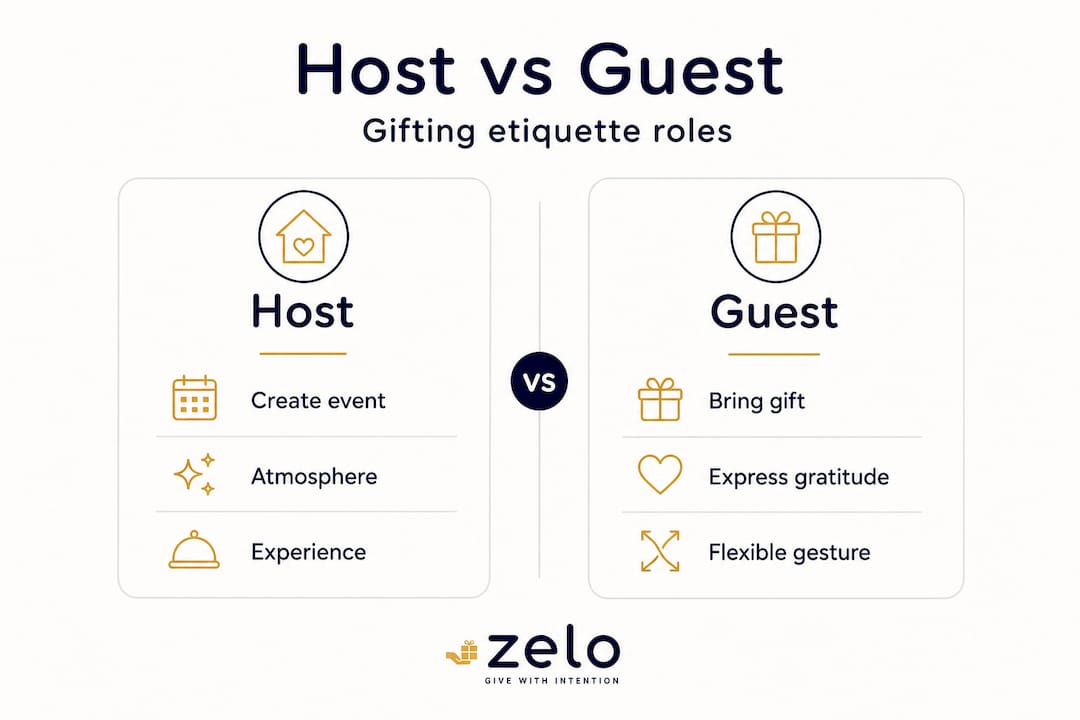
For hosts, the social contract is equally clear. Hospitality should never feel like a reimbursement scheme. Charging guests admission, asking them to fund venue costs, or designing events around extracting maximum gifts are all violations of the spirit of gifting etiquette.
Some core principles worth keeping in mind:
- Gifts are separate from hospitality costs. Guests should never feel they’re covering what it costs to host them.
- Gift giving is expected but the format is flexible. Cash, registry items, and experience gift registries are all increasingly accepted.
- Hosts should consult a baby shower gift registry guide to set clear expectations for guests without being prescriptive.
- A gift’s value is relational, not monetary. Price tag is far less important than thoughtfulness and intention.
“Gift etiquette functions primarily as coordination mechanics: guests are expected to give a gift, while hosts are expected to manage hospitality costs and event flow so guests don’t feel they’re paying for their ‘plate.’” — Emily Post Institute
Modern couples and expecting parents are increasingly drawn to collaborative gift registry tips that allow multiple contributors to participate without pressure. This shift reflects a broader cultural movement toward making gifting more accessible, inclusive, and personally meaningful.
Navigating common edge cases and social pitfalls
With foundational etiquette understood, it’s essential to address the nuances and avoidable social missteps that come up in real life. Even the most well-intentioned hosts and guests can stumble into awkward territory.
One of the most discussed edge cases involves shower invitations. Inviting someone to a baby shower or bridal shower while excluding them from the main event, whether that’s the wedding or a larger celebration, sends an uncomfortable signal. It suggests the invitation is more about gift collection than genuine inclusion. Etiquette experts consistently flag this as awkward and potentially gift-driven behavior that strains relationships.
Another pitfall is asking guests to contribute financially to hosting costs. This includes scenarios like charging for event entry, requesting Venmo payments to offset catering, or building a “fund” for the venue into the event invitation. While it might seem practical from a budget perspective, etiquette experts discourage it because it fundamentally reframes hospitality as commerce.
Here’s a comparison of behaviors that land well versus those that create friction:
| Etiquette-friendly behavior | Behavior that causes friction |
|---|---|
| Offering a range of gift options and price points | Specifying minimum gift amounts |
| Inviting guests to both the shower and main event | Inviting someone only to the shower |
| Asking for a group gift to an experience or fund | Asking guests to cover hosting costs |
| Honoring “no gifts” requests gracefully | Ignoring a host’s “no gifts” request |
When a host explicitly says “no gifts,” that instruction deserves respect. Guests who still want to express appreciation can send a handwritten note or a small token, but the “no gifts” policy should be honored without exception. Experts recommend sending a thank-you note regardless, as a gracious gesture that doesn’t violate the host’s wishes.
Group gifting has emerged as one of the most etiquette-friendly solutions for large events. Rather than every guest scrambling to find a unique, meaningful, affordable gift independently, group gift etiquette allows multiple people to contribute smaller amounts toward a single, more significant gift. This approach reduces financial pressure, encourages participation from guests at all budget levels, and often results in a more meaningful contribution for the recipient.
Pro Tip: When organizing a group gift, designate one person to collect contributions and communicate clearly about the timeline and total goal. Transparency prevents awkward follow-ups and ensures everyone who wants to participate can do so comfortably.
The psychology behind meaningful gifts shows that recipients consistently value gifts that reflect genuine thought and shared experience over expensive items selected out of obligation. This is why cash contributions toward experiences, honeymoon funds, or baby essentials often feel more personal than a randomly selected registry item. Understanding this dynamic helps both hosts and guests make choices that strengthen relationships rather than satisfy a social checklist.

Host contributions: Making the event the gift
Having explored social pitfalls, let’s focus on how hosts can contribute meaningfully without blurring the lines between hospitality and gifting. The most important thing to understand is that for event organizers, hosting itself is the gift.
Modern etiquette treats the host’s primary contribution as the event itself: the venue, food, drinks, decor, and activities that create a memorable, welcoming atmosphere. This is no small thing. Organizing a well-run baby shower or bridal brunch takes significant time, energy, and financial investment. The experience guests receive is the host’s gift to the honoree.
Optional hostess gifts are a separate, secondary gesture. If a host chooses to give the guest of honor a small personal item, a book, a candle, a keepsake, it should feel like an add-on rather than the centerpiece. The celebration comes first.
Here’s a practical framework for hosts planning any major life event:
- Prioritize the guest experience. Focus planning energy on creating a comfortable, joyful atmosphere. Great food, thoughtful decor, and genuine warmth leave a lasting impression.
- Choose optional tokens thoughtfully. If giving a small gift to the honoree, personalizing luxury gifts or adding a personal touch makes even a modest item feel significant.
- Keep finances clear and separate. Never blend hosting costs with gift expectations. Guests should never feel that their gift is subsidizing the party.
- Express appreciation openly. A host who acknowledges guests’ time, travel, and generosity sets a positive tone for the entire event.
- Send timely thank-you acknowledgments. Learning how to thank wedding guests or shower attendees in creative, personal ways deepens the celebratory experience long after the event ends.
“The host’s contribution is the event itself. A small token gift for the honoree is a separate, secondary gesture rather than the event’s core purpose.” — Emily Post Institute
One of the most common mistakes hosts make is over-indexing on the gift component of their role. They spend enormous energy curating gift bags, selecting favors, and organizing gift presentation, while underinvesting in the actual guest experience. The food gets cold. The schedule runs long. Guests feel rushed. None of that is fixed by a beautiful gift table.
Pro Tip: Before finalizing your event budget, allocate funds first to the guest experience: catering, space, and activities. Only after those elements are fully covered should you consider optional extras like favor bags or host gifts.
Registry etiquette and modern gifting solutions
Finally, let’s examine how registries and group gestures are evolving and how you can embrace modern solutions without losing etiquette clarity. The registry, once a straightforward catalog of kitchen appliances and bedding sets, has transformed into a flexible, personalized tool that reflects how people actually live.
Modern etiquette no longer treats registries as rigid shopping lists. Instead, the best registries serve as inspiration and guidance, giving guests a starting point without making them feel locked into specific items or price ranges. A well-designed registry communicates the couple’s or expecting parent’s actual needs and preferences, while leaving room for guests to contribute in the way that feels most comfortable.
Here’s what registry etiquette looks like in practice:
- Offer a wide price range. Including gifts at multiple price points ensures guests at all budget levels can participate without feeling excluded.
- Include non-physical options. Cash funds, experience contributions, and cash gift trends reflect the reality that many couples and new parents genuinely prefer flexible contributions over more stuff.
- Keep the registry updated. Remove purchased items promptly to prevent duplicate gifts, which create awkward situations for everyone involved.
- Don’t include the registry link in invitations. Share registry information through your event website, word of mouth, or a separate communication. Placing it directly on the invitation can feel presumptuous.
Cash and experience-based registries are increasingly etiquette-approved as couples and families prioritize experiences over accumulating physical items. Honeymoon funds, home down payment contributions, and baby experience funds are all widely accepted in modern gifting culture.
| Registry type | Best for | Modern etiquette standing |
|---|---|---|
| Traditional product registry | Couples who need household items | Fully accepted |
| Cash fund or contribution registry | Experiences, savings goals, travel | Increasingly standard |
| Group gift registry | Single large purchases | Etiquette-friendly and inclusive |
| Charity donation registry | Socially conscious honorees | Accepted with guest choice in mind |
Pro Tip: If you’re setting up a cash fund, frame each contribution around a specific purpose. “Help us fund our first family vacation” feels more personal and engaging than a generic cash request. Guests connect more deeply when they understand what their contribution enables.
Group gifting, already discussed as a social pitfall prevention tool, also shines as a registry strategy. When guests can collectively contribute to a single meaningful experience or item, the gift becomes a shared memory rather than an individual transaction. That’s a win for everyone involved.
A fresh perspective: Meaning over material, etiquette over expectations
Here’s an honest observation: most gifting anxiety, on both the host and guest side, comes from treating etiquette as a performance rather than a framework for genuine generosity. People worry about spending enough, registering correctly, or following the “right” rules because they’ve internalized gifting as a social test rather than a celebration of connection.
The shift happening in modern gifting culture isn’t just about cash registries or group gifts. It’s about a fundamental reorientation toward what actually matters at these events. Nobody looks back on their wedding and thinks, “I wish we’d received more toasters.” They remember the people who showed up, the stories that were told, and the feeling of being surrounded by people who genuinely cared.
Etiquette, at its best, exists to reduce friction so that genuine connection can happen more easily. When hosts obsess over following every rule perfectly, or guests stress about choosing the exact right gift, the celebration itself gets buried under anxiety. The rules exist to serve the relationship, not the other way around.
What this means practically is that flexibility and communication are more valuable than rigid adherence to tradition. A host who clearly communicates their preferences through a thoughtful registry, an honest event page, or simple word of mouth creates an environment where guests feel empowered rather than pressured. A guest who contributes memories over material gifts, whether that’s a cash contribution toward a family trip or a heartfelt note alongside a modest gift, often makes a deeper impression than someone who spends triple the amount on a random registry item.
The most meaningful celebrations prioritize generosity in all its forms: the host’s generosity in creating a beautiful experience, the guest’s generosity in showing up and contributing, and the honoree’s generosity in receiving both with genuine gratitude.
Simplify your next celebration with modern gift solutions
Planning a life event involves dozens of decisions, and figuring out how to handle gifting shouldn’t add unnecessary stress. Zelo makes it easy to put modern gifting etiquette into practice by giving hosts a simple, beautiful way to share their actual wishes with guests.

With Zelo, hosts can create personalized event pages that communicate the purpose of contributions clearly and warmly, whether that’s a birthday cash registry or a wedding fund. Guests can contribute through a secure, simple checkout experience that feels thoughtful rather than transactional. Zelo’s platform is built with cash registry security at its core, so both hosts and guests can participate with confidence. If you’re ready to move from gifting confusion to gifting clarity, Zelo is designed exactly for that moment.
Frequently asked questions
Is it mandatory to bring a gift to a wedding or shower?
Traditional and modern U.S. etiquette still expects a gift for major life events, even if you cannot attend in person. The format of that gift is flexible, but the gesture itself remains a standard social expectation.
What should I do if the host says “no gifts”?
Honor the request fully and express appreciation in another way, such as a heartfelt handwritten note. Experts recommend sending a thank-you note regardless, as it acknowledges the host’s generosity without overriding their wishes.
Can guests request cash gifts instead of physical presents?
Cash and experience-based registries are increasingly etiquette-approved in modern gifting culture. The key is to frame them as options and invitations rather than requirements, so guests feel welcomed rather than directed.
Is it okay to invite someone to a shower but not the wedding?
This practice is widely discouraged by etiquette experts because it can feel gift-driven and create real social discomfort. If someone is important enough to invite to the shower, the expectation is that the main event invitation should follow.
Recommended
Enjoyed the article? Share it!