
A beloved team member is getting married. A colleague you’ve worked with for years is retiring. A teammate is welcoming a new baby. These moments bring out the best in a workplace, but they also create the same practical problem every time. Someone has to organize the gift.
That usually means a messy chain of messages, a spreadsheet that only one person understands, and awkward follow-ups to people who meant to contribute but forgot. Then there’s the harder question. What gift will feel useful, personal, and appropriate for a coworker?
That’s where modern group gifting works better than the old envelope-on-a-desk routine. A 2025 VistaPrint survey found that employees lean toward practical gifts, with apparel ranking highly among coworker gift preferences and food and snacks also standing out as popular choices. The same report also notes growing interest in everyday useful gifts rather than one-off novelty presents, which is one reason pooled giving feels more sensible for workplace milestones today (VistaPrint employee appreciation gift ideas).
The tools matter as much as the gift idea. Existing advice often covers what to buy, but it rarely helps with the hardest part: collecting money fairly, keeping contributions transparent, and avoiding organizer burnout. That’s exactly the gap that makes a good platform worth using.
This guide focuses on both sides of the decision. It covers strong group gift ideas for coworkers, the best tools for collecting contributions, and the etiquette that keeps the process smooth for everyone involved. The result is a workplace celebration that feels generous instead of stressful.
Featured Image Suggestion: A photorealistic metaphor style image showing a single, beautifully wrapped gift box being effortlessly passed between multiple hands of diverse people in a bright, modern office setting, symbolizing fluid team collaboration.
1. Zelo

A familiar office moment: someone volunteers to organize a retirement or baby gift, then spends the next three days chasing Venmo screenshots, answering duplicate questions, and trying to guess what the recipient will want. Zelo works well because it cuts down that admin and gives the team one clear contribution flow.
It is a strong fit for workplace milestones where flexibility matters more than picking a single boxed item. Weddings, baby arrivals, graduations, housewarmings, milestone birthdays, and retirements all tend to fall into that category. Instead of debating whether to buy one object that may miss the mark, coworkers can contribute toward something the recipient will use in a way that suits their life.
Why it works well for coworker milestones
Zelo uses a cash gift registry model, which suits modern office gifting better than many teams expect. A teammate getting married may want honeymoon funds. A new parent may prefer diapers, childcare help, or nursery basics. A graduate may put the gift toward moving costs, work clothes, or a first apartment. A retiring coworker may value a trip, classes, or time with family more than another physical keepsake.
That flexibility solves one of the hardest parts of organizing a group gift. The organizer does not have to survey everyone about brands, sizes, colors, delivery addresses, or duplicate purchases. They set up a page, share the link, and keep the process simple.
Zelo also covers the details that often get handled manually in chat threads and email chains. The platform includes a custom event page, invitations, RSVP management, guest messaging, and gift tracking. For an organizer, that usually means fewer follow-up messages and fewer small tasks piled on top of normal work.
Practical rule: If no one on the team wants to manage shipping, returns, or exchanges, a cash registry is usually the cleaner option.
Setup, sharing, and organizer control
The mobile-first design matters. Office contributors usually open these links between meetings, from Slack, text, WhatsApp, or email. A short, clear contribution path gets better participation than a process that feels heavy or scattered across multiple tools.
Zelo also gives the organizer better oversight than an informal collection. Contributions are tracked in one place. The page can be paused, extended, or closed. Funds go to a verified bank account. That reduces the usual uncertainty around personal transfers and manual tallying.
For teams planning a more personal workplace gift built around travel, experiences, or life milestones, Zelo also aligns well with the case for experience gift registries that prioritize memories over material things.
Key trade-offs to consider
Zelo is best for flexible giving, not for teams that already know the exact physical item they want to send.
If the office has agreed on a specific espresso machine, framed print, or kitchen appliance, another platform may be easier if it routes the funds straight into retailer gift cards or item redemption. If the team wants usefulness, speed, and less organizer effort, Zelo is often the better choice.
Security and transparency also matter here because coworkers are being asked to contribute online. Zelo highlights payment security features and fraud protections, which makes the ask easier to send with confidence. The practical point for organizers is simple: people are more comfortable contributing when the process looks legitimate and well structured.
Fees deserve a clear mention too. Zelo is free to create, but payout and processing costs can affect the final amount the recipient receives. Set expectations early if the team has a target number in mind.
Best when
- You want one flexible gift outcome: Good for weddings, baby showers, birthdays, graduations, and retirements.
- You need cleaner coordination: The event page, messaging tools, and gift records cut down organizer admin.
- You want the recipient to decide what matters most: That usually leads to a gift that feels more useful and less generic.
Less ideal when
- The office wants a shipped physical item: Zelo is not centered on product fulfillment.
- People expect a traditional store registry: This is a modern cash registry, not a department store list.
For workplace collections that need to stay simple and still feel thoughtful, Zelo makes the organizing side much easier. If your team wants one link, one contribution flow, and a gift the recipient can use, it is a practical place to start.
2. GroupTogether
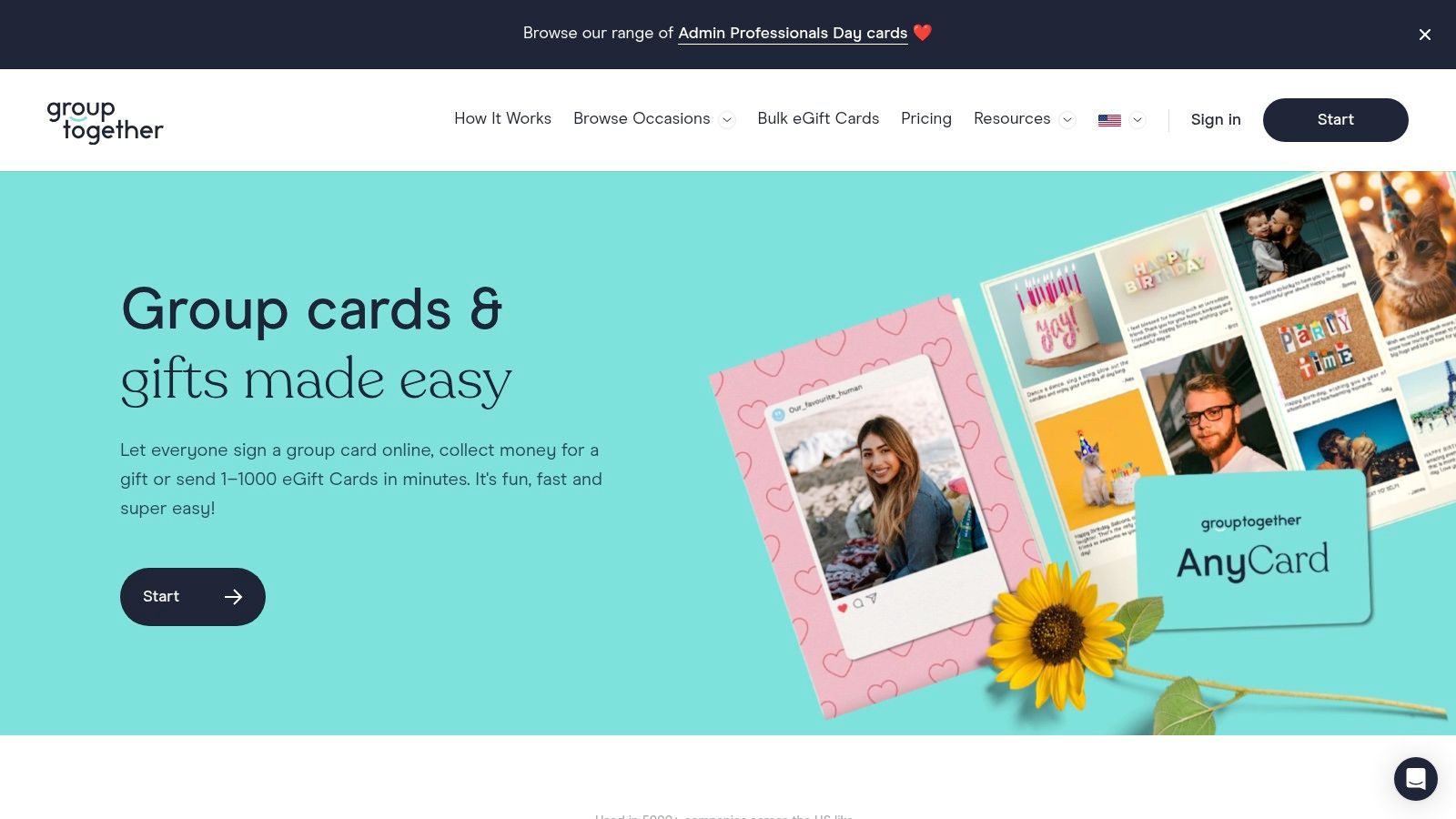
GroupTogether is a strong option when the team wants two things bundled neatly together: a shared card and a pooled gift. That pairing works especially well for farewells, promotions, parental leave send-offs, and retirements.
Its biggest strength is that it reduces organizer effort. The card and the contribution flow sit in the same experience, so coworkers don’t have to sign one thing in one place and send money somewhere else.
Where GroupTogether feels easiest
The platform is card-first, but in a good way. It keeps the celebration visible. Coworkers can add messages, photos, and GIFs, and the recipient gets something that feels more personal than a plain transfer link.
That matters because group gifts for coworkers often succeed or fail on sentiment, not just value. A practical gift is great. A practical gift with genuine messages from the team is what people tend to remember.
For organizers in the U.S., GroupTogether is also easy to explain. Contributors chip in, and the recipient redeems the result through a curated eGift flow or an AnyCard that works across a broad retailer network. If the team doesn’t know the recipient’s exact preferences, that flexibility is useful.
Keep the ask simple: “We’re collecting for a team gift and card. Contribute if you’d like, no pressure.”
The trade-off to know before choosing it
GroupTogether works best if the team is comfortable giving the recipient retailer-based choice rather than direct bank access. In the U.S., it doesn’t cash out to a bank account. That’s the main limit.
For some occasions, that’s perfectly fine. A farewell gift card pool or baby-shower retailer choice can feel easy and generous. For others, like weddings or larger life milestones, a direct cash registry may feel more useful.
Its pricing is also straightforward enough that organizers can communicate it clearly. One thing worth noting is the added fee on certain popular gift card selections. If the group already knows the intended redemption brand, it’s smart to confirm how that choice affects the final gift before sending the link.
The platform pairs nicely with teams that want a digital card culture and a repeatable process. If your office regularly organizes milestone gifts, this style can be easier to maintain than ad hoc collections. For anyone comparing models, this guide to the complete collaborative gift registry is useful context on how pooled gifting works when you want less friction.
Works best for
- Farewells and retirements: The group card element shines here.
- Teams that want low organizer overhead: One link covers messages and money.
- U.S. teams comfortable with eGift redemption: It’s simple and familiar.
Less ideal for
- Cash-first milestone gifts: The recipient can’t withdraw to a bank account in the U.S.
- Teams trying to buy one exact physical item together: This is more flexible-credit than product-purchase.
3. Thankbox
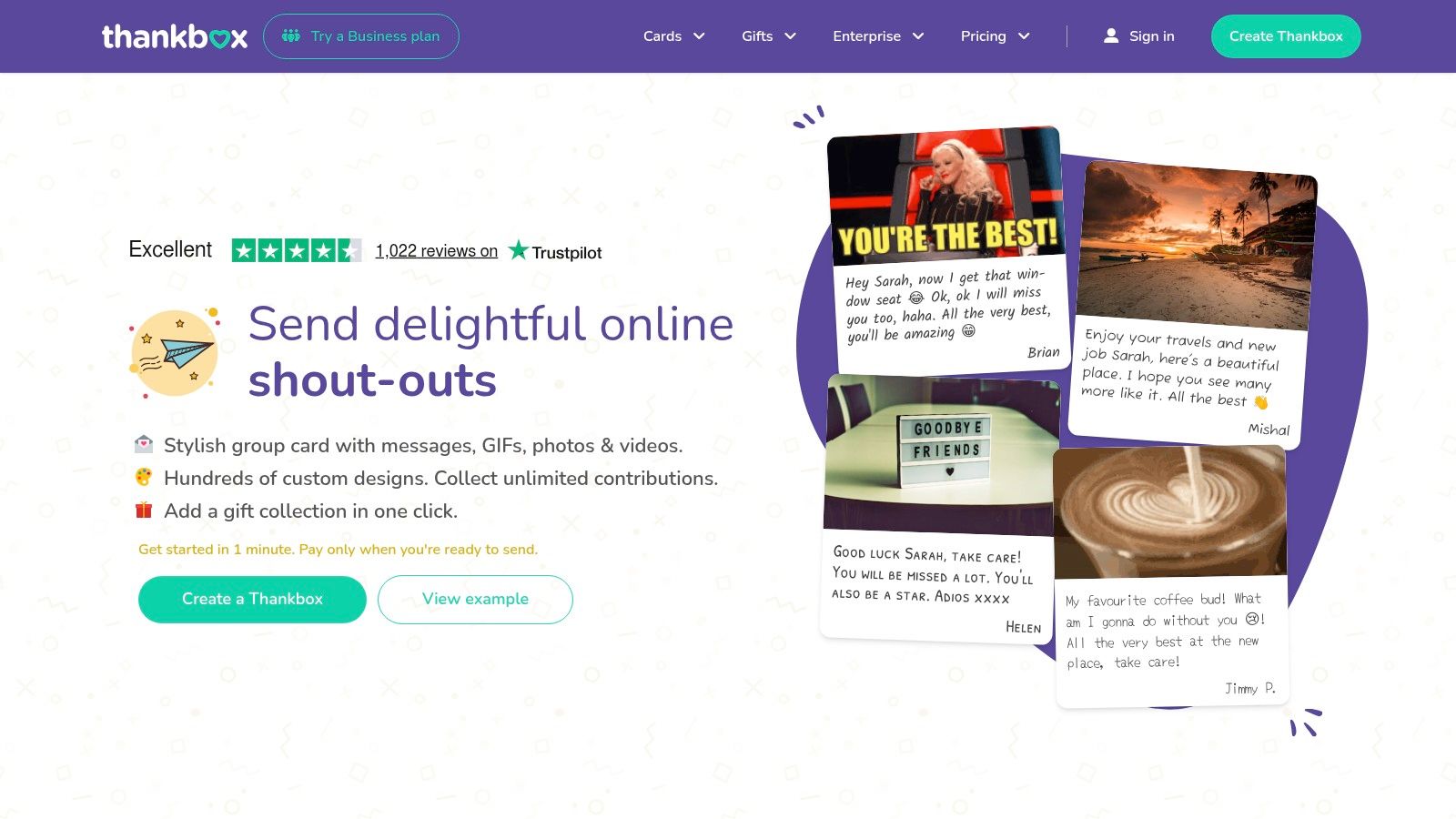
Thankbox is one of the most polished choices for distributed teams. If the office is hybrid, remote, or spread across countries, it gives people an easy place to leave a message and contribute to a gift in the same flow.
That combination solves a real coordination problem. Existing coworker gift content often spends plenty of time on gift ideas, but gives much less guidance on how to handle group payment logistics, contribution fairness, or visibility for the organizer. That gap is one reason tools like Thankbox have become so useful in practice (Thankbox group gift ideas for coworkers).
Best for remote-friendly celebrations
Thankbox feels warmer than a standard collection page because the card experience is rich. Contributors can add photos, GIFs, videos, and voice notes. For teams that rarely meet in person, that makes a difference.
A farewell Thankbox from a remote team can feel much closer to an actual office send-off than a plain gift card email. That’s the product’s best use case. It recreates a bit of shared presence.
It also helps that the contribution fee structure is publicly stated in USD, which makes internal communication easier for U.S. teams. Organizers can explain the process without sounding vague.
Where it wins and where it doesn’t
Thankbox is strongest when the emotional part of the gift matters as much as the gift itself. A manager going on parental leave, a teammate leaving after several years, or a colleague celebrating a milestone birthday all fit that pattern.
It’s weaker if your office wants direct cash payout to the recipient’s bank or wants to buy a physical item through the platform. The recipient usually redeems from a large digital gift card catalog instead. That still gives plenty of choice, but it’s a different kind of flexibility than a cash registry.
There’s also a small usability quirk. Depending on location, some public pricing views can default to EUR, which can create momentary confusion for U.S. users. It’s not a major issue, but it’s worth mentioning if you’re choosing a tool for a mixed-location team.
This is also the kind of platform that works better when the organizer writes a warm invitation. The product handles the logistics, but the tone still matters. For a useful perspective on why thoughtful gifting feels memorable, this article on the psychology of giving meaningful gifts is worth a read.
Use Thankbox when
- The team is remote or hybrid: Media-rich messages help the gift feel human.
- You want one place for signatures and funds: Fewer moving parts means fewer reminders.
- The recipient is happy choosing a digital gift card: That’s the core model.
Skip it when
- You need direct bank payout: It’s not the best fit for cash-first gifting.
- You want physical gifting built into the platform: That isn’t its strongest lane.
4. Kudoboard with Group Gift Cards powered by Tremendous

Kudoboard is often the easiest recommendation for companies that already use digital boards for birthdays, work anniversaries, and team recognition. People know how it works. That familiarity removes friction.
Its group gift feature, powered by Tremendous, adds a practical layer to the board experience. So instead of stopping at messages and photos, the team can attach a pooled gift card outcome or donation option as well.
A good fit for companies with repeat celebration habits
Kudoboard scales better than many lighter tools. If HR, People Ops, or office managers run celebrations regularly, its admin tools, integrations, and branding options can make the process more repeatable.
That matters because employee recognition dominates a large share of corporate gifting activity. In the U.S. corporate gifting market, employee recognition gifts account for about 58% of gift volumes, compared with 29% for client appreciation gifts, according to Market Reports World’s corporate gift market report. For organizations handling frequent internal milestones, a system that standardizes the process is useful.
Kudoboard also works nicely in Slack- and Teams-heavy workplaces because it doesn’t ask employees to learn a very different behavior. Add a message, upload media, contribute if desired, done.
The main limitation
The extra Tremendous step is the thing to understand before choosing it. Gift fulfillment is partner-powered, which can be perfectly fine, but it does add another layer compared with tools that keep everything under one roof.
That won’t bother most recipients. It may bother organizers who want the cleanest possible handoff or who are trying to explain the process to less tech-comfortable contributors.
Enterprise teams may also find that the best automation and admin controls sit behind higher-tier plans. That’s normal for workplace software, but it means Kudoboard is most attractive when the company expects to use it often, not just once.
A board-based gift works best when the messages are the centerpiece and the money is the add-on, not the other way around.
Kudoboard is also a useful middle ground if your company isn’t ready for a full registry approach but has already outgrown informal collections. It gives structure without feeling overly formal. For a broader view of why flexible gifting has become more common, this post on the future of gifting and why cash gifts are trending helps frame the shift.
Best for
- Organizations already using Kudoboard: Familiarity boosts participation.
- Internal recognition programs: Good for repeat use across departments.
- Teams that value board-style sentiment: Messages and media stay front and center.
Watch for
- An extra redemption layer: Tremendous handles the gift card step.
- Paid-plan dependence for advanced admin features: Better at scale than for one-off use.
5. GiftCrowd
GiftCrowd keeps things simple, and that simplicity is the product. If your office wants a link, broad payment options, and a gift outcome that doesn’t require a lot of explanation, GiftCrowd does the job well.
It’s especially helpful for teams where contribution friction is the main risk. Some people prefer cards. Some use PayPal. Some rely on Venmo. The more payment methods a platform accepts, the fewer coworkers disappear at the point of contribution.
Why GiftCrowd is easy to run
The organizer doesn’t have to choose a specific store upfront. That’s a quiet but important advantage. A lot of team gift debates happen because nobody wants to get the “wrong” retailer.
GiftCrowd avoids that early decision. The team contributes first, and the recipient chooses later from a large catalog of brands and experiences. For weddings, baby showers, and farewells, that flexibility removes the pressure to guess.
This also makes it useful for mixed teams where not everyone knows the recipient equally well. A close friend at work may know exactly what to buy. The wider department often doesn’t.
What it does well, and what it doesn’t try to do
GiftCrowd is not trying to be a product marketplace or a full event page. It’s a straightforward group gifting tool built around gift-card redemption. That narrow focus is why it feels uncluttered.
The downside is obvious. If the office wants to pool money for one exact physical gift, GiftCrowd isn’t the right platform. It doesn’t replace a traditional shopping cart. It replaces the awkward office collection.
Its no-platform-fee positioning for organizers and contributors is also appealing, though recipients should still read the details on certain prepaid choices that may involve activation fees. That’s not unusual in gift-card ecosystems, but it’s worth understanding before framing the gift as fully equivalent to cash.
For etiquette, GiftCrowd works best when the invitation sets a soft contribution tone. If people feel they’re being assessed on whether they joined, participation can drop fast. This guide on group gift etiquette and how much to give is a good reference if you’re trying to word the ask gracefully.
Strong choice for
- Teams with mixed payment preferences: More ways to pay usually means less drop-off.
- Office gifts where retailer choice is uncertain: The recipient decides later.
- Straightforward U.S. workplace use cases: Farewells, showers, weddings, promotions.
Not the best fit for
- Buying one physical item together: That’s not what the platform is built for.
- Cash-out expectations: This is still gift-card centered.
6. eGifter
eGifter has been around long enough to feel dependable, and that matters for last-minute office gifting. If the team remembered a work anniversary late, or if a farewell date moved up faster than expected, eGifter’s digital delivery model can save the day.
Its Group Gifting feature is straightforward. Set up the page, share the link, collect contributions, and let the recipient redeem through a brand-specific gift or an eGifter Choice Card.
A good option when time is short
Some platforms are strongest when you want a polished tribute. eGifter is strongest when you need the gift itself handled cleanly and fast.
That makes it useful for practical workplace moments. A manager’s birthday is tomorrow. A teammate’s last day got announced this week. The department wants to send something before parental leave begins. eGifter fits those situations because the workflow is familiar and digital-first.
There’s also less learning curve than with broader celebration platforms. Contributors generally understand what they’re doing as soon as they land on the page.
Where eGifter makes sense
This is a good tool for offices that already think in gift-card terms. It gives the recipient broad brand choice and avoids the problem of selecting a single merchant too early.
It’s less compelling if your workplace culture puts a lot of weight on the communal message or visual tribute. Contributors can add messages, but the emotional presentation isn’t the main event in the same way it is with some card-led platforms.
The other practical note is that eGifter’s policies and Choice Card details are worth reading before launch. That’s not a criticism so much as good organizer hygiene. Any system involving balances, redemption options, or brand selection is better when the organizer understands the support documentation in advance.
A simple way to use eGifter well is to pair it with a separate moment of recognition. For example, send the group gift digitally, then share personal messages in a team meeting or channel. That gives you the speed of eGifter without losing the human side of the celebration.
Best when
- You’re short on time: Fast delivery is the main advantage.
- The team wants broad brand choice: The recipient can pick from many options.
- You need a low-drama workflow: It’s simple and familiar.
Less compelling when
- You want an all-in-one tribute experience: The gifting mechanics are stronger than the ceremonial layer.
- You need direct purchase of one shared physical gift: That’s outside its main model.
7. GroupGreeting
GroupGreeting is the tool to choose when the card is the star of the show and the gift is secondary. For many coworker milestones, that’s exactly right.
A retirement, farewell, or work anniversary often lands emotionally because of what people write, not because of the denomination attached. GroupGreeting understands that. It’s built around a simple, shareable e-card with optional gift-card collection added on.
Where it feels most natural
If your office already likes circulating digital cards, GroupGreeting is easy to adopt. Coworkers can sign, add images or GIFs, and contribute to an attached gift-card flow without much explanation.
That card-first model fits workplace culture better than people sometimes expect. According to 2025 corporate gifting statistics compiled by Gift A Feeling, digital group platforms have grown quickly in coworker gifting, and recipients show a strong preference for flexible payout or redemption options over curated items in many settings (Gift A Feeling corporate gift statistics 2025). GroupGreeting sits squarely in that digital, flexible lane.
For an office manager running frequent celebrations, its volume options and discounted packs also make practical sense. It’s not trying to be everything. It’s trying to be easy to repeat.
The trade-off is clear
This isn’t a platform for direct cash gifting or physical item coordination. If the office wants to fund a honeymoon, support a growing family with flexible money, or pool toward a larger life goal, another platform will fit better.
But if the team’s instinct is, “Let’s send a card everyone can sign, and attach something useful,” GroupGreeting does that with very little fuss.
It also keeps the emotional balance right. Some platforms can make the card feel like a wrapper around the money. GroupGreeting does the opposite. That’s often the better call for coworker relationships, where thoughtfulness should stay visible and proportional.
“For retirements and farewells, the messages usually become the keepsake.”
Choose GroupGreeting when
- The digital card matters most: It’s built around shared sentiment.
- The team wants a fast, affordable ritual: Good for frequent office occasions.
- A gift-card add-on is enough: It complements the card without overcomplicating it.
Pass if
- You need cash-out or registry-style flexibility: That isn’t the product.
- You’re coordinating a larger life-event gift: Weddings and baby milestones often need more flexibility.
Top 7 Coworker Group-Gifting Platforms Comparison
| Item | Implementation complexity | Resource requirements | Expected outcomes | Ideal use cases | Key advantages |
|---|---|---|---|---|---|
| Zelo | Low, create event in under 60s | Minimal tech; verified bank account; pay-on-success fees + payment processor fees | Cash pooled and paid to bank account; transparent records and net payout | Weddings, showers, birthdays, milestones where cash is preferred | Mobile-first event site, bank payouts, RSVP/invite tools, strong security and social proof |
| GroupTogether | Low, single flow for card + collection | Minimal; Stripe payments; US-focused merchant catalog | Pooled funds redeemed as eGift/AnyCard (no bank cash-out) | Workplace farewells, promotions, retirements, baby showers | Unified group card + collection, AnyCard (150+ retailers), low organizer overhead |
| Thankbox | Low, card + pot in one setup | Minimal; built-in collection and global gift catalog; enterprise add-ons | Media-rich e‑card plus pooled gift redeemable from digital catalog | Remote/hybrid teams seeking polished e-cards with pooled gifts | Rich media support, built-in pot, automated reminders, enterprise features |
| Kudoboard (Tremendous) | Low–Medium, board plus gift collection | Moderate for enterprise integrations (SSO, Slack); partner fulfillment via Tremendous | Collaborative board plus recipient-selected gift card or donation | Companies already using digital boards; corporate celebrations | Familiar board experience, integrations, recipient choice or charity option |
| GiftCrowd | Very low, simple organizer flow | Minimal; broad payment options (CC, PayPal, Venmo, BNPL) | Recipient chooses from 450+ brands; typically no platform fee | Dispersed coworker occasions needing flexible payments | Broad payment methods, low organizer cost, frictionless payments |
| eGifter | Low, quick group gift page | Minimal; fast digital delivery via email/SMS/print | Rapid delivery; recipient redeems at 250+ brands | Last‑minute team gifts and distributed teams | Fast digital delivery, wide brand coverage, no monthly fee |
| GroupGreeting | Very low, card-first flow with optional pot | Minimal; optional gift card add-on (350+ merchants) with processing fees | E-card signed by team with optional pooled gift cards | Teams prioritizing sentimental messages with a simple collection | Extremely quick setup, affordable per-card pricing, message-focused experience |
Make Every Workplace Celebration Meaningful
Friday afternoon is when these gifts usually go sideways. Someone starts a last-minute chat thread, three people ask how to contribute, one person wants a sentimental card, another wants to send cash, and the organizer ends up chasing payments instead of celebrating the coworker.
A good group gift process prevents that mess. The best result comes from matching the platform to the moment, setting expectations early, and giving people a simple way to participate.
Start with the occasion, then work backward from the logistics. A retirement or farewell often calls for messages people can revisit later. A wedding, baby gift, or housewarming usually works better when the recipient can choose what fits their life. A close team may enjoy a more personal format, while a larger department usually needs something faster, clearer, and easier to manage.
That trade-off matters.
If recipient choice is the priority, registry-style giving is often the cleanest option. If the team cares most about notes, photos, and a shared card experience, Thankbox, GroupGreeting, or GroupTogether will usually feel more natural. If your company already uses digital boards for recognition, Kudoboard can fit existing habits without extra explanation. If speed matters and nobody wants setup complexity, GiftCrowd and eGifter are practical picks.
The organizer's job is part logistics, part etiquette. Both matter equally. Clear communication keeps a celebration generous instead of awkward.
A simple plan works well:
- Name the occasion clearly: Use a specific subject line such as "Farewell gift for Marcus" or "Baby gift for Priya."
- Keep contributions optional: Say that joining is appreciated, not expected.
- Choose one owner: One organizer avoids mixed messages and duplicate reminders.
- Set a firm cutoff: A real date gives people a reason to act.
- Include a message prompt: Ask each contributor to add a note, memory, or photo so the gift feels personal.
The wording matters too. I have found that a short, direct message gets better participation than a long explanation. Try: "We're collecting for Jenna's retirement gift. If you'd like to join, please contribute by Thursday at 3 p.m. No pressure at all. We'll also include team messages." It is polite, specific, and easy to act on.
Good workplace gifting should never create pressure, status anxiety, or confusion about where the money goes. The strongest tools reduce those problems by showing contributors exactly what they are joining and by keeping the collection in one place. That is the primary value of modern group-gifting platforms. They do more than process payments. They give organizers a repeatable system.
This guide is really about that system. The platform comparison helps you choose the right tool. The etiquette scripts help you ask gracefully. The coordination plan helps you get from idea to delivery without a pile of follow-up messages.
That structure is especially useful for hybrid teams. Colleagues may be spread across cities, time zones, or countries, and they still want to show up well for a birthday, farewell, wedding, new baby, or promotion. A clear digital process lets everyone participate without side payments, paper cards, or last-minute confusion.
Workplace celebrations do not need to be elaborate to feel meaningful. They need to feel thoughtful, organized, and fair. When the setup is right, the admin fades into the background and the appreciation comes through clearly.
Enjoyed the article? Share it!