A heart transplant typically runs into the million-dollar range in total billed charges once you include pre-transplant workup, the surgery itself, and the first year of follow-up care. Most of that burden falls on your insurer rather than you directly. Private insurance, Medicare, or Medicaid usually covers the bulk of the bill, but your out-of-pocket share still depends heavily on your plan’s deductible, coinsurance, and network rules.
Statistic Callout: One transplant-center guide puts the pre-insurance price at over $1 million, while national price-variability research finds the median commercial hospitalization alone at roughly $410,076, nearly double the Medicare median of about $211,993.
Key Takeaways
A heart transplant typically totals $1.2 million to $1.7 million in billed charges, but insurance, negotiated rates, and financial assistance programs mean most patients pay a fraction of that figure out of pocket.
| Point | Details |
|---|---|
| Total cost estimate | Expect $1.2 million to $1.7 million in billed charges across pre-op, surgery, and first-year follow-up. |
| Sticker price isn’t real price | Chargemaster rates run roughly triple negotiated commercial rates for the same procedure code. |
| Payer type changes everything | Private insurance, Medicare, and Medicaid each carry different coverage rules and out-of-pocket exposure. |
| Long-term costs continue | Lifelong immunosuppressants and monitoring add $30,000 to $50,000 in year one alone. |
| Cash-gift pages can help | Getzelo lets families collect documented contributions toward shortfalls like travel or copays. |
Table of Contents
- How Much Does a Heart Transplant Cost, and What’s Included?
- What Does Each Phase Actually Cost?
- Why Does the Sticker Price Differ From What You Actually Owe?
- How Does Insurance Typically Cover a Heart Transplant?
- What Will You Actually Pay Out of Pocket?
- Where Can You Find Financial Assistance?
- How Should You Plan Your First Steps?
- What Do Long-Term Medication and Monitoring Costs Look Like?
- Have You Considered a Cash-Gift Page for Recovery Costs?
- Frequently Asked Questions
- Sources
How Much Does a Heart Transplant Cost, and What’s Included?
The total figure isn’t one bill. It’s a sum of distinct phases of care, each billed separately and each with its own cost drivers.
- Pre-transplant evaluation and stabilization: testing, imaging, and often a mechanical support device while you wait for an organ
- Organ procurement: recovery and transport of the donor heart, billed as its own line item
- Index hospitalization and surgery: the transplant operation itself, including the surgical team and operating room time
- Immediate post-op ICU and ward care: often the single largest driver of hospital facility fees
- Early readmissions: common in the first 90 days if rejection or infection occurs
- Lifelong outpatient follow-up: clinic visits, labs, and daily medications
Hospital facility fees dominate the ICU and ward stages. Physician and surgeon fees are billed separately and tend to be more consistent across hospitals than facility charges.
What Does Each Phase Actually Cost?
Dollar ranges vary by hospital, region, and payer, but the pattern holds fairly consistently across major centers and studies.
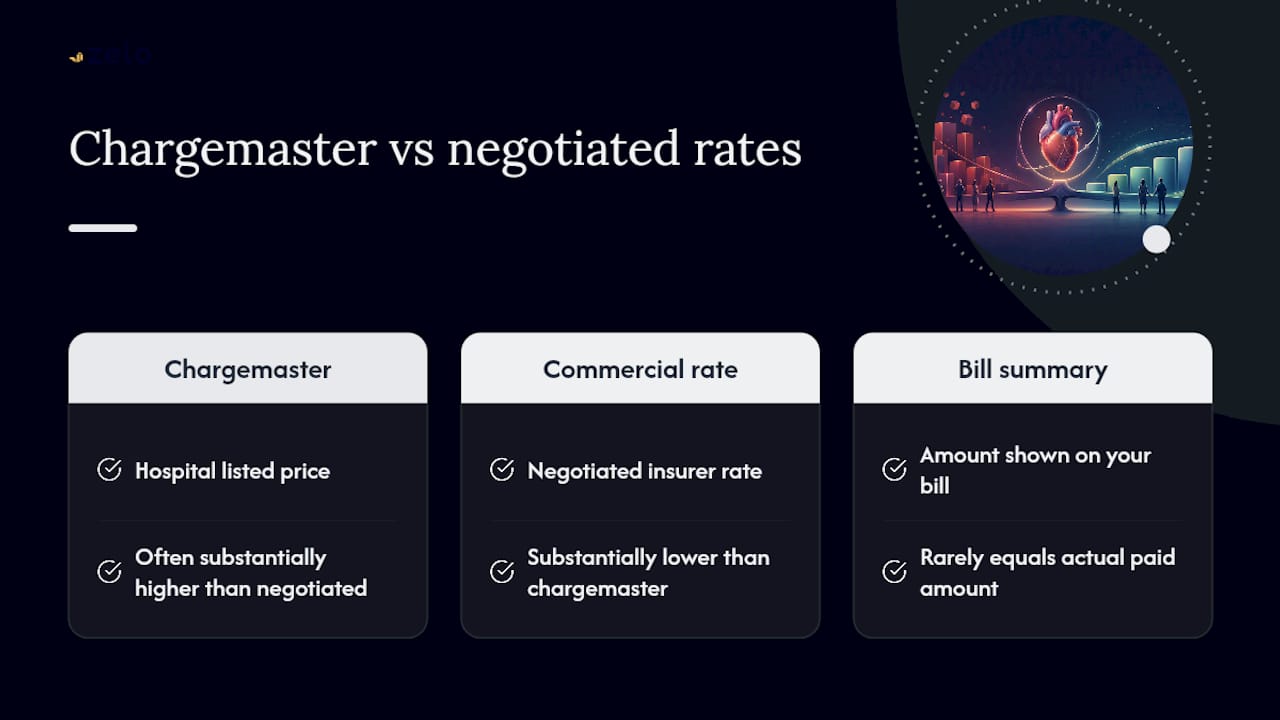
Statistic Callout: The same national pricing study found chargemaster list prices substantially higher than the negotiated commercial rate for the identical procedure code. The number on your hospital bill’s summary page is rarely what anyone actually pays.
Why Does the Sticker Price Differ From What You Actually Owe?
The chargemaster is a hospital’s master list price, essentially a starting number nobody pays in full. Commercial insurers negotiate discounted rates behind the scenes, and Medicare sets its own fixed reimbursement schedule, which is why the same MS-DRG code can produce three wildly different bills at the identical hospital.
Variability doesn’t stop between hospitals. Even patients with different commercial insurance plans at the same transplant center can see negotiated rates that differ by a factor of two, based on their specific contract. The biggest drivers of a higher final bill: extended ICU days, post-op complications, unplanned readmissions, and the region where the transplant happens.
- ICU length of stay and complication rate
- Readmissions within 90 days
- Geographic region and local hospital market power
- Whether facilities and physicians are in-network
Pro Tip: Ask your transplant financial coordinator for a written itemized estimate before surgery, not after. Centers that assign one early tend to produce far fewer billing surprises for patients.
How Does Insurance Typically Cover a Heart Transplant?
Coverage patterns differ sharply by payer type, and knowing which bucket you fall into changes your entire financial picture.
- Private insurance usually covers the majority of costs after prior authorization, but you’ll still face a deductible, coinsurance percentage, and an annual out-of-pocket maximum that can run into five figures.
- Medicare covers heart transplants that meet medical-necessity criteria, split between inpatient (Part A) and outpatient (Part B) rules; a Medigap supplemental plan can meaningfully reduce what you owe.
- Medicaid coverage varies significantly by state, both in eligibility rules and in which transplant centers accept it, so check your state’s program directly rather than assuming national uniformity.
Statistic Callout: Given that median commercial hospitalization prices sit near $410,076, even a modest coinsurance share before hitting your out-of-pocket max can represent a significant financial exposure.
What Will You Actually Pay Out of Pocket?
Real financial exposure depends on which of these three situations describes you.
- Well-insured commercial plan, modest deductible: expect to pay somewhere between $5,000 and $15,000 once you hit your annual out-of-pocket maximum, assuming in-network care throughout.
- Medicare beneficiary without Medigap: coinsurance on inpatient stays can add up fast without a supplement; adding a Medigap plan often cuts that exposure substantially.
- Uninsured or self-pay: you face the highest listed charges, but many hospitals will negotiate a cash-pay discount well below chargemaster rates if you ask before treatment begins.
The swing factor in every scenario is whether your hospital and surgical team are in-network, since a single out-of-network provider on an otherwise covered case can undo months of careful planning.
Where Can You Find Financial Assistance?
Even with strong coverage, gaps show up, especially around medications, travel, and lodging. Several established resources exist specifically to fill them.
- Transplant center financial coordinators and social workers, who help identify every available assistance program before you need it
- National charities such as Help Hope Live and the HealthWell Foundation, which fund medication copays and transplant-related expenses
- Manufacturer and foundation copay assistance programs for immunosuppressant medications specifically
- Crowdfunding platforms like GoFundMe, commonly used to cover travel, lodging, and lost-wage gaps that insurance never touches
Apply early. Most charity programs require documentation of your diagnosis, insurance denial or coverage gap, and income, and processing can take several weeks.
How Should You Plan Your First Steps?
- Schedule a meeting with the transplant center’s financial coordinator before surgery is scheduled, not after.
- Request a written, itemized cost estimate covering surgery, ICU days, and expected medications.
- Verify network status for the hospital, surgeons, anesthesiologists, and any device manufacturers involved.
- Confirm insurance preauthorization is filed and approved in writing.
- Ask about secondary or supplemental coverage options, including Medigap if you’re on Medicare.
- Budget separately for lodging, travel, and caregiver lost wages, since these rarely appear on any medical bill.
What Do Long-Term Medication and Monitoring Costs Look Like?
Surgery is the visible cost. Lifelong immunosuppressant therapy and routine monitoring are the recurring one, and they don’t stop after year one. Transplant recipients need daily anti-rejection medication indefinitely, plus regular labs and clinic visits to catch rejection or infection early, according to long-term follow-up guidance for organ transplant recipients.

Statistic Callout: First-year medication and follow-up costs commonly fall in the $30,000 to $50,000 range, and while ongoing annual costs typically decrease from that peak, they never disappear entirely.
A Practical Note on Planning Ahead
Financial planning works better started early, before the transplant date arrives. Transplant centers keep financial coordinators on staff precisely because navigating this is their job, not yours alone.
Have You Considered a Cash-Gift Page for Recovery Costs?
Even with insurance and hospital assistance programs stacked together, families often face a documented shortfall: travel, lodging, lost wages, or medication copays that no payer covers. Getzelo lets you create a personalized event page where friends and family can contribute directly toward those specific, named costs, rather than sending flowers or asking what you need.

Guests check out securely, your progress toward a stated goal is visible, and you can withdraw funds directly without Getzelo holding your money. The platform charges a percentage-based fee on contributions plus standard payment processing, with no signup or subscription cost. If you’re weighing ways to close a recovery-related funding gap, set up your page and share it with the people already asking how they can help.
Frequently Asked Questions
How much does a heart transplant cost without insurance? Uninsured patients face the highest billed amount, often near the chargemaster rate, which can exceed $1 million. Many hospitals will negotiate a lower cash-pay rate if you ask before treatment starts.
Does Medicare cover the full cost of a heart transplant? Medicare covers transplants meeting medical-necessity criteria but splits coverage between Part A and Part B, leaving coinsurance responsibility unless you carry a Medigap supplement.
What’s the biggest hidden cost after the transplant itself? Lifelong immunosuppressant medications and routine monitoring, which commonly add $30,000 to $50,000 in the first year and continue at a lower level indefinitely.
Can crowdfunding realistically help cover transplant costs? Crowdfunding through platforms like GoFundMe is commonly used for travel, lodging, and lost-wage gaps that insurance doesn’t cover, though it’s rarely enough to offset the full surgical bill on its own.
This article is general information, not a substitute for advice from a qualified doctor. Consult a qualified healthcare professional about your own circumstances before acting on anything here.
Sources
- Price Variability of Heart Transplant and Ventricular Assist Procedures Across the United States
- Heart Transplant Cost | Newark Beth Israel Medical Center, New Jersey
- Medicare coverage of organ transplants
- Where can people get help with Medicaid & CHIP?
- Transplants
Recommended
Enjoyed the article? Share it!