
A $10,000 gift means exactly what it says: ten thousand U.S. dollars given to a person or toward an event, whether that’s a wedding fund, a honeymoon, or a graduation milestone. Here’s the fact that matters most before you write that check or click “send”: for 2026, the annual federal gift tax exclusion is $19,000 per recipient. A single $10,000 gift falls comfortably below that line, so it creates no federal gift-tax liability and requires no Form 709 filing.
That’s the headline. Everything else—etiquette, timing, delivery method—is about making the gift feel right, not about clearing a legal hurdle.
- The dollar amount: $10,000 is ten thousand U.S. dollars, full stop. No conversion, no hidden meaning.
- The tax threshold: $19,000 per recipient per year, per donor, for 2026.
- The context: Most wedding guests give $100 to $150 per person as a baseline, which puts a $10,000 gift roughly 65 to 100 times above typical guest spending.
Quick stat: The 2026 annual gift tax exclusion sits at $19,000 per recipient. A $10,000 gift uses roughly half that allowance and triggers zero paperwork with the IRS.
Key Takeaways
A $10,000 gift is a high-value but legally uncomplicated gesture, since it stays under the 2026 federal gift tax exclusion and simply requires the right etiquette and delivery method to land well.
| Point | Details |
|---|---|
| Tax threshold | The 2026 annual gift tax exclusion is $19,000 per recipient, so $10,000 requires no Form 709. |
| Social scale | Typical guests give $100 to $150 per person, making $10,000 a significant outlier reserved for close family or pooled gifts. |
| Delivery method | Bank transfers and digital gifting platforms offer better security and recordkeeping than cash or checks. |
| Affordability rule | Confirm emergency savings and debt status before committing to a gift this size. |
| Recordkeeping | Recipients should log the gift’s amount, sender, date, and method within the first week. |
| Recommended platform | Zelo lets hosts collect gifts of any size, including $10,000, through a secure, trackable event page with no fees charged to guests. |
Table of Contents
- What Can $10,000 Actually Buy for a Milestone Event?
- When Is Giving $10,000 Appropriate?
- How Should You Present a $10,000 Gift?
- What Are the U.S. Tax Rules for a $10,000 Gift?
- How Should a Donor Budget for a $10,000 Gift?
- What’s the Safest Way to Send or Collect $10,000?
- What Should a Recipient Do With a $10,000 Gift?
- Why Etiquette and Tax Clarity Both Matter Here
- Give Big Without the Guesswork: How Zelo Handles Large Gifts
- Sources
What Can $10,000 Actually Buy for a Milestone Event?
$10,000 is a high-value gift by any measure, and it can meaningfully underwrite some of the biggest expenses tied to a milestone celebration. The number only means something once you attach it to a real cost.
- A full honeymoon. Ten thousand dollars covers airfare, lodging, and excursions for a two-week international trip for most couples, sometimes with room to spare.
- A meaningful down payment contribution. It won’t buy a house outright, but it can cover a security deposit plus a chunk of moving costs for a couple’s first place together.
- A semester or two of tuition. For graduates heading into a certificate program or a state school, $10,000 can offset a substantial share of annual costs.
- A “cover the whole guest list” gesture. If a wedding costs $200 per plate and 50 people attend, $10,000 quietly absorbs the entire catering bill.
- A pooled family gift. Several relatives combining $1,000 to $2,000 each reach $10,000 without any single person overextending.
- A home renovation kickstart. For a housewarming, $10,000 can fund a kitchen refresh or a full room’s furnishing.
- A business or side-project seed fund. Increasingly common for graduation gifts aimed at helping a young adult launch something real.
Quick stat: Guests attending an average wedding spend roughly $610 total once travel and lodging are factored in, which means a $10,000 giver is operating in an entirely different category from the typical attendee.
There’s a real distinction worth noting between funding an experience and funding a durable asset. A honeymoon contribution disappears the moment the trip ends, while a down payment gift builds equity that outlasts the celebration. Recipients often value both differently, and it’s worth understanding which one you’re actually offering before you frame the gift.

When Is Giving $10,000 Appropriate?
A $10,000 gift is typically appropriate for immediate family, an especially close mentor, or situations where multiple givers pool funds toward one shared purpose. Outside those circumstances, it tends to raise eyebrows rather than gratitude, mostly because it disrupts the social math everyone else at the event is working from.
- Parents and grandparents: Often the largest individual givers, sometimes reaching five figures for a wedding or house purchase.
- Siblings with shared resources: Occasionally pool funds to hit a bigger number together.
- Close aunts, uncles, and godparents: Usually land in the $200 to $1,000 range, rarely near $10,000 alone.
- Friends and coworkers: Typically follow the $100 to $150 per-guest guideline, making $10,000 a significant outlier.
- Group or workplace gifts: Can reach $10,000 collectively without any one person feeling the strain.
Affordability matters more than tradition here. A giver with disposable savings and no pressing debt can comfortably part with $10,000; a giver stretching to cover their own rent should not, regardless of how close the relationship is. Cultural norms, travel costs already incurred to attend the event, and whether the couple explicitly asked for cash toward a specific goal (see our guide to appropriate wedding gift cash) all factor into the decision.
Pro Tip: If you’re considering a gift this large, quietly ask a parent, close family member, or event organizer what feels right before committing. A five-minute private conversation prevents an awkward mismatch between your gesture and everyone else’s expectations.
How Should You Present a $10,000 Gift?
Deliver a gift this size with discretion and pair the cash with clear, warm wording, never a public announcement of the amount. Large sums invite comparison, and comparison is the fastest way to sour an otherwise generous act.
- Send the gift ahead of the event when possible, rather than handing it over in a crowded receiving line.
- Avoid mentioning the dollar figure in a toast, card display, or group chat.
- Include a short handwritten note alongside the funds, even when giving digitally.
- Use a secure digital collection page rather than cash in an envelope, both for your own recordkeeping and the recipient’s safety.
Sample wording depends on the relationship:
- For immediate family: “We couldn’t be prouder. This is our way of helping you start this next chapter.”
- For close friends: “We wanted to help make this milestone feel as big as it deserves. Congratulations.”
- For formal or professional relationships: “Please accept this gift with our warmest congratulations on this occasion.”
Pro Tip: If you’re the host, list a clear purpose on your event page, something like “cash contributions welcome toward our honeymoon”, so large givers know exactly what their gift supports and smaller givers don’t feel pressure to match it.
What Are the U.S. Tax Rules for a $10,000 Gift?
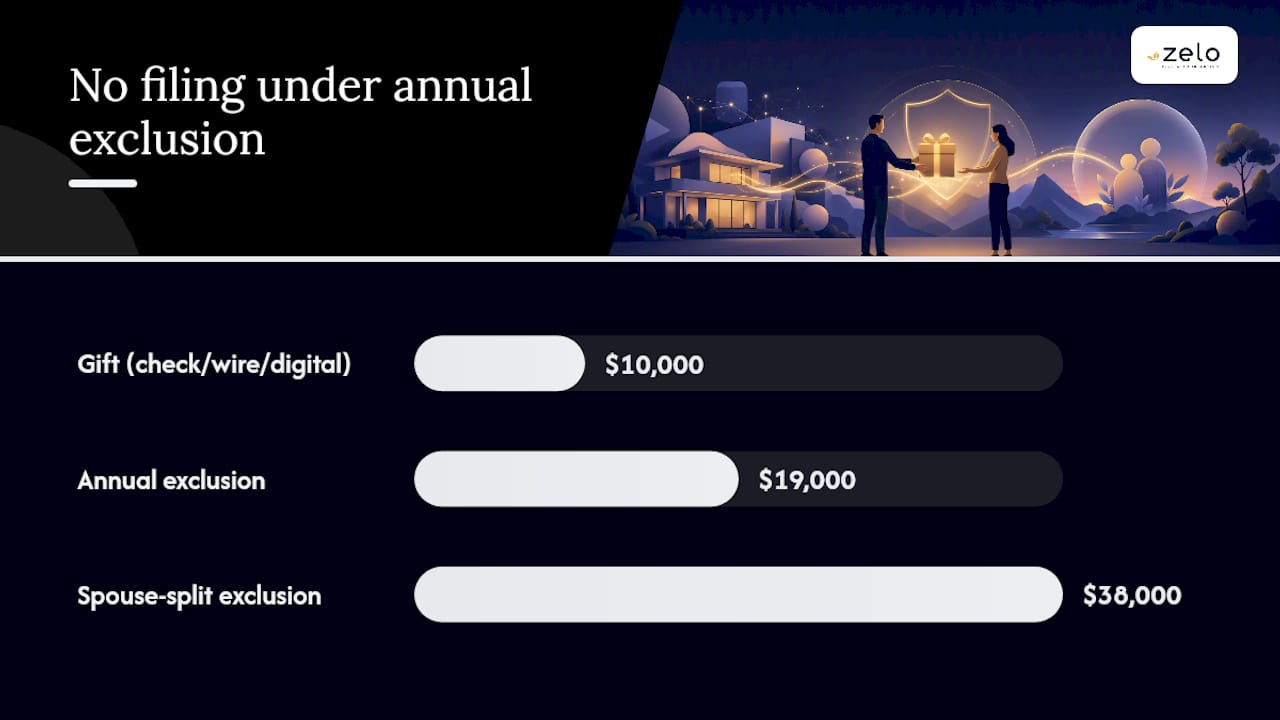
A standalone $10,000 gift to one person in 2026 sits below the annual exclusion, so it creates no federal gift tax liability and no filing obligation. That’s true whether the money moves by check, wire, or a digital gifting platform.
| Figure | 2026 Amount | Notes |
|---|---|---|
| Annual gift tax exclusion | $19,000 per recipient | Applies per donor, per recipient, per year |
| Lifetime basic exclusion | Significantly increased | Raised under the Working Families Tax Cuts Bill, per IRS guidance |
| Filing requirement | None for gifts under $19,000 | Form 709 only needed above the annual exclusion |
Practical tax steps worth following regardless of the amount:
- Keep a simple record of the gift: date, amount, method, and recipient.
- Save payment confirmations or bank statements as backup documentation.
- Consult a tax professional if you’re giving to the same person multiple times in one year and the total could cross $19,000.
- Talk to an advisor before gift-splitting with a spouse, since that strategy effectively doubles the exclusion to $38,000 per recipient.
- Watch cumulative lifetime gifts if you’re a frequent large-scale giver, since they draw against the lifetime exemption once the annual threshold is exceeded.
Gifts are also not taxable income to the recipient. The IRS places the reporting burden on the donor, not the person receiving the money, and only when gifts to one recipient exceed the annual exclusion in a calendar year.
How Should a Donor Budget for a $10,000 Gift?
Prioritize your own financial stability first. No relationship is served by a gift that puts the giver in a precarious position, no matter how meaningful the occasion.
- Confirm you have three to six months of expenses in an emergency fund before committing $10,000 elsewhere.
- Check your outstanding debt, particularly high-interest credit card balances, and pay those down before gifting.
- Verify you won’t need this cash for short-term obligations like rent, tuition, or a planned move.
- Consider whether this gift, combined with others to the same person, could approach the $19,000 exclusion and require tracking.
If $10,000 isn’t realistic, several alternatives preserve the sentiment without the financial strain:
- Group gifts: Coordinate with siblings or close friends to reach a large number collectively.
- Installment plans: Contribute in stages rather than all at once.
- Targeted smaller amounts: Give $1,000 or $2,000 toward one specific line item, like flights or a wedding cake.
- Experience gifts: Cover a dinner, a spa day, or a weekend trip instead of a lump sum.
A sample six-month installment template: contribute $1,667 monthly for six months, timed to land the final payment before the event date. Adjust the schedule around paychecks or bonus cycles to keep it painless.
What’s the Safest Way to Send or Collect $10,000?
Prefer secure, traceable methods over cash. For a sum this large, a bank transfer or a reputable digital gifting platform beats a physical envelope on every measure that matters.
| Method | Security | Fees | Speed | Recordkeeping |
|---|---|---|---|---|
| Bank wire or ACH transfer | High | Low to moderate bank fees | 1 to 3 business days | Strong, bank-generated records |
| Cashier’s check | High | Small flat fee | Same day to issue, days to clear | Paper trail, easy to lose |
| Digital gifting platform | High | Platform and processing fees | Near-instant | Automatic, built-in ledger |
| In-person cash | Low | None | Immediate | None unless manually tracked |
- Bank transfers are hard to intercept but require both parties to share account details, which some people find intrusive.
- Cashier’s checks feel formal and traditional but can be lost, delayed by mail, or take days to clear.
- Digital platforms offer instant confirmation and automatic recordkeeping, useful when tax questions come up later, though they typically carry a processing fee.
- Cash has zero fees but zero protection if it’s lost, stolen, or misplaced at a venue.
Fees callout: Wire transfers often carry a flat bank fee. Digital platforms typically charge a percentage-based processing fee, split between payment processing and platform costs, which is worth understanding before committing to a method.
Pro Tip: Never leave a large cash gift in a physical card box at a venue. Gift boxes get moved, misplaced, or occasionally targeted for theft. A digital page tied to the couple’s names, like the ones our cash fund registry guide walks through, keeps the money accounted for from the moment it’s sent.
What Should a Recipient Do With a $10,000 Gift?
Say thank you promptly and keep a clear record of exactly what you received. A gift this size deserves more than a group text, and the recipient’s own paperwork matters just as much as the giver’s.
- Deposit the funds into your bank account immediately rather than letting cash sit around.
- Split the money by purpose: some toward an emergency fund, some toward the stated goal, some invested if there’s no immediate need.
- Consult a financial planner if the gift changes your overall financial picture significantly.
- Talk to a tax advisor if you’re unsure whether the gift affects other filings, even though the gift itself isn’t taxable income to you.
Sample thank-you wording: “Thank you so much for your generous gift. It means the world to us and will go directly toward [specific goal].” Keep a simple log with the sender’s name, amount, date, and delivery method for your own reference.
Why Etiquette and Tax Clarity Both Matter Here
The most common mistake in cash gifting isn’t giving too much or too little, it’s giving without understanding either side of the equation. Hosts obsess over etiquette and forget the tax facts entirely, while donors sometimes assume any large gift triggers a tax bill and hold back out of unnecessary caution. Neither instinct serves the relationship well.
What the research consistently shows is that $10,000 sits far outside typical guest spending, yet it’s legally uncomplicated as long as it stays under the $19,000 annual exclusion. That gap between social weight and legal simplicity is exactly why transparency matters. When hosts state their goals clearly and donors use traceable delivery methods, the awkwardness that usually surrounds large gifts mostly disappears. For anything unusual, a gift-splitting arrangement, a gift that approaches the lifetime exemption, a complex family situation, talking to a tax or financial advisor beats guessing.
Give Big Without the Guesswork: How Zelo Handles Large Gifts
Zelo is a secure cash-gifting platform built for milestone events, and it’s designed specifically to handle contributions at every level, including gifts as large as $10,000, without the awkwardness of a card box or the hassle of coordinating a wire transfer.

Hosts create a personalized event page, whether for a wedding, a graduation, or any other milestone, and guests contribute through a secure checkout that tracks progress toward a stated goal in real time. Every contribution is logged automatically, which solves the recordkeeping question recipients face with large gifts. Zelo charges hosts a percentage-based platform fee only when a contribution comes through, guests never pay a fee to give, and hosts can withdraw funds directly without the platform holding onto their money. If you’re planning an event and expect a mix of gift sizes, from $50 to $10,000, set up your event page and see exactly how contributions and goal tracking work before your first guest gives a dime.
Sources
- 2026 gift tax exclusions | Ohio State Farm Office
- About Form 709, United States Gift (and Generation-Skipping Transfer) Tax Return (PDF)
- How much to give at a wedding: What should a wedding gift cost? | Fidelity
Recommended
Enjoyed the article? Share it!