Every save-the-date envelope needs three things: the recipient’s name formatted correctly for their situation, their full street address including any apartment or unit number, and their city, state, and ZIP code. The card itself should carry the couple’s names, the wedding date, a general location (city and state), an optional wedding website URL, and the phrase “Invitation to follow.” Per Paperlust’s addressing guide, every invited adult should appear by name on the envelope, and a return address must be included so undelivered mail comes back to you.
Envelope essentials at a glance:
- Recipient name line: Full name(s) with titles if you are using them
- Street address: Full street address, spelled out on formal envelopes, with apartment or suite number
- City, state, ZIP: All three on one line
- Return address: Back flap or top-left corner of the front
- Correct postage: Weighed and confirmed before mailing the full batch
Titles are optional on save-the-dates, but whatever you decide, apply it consistently across your entire guest list.
Key Takeaways
Addressing save-the-dates correctly requires listing every invited adult by full name, using consistent titles, including complete addresses, and mailing at the right time for your wedding type.
| Point | Details |
|---|---|
| Name every invited adult | List all adults by full name on the envelope; never use “and family” without specifying who is included. |
| Send at the right time | Mail 6–8 months out for local weddings, 8–10 months for out-of-town, and 10–12+ months for destination events. |
| Keep titles consistent | Decide whether to use formal titles and apply that choice to every envelope on your list. |
| Weigh and test before mailing | Take a finished package to the post office to confirm postage, then mail one test envelope to yourself. |
| Use a return address | Place a return address on every envelope so undelivered mail comes back to you for correction. |
For most couples, DIY addressing works well for lists under 75; beyond that, a professional calligrapher or mail-house service saves time and reduces errors.
Table of Contents
- What goes on the card versus what goes on the envelope
- When to send save-the-dates and who should receive them
- How to address save-the-dates for every guest type
- Address formatting, envelope sizes, and postage
- Options for addressing envelopes: handwriting, printing, and calligraphy
- Ready-to-use wording templates for save-the-date cards
- A step-by-step process for finalizing and mailing save-the-dates
- How to handle tricky addressing situations
- The detail that actually matters most
- Put your wedding website URL to work
- Sources
What goes on the card versus what goes on the envelope
The card and the envelope have different jobs. Mixing them up is one of the most common save-the-date mistakes, and it usually results in either a cluttered card or a confusing envelope.
What belongs on the card:
- The couple’s full names
- The day of the week and full wedding date (e.g., “Saturday, September 12, 2026”)
- General location: city and state, or city and country for international weddings
- Wedding website URL (optional but recommended)
- A short closing line: “Invitation to follow”
InviteDrop’s save-the-date guide is clear on what to leave off: full venue address, ceremony and reception times, dress code, RSVP instructions, and registry information all belong on the formal invitation, not here. Including them on a save-the-date creates confusion and undercuts the purpose of sending a formal invite later.
What belongs on the envelope:
- Full recipient name(s) with titles, if you are using them
- Complete street address, including apartment or suite number
- City, state, and ZIP code
- Return address (back flap or top-left corner)
Two quick examples showing the difference in tone:
Formal card:
Mr. and Mrs. James and Catherine Holloway request the pleasure of your company Saturday, the twelfth of September, two thousand twenty-six Charleston, South Carolina www.hollowaywedding.com Formal invitation to follow
Formal envelope:
Mr. and Mrs. David Reyes 412 Magnolia Street, Apartment 3B Savannah, GA 31401
Casual card:
James & Cat are getting married! September 12, 2026 · Charleston, SC hollowaywedding.com Invite coming soon
Casual envelope:
Sarah and Tom Nguyen 88 Birchwood Drive Austin, TX 78701
Notice how the formal version spells out “Apartment” and uses titles, while the casual version uses first names and abbreviations. The Greenvelope addressing guide recommends double-checking addresses carefully and placing the return address consistently, whether on the back flap or the top-left corner of the front.
When to send save-the-dates and who should receive them
Timing by wedding type:
- Local weddings: Mail 6–8 months before the date. Guests have minimal travel to arrange, so a shorter lead time is acceptable.
- Out-of-town weddings: Mail 8–10 months out. Guests need time to book flights and hotels.
- Destination or international weddings: Mail 10–12 months out, or even earlier for peak travel seasons. InviteDrop recommends this extended window specifically so guests can plan travel and request time off work.
For multi-day events where guests are invited to the entire weekend, use “Save the Weekend” language only when that is genuinely the case. Brides’ save-the-date etiquette guide notes that this phrase implies guests are invited to all events across multiple days, so reserve it for that situation.
Who gets a save-the-date:
Anyone who will definitely receive a formal invitation should get a save-the-date. The rule is simple: if you are not certain someone will make the final guest list, do not send them one. A save-the-date is a commitment.
- Plus-ones: If the plus-one’s name is known, include it on the envelope. If not, use “and Guest.” Avoid leaving plus-ones unnamed on the card itself.
- Children: If children are invited, include their names on the envelope (see the addressing examples in the next section). If children are not invited, address the envelope only to the adults in the household.
- A-list vs. B-list: Send save-the-dates only to your A-list. If you plan to invite additional guests after receiving regrets, those B-list guests should receive only a formal invitation, not a save-the-date, since the timing gap would be obvious and potentially awkward.
Pro Tip: Build your mailing list in a spreadsheet with separate columns for first name, last name, title, street address, apartment number, city, state, and ZIP. This format makes it easy to merge addresses for printed labels or calligraphy, and it doubles as your RSVP tracking tool later.
How to address save-the-dates for every guest type
Paperlust’s addressing guide sets the baseline: list every invited adult by full name, use a consistent title policy, spell out street words on formal envelopes (Street, Avenue, Boulevard), and always include apartment or unit numbers. Emily Post’s correspondence guide adds that professional titles like “Dr.” should be used when applicable, and whatever title approach you choose must be applied uniformly across the list.
General rules before the examples
- Use full legal names on the outer envelope, not nicknames.
- Spell out “Street,” “Avenue,” and “Boulevard” on formal envelopes; abbreviations are acceptable on casual ones.
- For couples living together, list both names, one per line or joined with “and.”
- Never write “and family” without specifying who is included. It creates ambiguity about whether children or extended relatives are invited.
Line-by-line addressing examples
Single adult (formal):
Ms. Rachel Torres 220 Oak Avenue Portland, OR 97201
Single adult (casual):
Rachel Torres 220 Oak Avenue Portland, OR 97201
Single adult with a named plus-one:
Ms. Rachel Torres and Mr. Daniel Kim 220 Oak Avenue Portland, OR 97201
Single adult with an unnamed plus-one:
Ms. Rachel Torres and Guest 220 Oak Avenue Portland, OR 97201
Married couple, same last name:
Mr. and Mrs. Daniel and Laura Kim 54 Riverside Drive Chicago, IL 60601
Married couple, different last names:
Ms. Laura Chen and Mr. Daniel Kim 54 Riverside Drive Chicago, IL 60601
Unmarried or cohabiting couple:
Ms. Laura Chen Mr. Daniel Kim 54 Riverside Drive Chicago, IL 60601 (List names on separate lines; alphabetical order or the name of the person you know better first.)
Same-sex couple, same last name:
Mr. and Mr. James and Oliver Holloway 18 Elm Street Nashville, TN 37201
Same-sex couple, different last names:
Ms. Priya Sharma and Ms. Yuki Tanaka 18 Elm Street Nashville, TN 37201
Family with children invited:
The Reyes Family 412 Magnolia Street Savannah, GA 31401 Or, for clarity: Mr. and Mrs. David and Ana Reyes Sofia, Marco, and Lucia 412 Magnolia Street Savannah, GA 31401
Family, children not invited:
Mr. and Mrs. David and Ana Reyes 412 Magnolia Street Savannah, GA 31401
Guest with a professional title:
Dr. and Mrs. Michael and Susan Park 7 Lakeview Court Boston, MA 02101
Reverend or other clergy:
The Reverend Thomas and Mrs. Grace Whitfield 33 Church Lane Atlanta, GA 30301
Inner envelope vs. single envelope
Most modern save-the-dates use a single outer envelope. Format it as described above, with full names and titles. Inner envelopes, when used, are more casual: first names only, or “The Reyes Family.” If you are using a single envelope, treat it like the outer envelope throughout.
Quick-reference format summary
| Guest scenario | Envelope format |
|---|---|
| Single adult | Ms./Mr. [First Last] |
| Single + named plus-one | Ms. [First Last] and Mr. [First Last] |
| Single + unnamed plus-one | Ms. [First Last] and Guest |
| Married, same last name | Mr. and Mrs. [First and First Last] |
| Married, different last names | Ms. [First Last] and Mr. [First Last] |
| Unmarried/cohabiting couple | [Name] / [Name] on separate lines |
| Same-sex couple | Use appropriate titles; same logic as above |
| Family with children | [Parents’ names] + children’s first names |
| Family, adults only | Parents’ names only |
| Professional title | Dr./Rev./Prof. [First Last] |
Address formatting, envelope sizes, and postage
Getting the address block right matters as much as the wording. A beautifully designed save-the-date that arrives with a smudged address or insufficient postage leaves a poor first impression.
Address formatting rules:
- Center the address block on the envelope for a clean, formal look.
- Line order: recipient name(s), street address, city/state/ZIP.
- On formal envelopes, spell out directional words (“North,” “West”) and street types (“Boulevard,” “Court”).
- Use dark ink on a light envelope, or light ink on a dark envelope. Low contrast causes postal scanning errors.
- A USPS-standard address block looks like this:
Ms. Rachel Torres 220 Oak Avenue, Apt 3B Portland, OR 97201
Envelope sizes and postage:
Standard A7 envelopes (5.25" x 7.25") qualify for first-class letter rates. Square envelopes and oversized cards require additional postage because they fall outside USPS’s standard aspect-ratio rules. VistaPrint’s mailing guide recommends weighing a complete, finished package at the post office before buying postage in bulk. A finished envelope with a card, insert, and any embellishments can weigh more than you expect.
Hand-canceling:
If your save-the-dates include wax seals, ribbons, or thick embellishments, ask your local post office about hand-canceling. USPS guidance supports this practice: high-speed sorting machines can damage or destroy decorative elements on envelopes. Hand-canceling means a postal worker applies the postmark manually, bypassing the sorting equipment. Not every post office offers this service, so call ahead.
Mailing checklist before sending the full batch:
- Weigh one complete, sealed envelope at the post office
- Confirm correct postage (first-class letter, non-machinable surcharge if applicable)
- Request hand-canceling if the envelope has embellishments
- Mail one test envelope to yourself to check postage, ink contrast, and that embellishments survive
- Track undelivered returns using your return address
Pro Tip: Buy a few extra stamps in a denomination that covers non-machinable surcharges. Square envelopes, wax seals, and thick card stock all trigger the surcharge, and discovering this after mailing 150 envelopes with insufficient postage means every one comes back.
Options for addressing envelopes: handwriting, printing, and calligraphy
The method you choose for addressing envelopes affects cost, timeline, and the overall feel of your stationery suite. Each approach has a real trade-off.

DIY handwriting is personal and costs nothing beyond your time. It works well for small guest lists (under 50) and casual or rustic aesthetics. The downside is legibility: inconsistent handwriting across 100+ envelopes can cause delivery problems, and the time commitment is significant. If you go this route, use a fine-tip pen with good ink flow and practice on spare envelopes first.
Printed labels and at-home printing are fast and legible. Labels are inexpensive and easy to produce from a spreadsheet merge, but they can look out of place on premium stationery. Printing directly onto envelopes with a home printer produces a cleaner result, though not all printers handle thick envelopes reliably. Test a few before committing to the full run.
Professional calligraphy is the most elegant option and pairs naturally with formal stationery. Calligraphers typically charge per envelope, and lead times can run 2–4 weeks or longer for large guest lists. Budget accordingly and book early, especially for fall weddings when demand peaks. Design and tone should match across card and envelope: formal calligraphy pairs with full titles and spelled-out street names, while a casual photo card pairs better with first-name addressing and a cleaner type style, per VistaPrint’s guidance.
Mail-house and full-service mailing vendors handle addressing, weighing, postage, and mailing on your behalf. Services like Paperlust and Greenvelope offer digital or print-and-mail options that take the entire process off your plate. This is worth considering for guest lists over 150 or when time is genuinely short. The cost is higher, but the time savings and reduced error rate can justify it.
Pro Tip: Regardless of method, have a second person proof every address before anything is sealed. One person catches typos; two people catch the wrong apartment number, the misspelled street, and the ZIP that belongs to the next town over.
Ready-to-use wording templates for save-the-date cards
Good save-the-date wording is short, clear, and matches the tone of the wedding. These templates cover the most common scenarios and can be adapted directly.
Formal
Mr. James Holloway and Ms. Catherine Brennan Together with their families Request that you save the date Saturday, the twelfth of September, two thousand twenty-six Charleston, South Carolina www.hollowaywedding.com Formal invitation to follow
Semi-formal
James Holloway and Catherine Brennan Are getting married! September 12, 2026 Charleston, South Carolina Details at hollowaywedding.com Invitation to follow
Casual
Save the date! James & Cat are tying the knot September 12, 2026 · Charleston, SC hollowaywedding.com
Destination with “save the weekend” language
Save the Weekend James Holloway and Catherine Brennan September 11–13, 2026 Tulum, Mexico Join us for a full weekend of celebration Travel details at hollowaywedding.com Formal invitation to follow
Per Brides’ etiquette guide, “Save the Weekend” should only appear when guests are genuinely invited to all events across multiple days. Using it for a single-day wedding creates false expectations.
Digital save-the-date (email subject line and opening)
Subject line: Save the Date — James & Cat, September 12, 2026 Opening line: Dear [First Name], we’d love for you to join us as we celebrate our wedding…
Greenvelope’s addressing guide and Paperless Post’s guidance both emphasize personalizing digital subject lines and recipient greetings. A mass-email feel undercuts the significance of the announcement. For more on choosing between paper and digital formats, the Getzelo blog’s digital vs. paper invitations guide covers the trade-offs in detail.
Wedding website and QR codes:
Place the URL or QR code on the card, not on the envelope. The envelope’s job is delivery; the card’s job is information. Keep the URL short and memorable. Registry information belongs on the wedding website, not on the save-the-date itself. If you need guidance on setting up a registry page that guests can access from your wedding website, Getzelo’s wedding registry guide is a useful starting point.
A step-by-step process for finalizing and mailing save-the-dates
Follow these steps in order to avoid the most common addressing and mailing errors.
- Finalize your guest list. Confirm every name on the list is a definite invitee. Remove anyone tentative. This is your A-list only.
- Collect and verify addresses. Send a short message or use a digital address-collection tool to confirm current mailing addresses. Do not rely on addresses from memory or old contacts.
- Build your address spreadsheet. Use separate columns for title, first name, last name, street address, apartment/unit, city, state, and ZIP. This structure supports any addressing method.
- Decide on your addressing method. Choose handwriting, at-home printing, professional calligraphy, or a mail-house service based on your timeline and budget.
- Apply your title policy. Decide whether to use formal titles and apply that decision to every envelope without exception.
- Proof a sample batch. Print or write five to ten envelopes and have a second person review every line for spelling, apartment numbers, and ZIP codes.
- Assemble one complete package. Put the card, any inserts, and the envelope together exactly as you plan to mail them.
- Weigh the finished package. Take it to the post office to confirm postage. Buy stamps accordingly.
- Mail a test envelope to yourself. Confirm postage is sufficient, ink is legible after handling, and any embellishments survive processing.
- Request hand-canceling if needed. If your envelopes have wax seals or thick embellishments, arrange this with your post office before mailing the full run.
- Mail the full batch. Drop them at the post office rather than a collection box for better handling, especially for embellished pieces.
- Monitor returns. Check your return address over the following two weeks. Any returned envelopes indicate an address error; correct and re-mail promptly.
Immediate tasks before sealing envelopes:
- Confirm every address is current
- Verify every name spelling, including middle names or initials if used
- Check that every invited adult appears by name
- Confirm postage amount with a weighed sample
- Complete a two-person proof pass
How to handle tricky addressing situations
Some guests don’t fit neatly into standard categories. Here is how to handle the most common edge cases without causing offense or confusion.
Divorced or remarried parents: Address each household separately, based on who lives there and who is invited. If a parent has remarried and both are invited, address the envelope to both: “Ms. Linda Carter and Mr. Robert Carter.” If only the parent is invited and not the new spouse, address it to the parent alone.
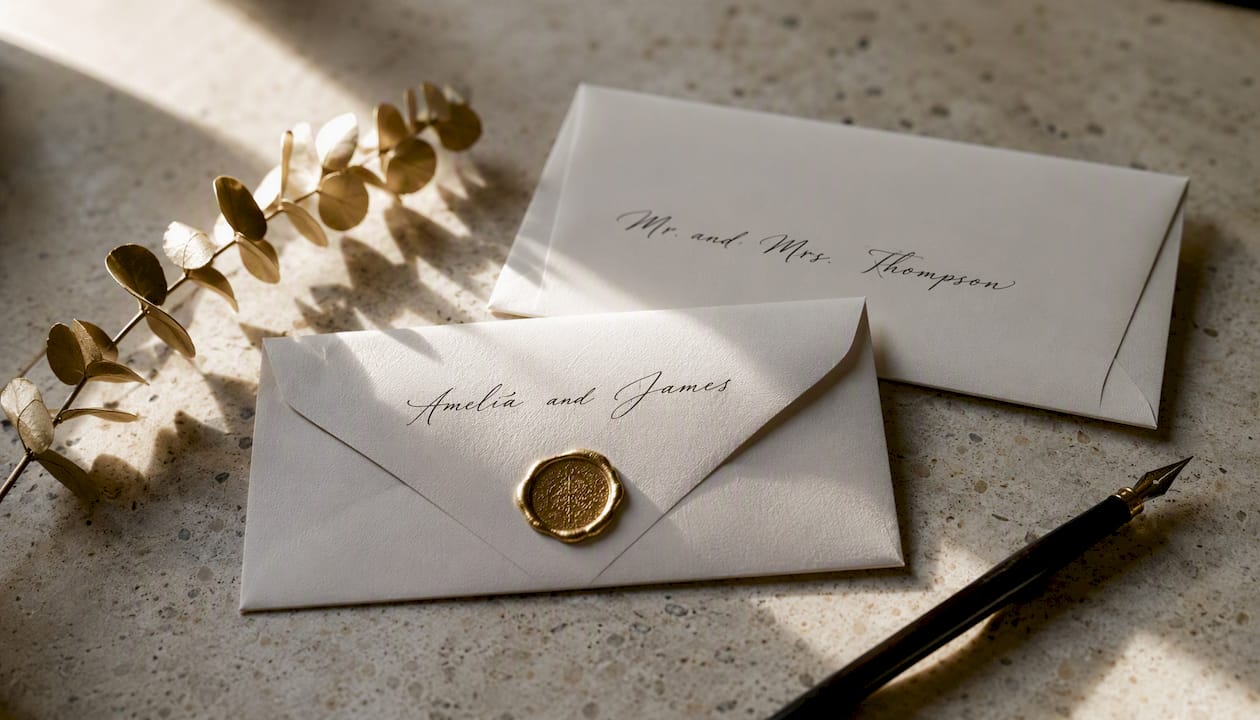
Recent name changes and preferred names: When in doubt about a guest’s current name, a quick call or text is far better than guessing. Greenvelope’s guide notes that guests appreciate the accuracy and the personal touch. For title preferences, use “Ms.” for women over 18 when marital status is unknown, “Mrs.” for married women who use it, “Miss” for younger girls, and “Mx.” for guests who use a gender-neutral title.
Incorrect addresses and returned mail: If a save-the-date comes back, update your spreadsheet immediately, find the correct address, and re-mail with a handwritten note if the timing is tight. Do not wait. A returned piece means that guest has no idea the wedding is happening.
Deceased guests: If a guest has recently passed away and their name appears on your list, simply omit them with discretion. There is no need for explanation on the envelope or card.
Group and institutional addresses: For guests in a dorm, military housing, or a shared office, use the full name plus department or mail stop: “Specialist James Ortega / 3rd Battalion, 75th Ranger Regiment / APO AE 09354.” For APO/FPO military addresses, USPS provides specific formatting guidelines that differ from standard domestic addresses.
Common mistakes to avoid (per Envelopes):
- Using nicknames on the outer envelope
- Omitting apartment numbers
- Abbreviating street words on formal envelopes
- Writing “and family” without specifying who is included
- Skipping the return address
Pro Tip: Treat save-the-date addressing as a practice run for your formal invitation suite. Confirm spellings and mailing addresses now, and you will avoid reprinting costs and awkward corrections when the formal invites go out.
The detail that actually matters most
There is a tendency to focus on the aesthetics of save-the-dates: the paper stock, the calligraphy, the wax seal. Those things matter, but the single most consequential decision is whether every invited adult appears by name on the envelope.
An envelope addressed only to “The Johnson Family” tells no one whether the adult children are invited, whether the plus-one is welcome, or whether the kids are included. That ambiguity creates real social friction, and it usually surfaces at the worst possible moment: when a guest calls to ask whether their partner is invited, three months before the wedding.
A consistent addressing policy, applied from the first envelope to the last, eliminates that friction. It also signals to guests that the invitation was considered and personal, not mass-produced. That impression carries forward to how guests feel about the wedding itself.
One practical shortcut worth knowing: mail your test envelope on a Monday. Weekend mail handling at many facilities is lighter, which means your test piece may not encounter the same sorting conditions as a Tuesday batch. Mailing mid-week gives you a more accurate read on how the full run will be handled.
Put your wedding website URL to work

Your save-the-date is the first place guests will look for your wedding website URL. Make sure that URL leads somewhere worth visiting. Getzelo lets you build a personalized event page where guests can contribute cash gifts toward the experiences and goals that actually matter to you, without the clutter of a traditional product registry. It’s a clean, modern alternative that fits naturally on a wedding website. Create your Getzelo event page before your save-the-dates go out, so the link is live when guests start looking.
Sources
The guidance in this article draws on the following authoritative sources. Each is worth bookmarking for reference as you finalize your save-the-date and formal invitation plans.
- How to Address Save the Dates: Every Scenario Covered - Paperlust
- A Guide to Addressing Correspondence - Emily Post
- How to Mail Save-the-Dates | VistaPrint US
- How to address save the dates | Greenvelope
- United States Postal Service - USPS
- How to Write a Save the Date (With Examples) | InviteDrop
Recommended
Enjoyed the article? Share it!