
The engagement glow is real. So is the registry confusion.
One minute, a couple is celebrating with prosecco and screenshots of venues. The next, they are staring at stand mixers, linen sets, honeymoon funds, and unsolicited opinions from relatives who got married in a totally different era. That spiral is normal.
A smart registry is not a random wish list. It is a practical, generous guide for guests and a snapshot of the life a couple is building together. For some, that means cookware and towels. For others, it means a honeymoon, a home project, or help funding a celebration that looks nothing like a traditional ballroom wedding.
Modern couples also need room for real life. Some already live together. Some are planning a second marriage or vow renewal. Some are hosting a destination wedding now and a party later. Traditional advice often skips those realities, even though Zola’s guidance for couples who already live together makes clear that many couples want a registry built around upgrades, experiences, and flexibility rather than basic starter items.
That is why learning how to create a wedding registry now requires more than picking plates. It requires intention. It should reflect the couple’s routines, values, priorities, and the way they want to be celebrated.
Reimagining Your Wedding Registry for 2026
A couple gets engaged in London, books a dinner in Lisbon for a planning weekend, and opens a shared note titled “registry ideas.” One partner adds espresso cups and a dutch oven. The other adds “mini moon train trip,” “house fund,” and “new sofa someday.” Both are right.

That is what a registry looks like now. It is not a test of whether a couple wants “proper” gifts. It is a chance to tell guests, clearly and gracefully, what would matter.
A registry should tell a story
The best registries feel personal without becoming precious. They show guests how to celebrate the couple well.
That might look like:
- A home-focused list with upgraded bedding, serving pieces, and a dining table fund
- A travel-focused registry with honeymoon experiences and a few practical household upgrades
- A minimal registry for couples who already have the basics and want flexible contributions instead
- A blended celebration registry for vow renewals, second marriages, or post-elopement parties
Couples should stop asking, “What are we supposed to register for?” and start asking, “What would make our next chapter easier, more beautiful, or more memorable?”
Old etiquette is not always useful etiquette
Plenty of registry advice still assumes a first apartment, a traditional wedding shower, and a household built from scratch. That is not most couples anymore.
Some are merging two fully furnished homes. Some want fewer objects. Some are inviting guests from multiple countries and need a simpler, digital-first option. Some are planning a wedding in Europe while family gives from the US or Australia. Flexibility is not a bonus now. It is the baseline.
A good registry removes guesswork for guests. A great registry also fits the couple’s actual life.
There is also a mindset shift happening. Guests increasingly understand that meaningful gifts are not limited to wrapped boxes. A contribution to a honeymoon dinner, home deposit, nursery setup, or graduation move-in fund can feel every bit as thoughtful when it is presented well.
For couples who are already leaning that direction, this look at why cash gifts are trending captures the bigger change nicely.
The new rule is simple
A registry should be easy to browse, easy to understand, and easy to feel good about.
That means clear goals. Thoughtful wording. A mix of options. No filler. No “just in case” junk. No giant list of things a couple does not even want in their home.
The registry is not about proving gratitude. It is about making generosity easier.
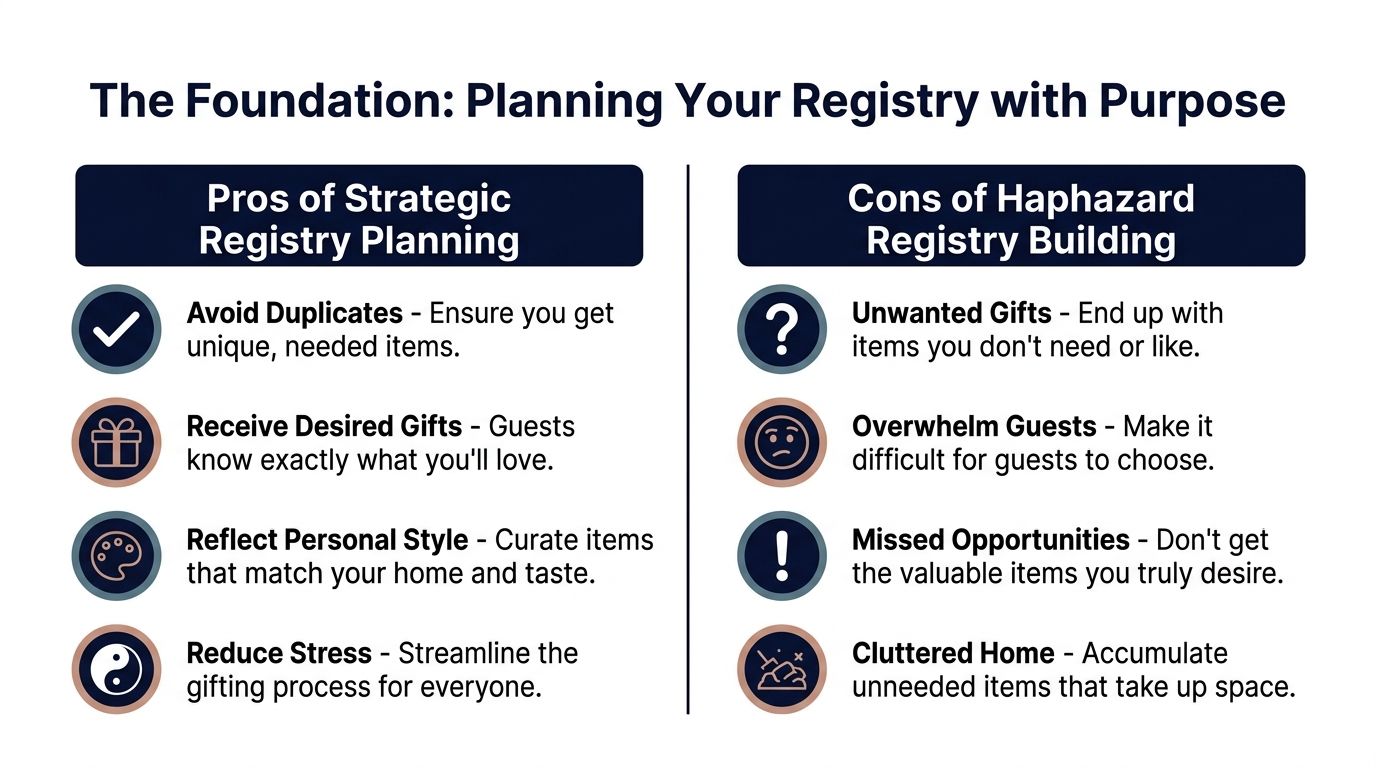
The Foundation Planning Your Registry with Purpose
The couples who love their registry later are usually the ones who paused before adding anything.
They did not start with products. They started with decisions.
Start with a life inventory
Before a couple chooses a single gift, they should walk room by room and ask a blunt question: what needs attention?
That inventory usually reveals one of three realities.
| Registry type | Best for | What it looks like |
|---|---|---|
| Traditional | Couples setting up a home or replacing lots of basics | Physical gifts such as cookware, sheets, glassware, towels, and hosting pieces |
| Cash-first | Couples who prioritize flexibility, travel, or a larger goal | Honeymoon funds, home funds, moving costs, or celebration-related experiences |
| Hybrid | Couples who want both useful objects and meaningful contributions | A curated retail list plus a few well-named funds |
Most couples do best with hybrid. It gives guests options and keeps the registry from feeling one-note.
Cash funds are mainstream now
This is not a fringe idea anymore. Over 70% of US couples now include cash registries for honeymoons or homes, up from under 10% in 2000, according to Chateau Bee Selection’s wedding registry guide. That same source notes average contributions of $150 per guest.
That shift matters because it reflects how people live now. Many couples do not need another toaster. They need flexibility, breathing room, and gifts that fit bigger life goals.
The right registry starts with the right conversation
A couple should decide these points before building anything:
- What do we already own well enough? Keep the good sheets. Skip the extra blender.
- What do we want to upgrade? Everyday items matter more than novelty gadgets.
- What would we never buy for ourselves, but would love to have? Special pieces belong there.
- What larger goal matters most right now? Honeymoon, home, renovation, relocation, or future planning.
- How do we want guests to experience our registry? Practical, playful, design-forward, travel-led, minimal.
If the answers feel mismatched, that is useful. Better to debate now than end up with a list that satisfies no one.
Use a simple planning filter
A solid registry usually includes items and funds that fit one of these categories:
Daily life Things used constantly. Better knives. Good bath towels. Reliable cookware.
Hosting Pieces that support dinners, holidays, and future gatherings.
Memory-making Honeymoon meals, museum tickets, train passes, cooking classes, weekend stays.
Big-picture goals Home deposit support, nursery planning, relocation, or a design upgrade that changes how the couple lives.
If a gift would sit in a cupboard untouched, it does not belong on the registry.
Keep the registry aligned with the celebration
A city wedding with a small dinner might inspire a sleek, edited list. A multiday celebration in Brazil might suit a travel-forward registry with funds for experiences and a handful of practical gifts. A vow renewal might call for almost no physical items at all.
The point is not variety for its own sake. The point is coherence.
For couples leaning toward meaningful experiences over more stuff, this guide on experience gift registries and memories over material things is a strong place to sharpen that vision.
What planners recommend most
The strongest recommendation is simple. Be selective, not sparse.
Guests want direction. They do not want to reverse-engineer what the couple might need. A registry with purpose feels confident. A registry built in a panic feels chaotic.
That early planning work is where confidence comes from.
Curating Your List Blending Physical Gifts and Cash Funds
Once the plan is clear, the registry becomes much easier to build. At this point, couples stop thinking in broad categories and start choosing what deserves a spot.
The first rule is essential. Wedding planning experts at The Knot and Minted advise couples to register for 2 to 3 times as many items as they have guests, and only about 60% of listed items are typically purchased, according to Minted’s wedding registry advice. Couples who under-list force guests into fewer choices and increase the odds of awkward off-registry buying.
Build breadth, not clutter
Over-registering does not mean adding nonsense. It means creating enough range that guests can choose something that fits their budget and style of giving.
A useful physical gift list often includes:
- Kitchen workhorses such as cookware, serving bowls, glassware, sheet pans, and a coffee setup
- Bed and bath upgrades like better pillows, towels, sheets, and a duvet worth keeping for years
- Hosting pieces including platters, candles, barware, cloth napkins, and casual dinnerware
- Home details such as frames, vases, storage, throws, and small furniture accents
- Lifestyle gifts that reflect real hobbies, from picnic gear to baking tools to gardening basics
The keyword is edited. A couple does not need six versions of the same thing.
Choose gifts at different spending levels
A registry should never trap guests at one price point. It should feel welcoming, not intimidating.
A practical way to curate the list:
| Gift tier | What belongs here | Why it matters |
|---|---|---|
| Accessible | Candles, linens, utensils, frames, bar tools | Gives friends and colleagues easy options |
| Mid-range | Cookware pieces, small appliances, quality bedding, serving sets | Covers the most common gifting zone |
| Higher-end | Furniture contributions, premium kitchen tools, statement home pieces | Gives close family and group gift givers room to go bigger |
This mix matters even more for international guest lists, where customs, shipping, and local shopping habits vary. Digital flexibility helps, but the gift mix should still feel broad.
What to skip
Couples should be ruthless here.
Do not register for:
- Aspirational clutter that looks pretty online but solves no real need
- Duplicates unless the item is something a household uses in multiples
- Trend pieces that will date quickly
- Emergency fillers added only to bulk up the list
- Anything difficult to store unless the couple is certain it will be used
A registry is not a department store audit. It is a short list of what fits the couple’s home and life.
The best registry item is not the fanciest one. It is the one the couple will still be glad they chose a year later.
Cash funds should be specific
The biggest mistake with cash funds is vagueness. “Cash fund” says nothing. “Our honeymoon train journey through Italy” gives guests a picture. “Living room sofa fund” feels more tangible than “home fund.” Good naming turns a transaction into participation.
Stronger examples include:
- First home paint and repairs
- Honeymoon dinners in Brazil
- Weekend escape after the wedding
- Custom framing for wedding photos
- Nursery setup for our growing family
- Graduate move-in essentials
- Birthday trip with our favorite people
This matters beyond weddings too. The same thinking works for baby showers, milestone birthdays, and graduations. A registry becomes more compelling when every fund has context.
Write fund descriptions that sound human
Each fund should answer three quiet guest questions:
- What is this for?
- Why does it matter to them?
- How will my contribution help?
A good description can be one or two lines. It does not need to be dramatic.
For example:
- For a honeymoon meal fund: “We’re planning slow dinners by the sea and would love help making those moments happen.”
- For a sofa fund: “We’ve waited to replace our tiny apartment sofa until after the wedding. This will go toward one we can host friends on.”
- For a graduation relocation fund: “This gift will help with the transition into a new city and a first post-grad home.”
Hybrid wins because it feels generous both ways
Physical gifts give guests the pleasure of choosing something tangible. Cash funds give couples flexibility. Together, they create a registry that serves everyone better.
A couple might register for:
- upgraded sheets
- an everyday dinnerware set
- a serving platter
- a coffee grinder
- a honeymoon museum pass fund
- a first-home repairs fund
- a group gift for a dining table
That is balanced. It gives structure without feeling rigid.
For couples ready to make that digital cash side central, a dedicated wedding cash registry keeps those goals organized and easy to share.
Bringing Your Registry to Life with Zelo
A registry platform should make setup feel quick, clear, and polished. If it feels clunky behind the scenes, guests feel that too.
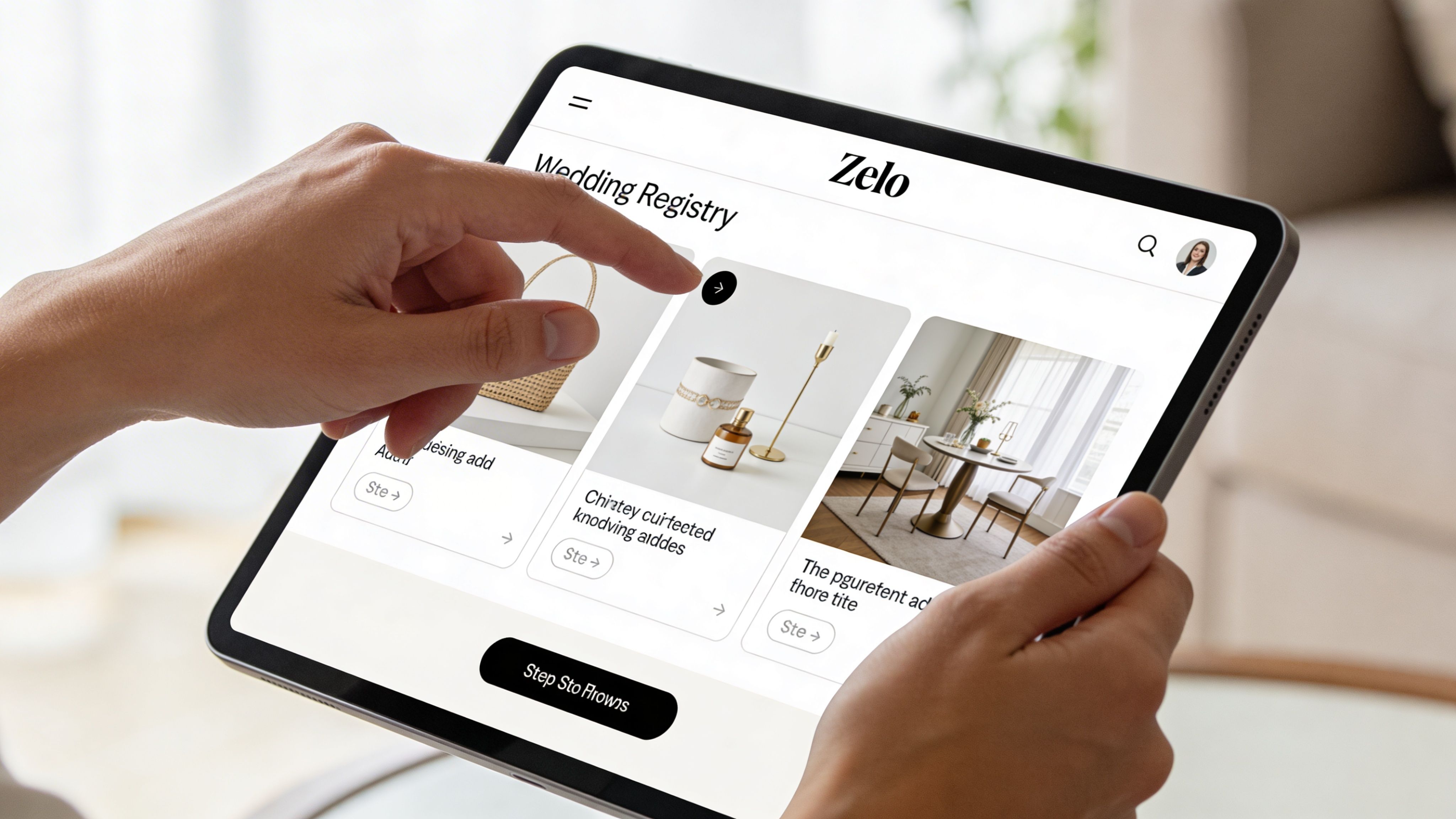
Start with the page itself
The strongest registry pages are clean and warm. Not overdesigned. Not blank.
A couple should begin with three basics:
- A cover photo that feels like them. It does not need to be formal.
- A short welcome message that thanks guests and explains the spirit of the registry.
- A simple event title that is easy to recognize when shared by text, email, or wedding website.
A good welcome note sounds like this: “We’re so grateful to celebrate with you. We’ve created a registry that reflects the home and experiences we’re building together.”
That is enough. Clear beats clever.
Add funds with names guests instantly understand
The platform's features matter here. Couples should be able to create funds quickly and customize them without friction.
The best approach is to add a few focused funds, not a long list of overlapping ones.
A polished setup often includes:
- one larger goal
- one experience-based fund
- one home-related fund
- one flexible catchall if needed
The names should be concrete. Guests should not have to click around to decode what “future adventures” means.
Keep the page visually coherent
Photos and descriptions should support the same story.
If the registry includes a honeymoon fund, add imagery that feels connected to that trip. If it is home-focused, keep the copy grounded in how the couple wants to live. If it is for a baby shower or graduation, the same rule applies. The page should feel intentional from top to bottom.
That consistency matters because digital registries are emotional. Guests are not just scanning features. They are deciding how they want to take part in a moment.
Make contributing easy
A registry page should work smoothly on mobile, because that is where many guests will open it. It should also make group gifting intuitive so larger goals do not feel awkward or inaccessible.
That is especially useful for:
- a honeymoon stay
- a nursery furniture upgrade
- a birthday trip
- a new-apartment setup after graduation
- a major home purchase for a wedding or vow renewal celebration
The easier it is for several guests to contribute toward one meaningful goal, the more realistic those bigger gifts become.
Think beyond the wedding day
A modern registry page should also handle different kinds of celebrations gracefully.
That includes:
- Second marriages where the couple wants thoughtful contributions, not more household basics
- Elopements with later parties where guests still want a way to celebrate
- Multi-location celebrations where physical gift logistics become messy
- Baby showers and birthdays where one shared page is simpler than multiple text threads
- Graduations where friends and family want to support a next-step milestone
This is one reason digital gift pages have become so useful across the US, UK, Europe, Brazil, and Australia. They fit celebrations that do not follow one old script.
Keep trust front and center
Guests should feel safe using the registry. Couples should feel confident sharing it.
A clean payment experience matters, especially for cross-border families and modern guest lists that include friends, coworkers, and relatives of different ages. Simple payment flows remove hesitation.
If a guest can understand the page in seconds, the registry is doing its job.
For couples ready to put all of that into one place, they can start your Zelo page and create a registry that feels current, personal, and easy to use.
Sharing and Managing Your Registry with Grace
Most registry stress does not come from creating it. It comes from sharing it without sounding awkward and managing it once gifts start coming in.
That part deserves more attention than it gets.
Share it where it belongs
The registry should be easy to find, but not pushed into places where it feels transactional.
Best practice is simple:
- Put it on the wedding website
- Include it in shower communications if appropriate
- Share it directly when someone asks
- Do not print it on the formal wedding invitation
That last point still matters. The invitation is about the event. The wedding website handles logistics.
For broader etiquette guidance, couples can compare advice from The Knot, Brides, and BabyCenter depending on the type of celebration they are planning.
Use wording that sounds gracious
Registry wording should feel appreciative, never salesy.
A few clean examples:
- “Your presence is the best gift. If you’d like to give something, we’ve shared a registry on our website.”
- “We’re so grateful to celebrate with you. For friends and family who’ve asked, we’ve put together a small registry.”
- “We’ve created a registry with a mix of home gifts and future plans if you’d like to contribute.”
None of that sounds demanding. It sounds organized.
Manage the post-purchase experience properly
Traditional registries often break down at this stage.
A major pain point in traditional registries is managing what happens after purchase, especially duplicate gifts and group contributions, as noted in 1899 Events’ wedding registry article that makes sense. That same piece highlights the value of transparent, real-time contribution tracking because guests can see what has already been funded and what remains.
That is not a minor convenience. It changes the guest experience.
Without visibility, people guess. They wonder if the sofa has already been covered. They worry their contribution is redundant. They text siblings and cousins to coordinate. It gets messy fast.
With real-time tracking, the process feels calm. Guests can contribute confidently. Couples avoid awkward overlap. Large gifts become easier to manage.
Keep your registry alive, not static
A registry should not be built once and ignored.
A couple should check it regularly and ask:
- Are the remaining options still balanced?
- Have our priorities changed?
- Does the page still feel current?
- Do guests still have enough variety?
If something no longer fits, remove it. If one category is wiped out, add a few thoughtful replacements. A good registry evolves a little as gifting begins.
Registry etiquette is not about being formal. It is about making generosity feel easy and appreciated.
Thank people promptly and specifically
Vague gratitude is forgettable. Specific gratitude lands.
Good thank-you notes mention:
- the exact gift or contribution
- why it matters
- how the couple plans to use or enjoy it
For example: “Thank you for contributing to our honeymoon dinner fund. We’re excited for slow meals together after the wedding, and we’ll think of you when we toast there.”
That feels personal because it is personal.
After the Celebration Post-Wedding Registry Tasks
Once the wedding ends, the registry still needs a proper finish. Couples who handle this quickly feel far more organized afterward.
Use the gifts the way they were intended
Cash gifts should not sit untouched because the couple is too tired to decide what happens next.
A practical post-wedding checklist looks like this:
Transfer funds and sort them by goal Keep honeymoon money, home money, and flexible gifts mentally separate even if they land together.
Make the first meaningful purchase That could be booking a hotel, ordering the sofa, paying for frames, or covering a repair. Momentum matters.
Review remaining physical gifts For hybrid registries, check what was purchased, what still matters, and what no longer does.
Use store completion perks if relevant If a couple kept a small retail registry, this is the moment to decide whether any unpurchased items are still worth buying.
Write thank-you notes while details are fresh
The best thank-you notes are timely and concrete. They do not need to be long. They do need to sound like a real person wrote them.
A useful structure:
- Thank them for the gift
- Name it specifically
- Say how it will be used
- Add one warm personal line
Examples:
- “Thank you for the serving bowl. We already know it will come out for family dinners.”
- “Thank you for contributing to our home fund. It helped us choose pieces we’ll use every day.”
- “Thank you for celebrating our graduation and helping with our move.”
For couples who want help with phrasing, these gift thank-you message templates can make the process faster without making it sound canned.
Close the registry cleanly
Do not leave the page hanging around indefinitely.
Once the main wave of gifts is over:
- confirm all contributions are accounted for
- send the final thank-you notes
- archive or deactivate the registry
- save any photos or wording the couple wants to keep
That closeout matters more than people think. It turns the registry from an open task into a completed chapter.
Frequently Asked Questions About Wedding Registries
What if guests buy off-registry gifts anyway
Thank them warmly and receive the gift graciously. A registry is guidance, not a guarantee. If the item is useful, enjoy it. If it is not a fit, handle exchanges or regifting privately and with tact.
Is it rude to ask for cash instead of physical gifts
No. It is only awkward when it is presented vaguely or bluntly. A well-written fund with a clear purpose feels thoughtful and modern. Guests usually appreciate knowing what will help.
Can a couple have a small retail registry and a primary cash registry
Yes. That is often the best balance. A concise retail list satisfies guests who love giving a physical gift, while the main registry can focus on larger goals and experiences.
What if the couple already has everything
They probably do not have everything. They may not need more household basics. In that case, register for upgrades, meaningful experiences, or future-focused contributions. If they prefer no gifts, they can say so kindly and still prepare for guests who insist.
Should registry information go on the wedding invitation
No. Put it on the wedding website instead. If someone wants gift details, they will find them there without the invitation feeling transactional.
Can this approach work beyond weddings
Absolutely. The same registry strategy works beautifully for baby showers, birthdays, graduations, and milestone celebrations. The principle stays the same. Give people an easy, thoughtful way to celebrate with purpose.
A modern registry should feel like the couple, not a default template. If they want a flexible, digital-first way to collect meaningful contributions for weddings, baby showers, birthdays, graduations, and more, they can explore Zelo and create your gift registry in a way that feels personal, polished, and easy for guests to use.
Enjoyed the article? Share it!