Recipients of wedding gifts do not report those gifts as taxable income on their federal return. The donor is the one who may need to act. If you gave more than a recognized annual exclusion amount to any single person in a calendar year, check IRS gift tax guidance and confirm whether you need to file Form 709. That filing is usually a disclosure step, not a tax bill.
Key Takeaways
Recipients of wedding gifts owe no income tax on those gifts; the donor is responsible for filing Form 709 when gifts to one person exceed the annual exclusion of approximately $19,000 in a calendar year.
| Point | Details |
|---|---|
| Recipients owe no income tax | Cash and physical wedding gifts are not taxable income; newlyweds do not report them on a federal return. |
| Donors file Form 709 when required | Gifts above the ~$19,000 annual exclusion per recipient trigger a filing requirement, even if no tax is owed. |
| Excess reduces lifetime exemption | Amounts above the annual exclusion reduce the donor’s ~$15 million lifetime exemption before any tax applies. |
| Document transfers and vendor payments | Keep gift letters, bank records, and platform CSVs; note who signed vendor contracts for any direct payments. |
| Consult a pro for complex situations | Large gifts near the lifetime exemption, trust transfers, or non-U.S. persons warrant a CPA or estate attorney. |
Table of Contents
- Are wedding gifts taxable to the recipient?
- When does the giver need to report or pay gift tax?
- Common wedding scenarios that change how a transfer is classified
- How to file Form 709: a step-by-step checklist
- Worked examples: $5,000, $50,000, and $100,000 gifts
- Documentation tips for couples and hosts using cash-gifting platforms
- When should you talk to a tax pro or estate attorney?
- Sources
Are wedding gifts taxable to the recipient?
The short answer: no. Northwestern Mutual confirms that cash wedding gifts are not considered taxable income, and newlyweds do not report them on a federal income tax return. That rule holds regardless of how the gift arrives — a check in an envelope, a bank transfer, a Venmo payment, or a PayPal contribution through a cash-gifting platform.
There are a few situations where tax consequences can show up later, even when the original gift was clean:
- Income produced by gifted property. If a donor gives rental property or dividend-paying stock, the income that property generates after the transfer is taxable to the recipient.
- Selling gifted property. The recipient takes the donor’s original cost basis. A low basis can mean a larger capital gain when the property is eventually sold.
- Gifts that look like loans. A large transfer without documentation of intent can be reclassified. A short gift letter removes that ambiguity.
The method of delivery does not change the tax status. Cash, checks, and app transfers are treated identically under federal rules, as LegalClarity notes.
Pro Tip: For any cash gift above a few thousand dollars, ask the donor to write a brief gift letter stating the amount, the date, and that no repayment is expected. One paragraph is enough, and it protects both parties if questions arise later.
When does the giver need to report or pay gift tax?
The IRS treats virtually every transfer of value as a taxable gift by default, but a set of exclusions covers most wedding gifts entirely. Understanding how those exclusions stack determines whether a donor files anything at all.
The annual exclusion and present-interest requirement
The annual exclusion lets a donor give up to a set dollar amount to any one recipient in a calendar year without triggering a filing requirement. For 2025 and 2026, Fidelity reports that figure at approximately $19,000 per recipient. Confirm the current-year amount on IRS.gov before filing, since the IRS adjusts it periodically for inflation.
One condition applies: the gift must be a “present interest,” meaning the recipient can use or enjoy it immediately. A direct cash gift or a contribution to a couple’s cash registry qualifies. Certain conditional transfers or gifts placed in some types of trusts may not, because the recipient cannot access the funds right away. The IRS gift tax FAQ covers this distinction in detail.
The lifetime exemption and how excess gifts reduce it
Gifts above the annual exclusion do not automatically create a tax bill. Instead, the excess reduces the donor’s lifetime gift-and-estate tax exemption. Fidelity reports that exemption at approximately $15 million per person for 2026. Most donors never exhaust it, which means Form 709 functions as a tracking document rather than a payment notice for the vast majority of filers.
LegalClarity emphasizes that failing to file when required can lead to penalties, even when no tax is owed. Filing protects the donor’s record.
Gift-splitting for married donors
Married donors can elect to split a gift, treating it as if each spouse gave half. That effectively doubles the annual exclusion per recipient. One important exception: if the recipient spouse is not a U.S. citizen, the standard marital deduction does not apply, and different rules govern transfers between spouses.
| Mechanism | 2025/2026 figure | What it does |
|---|---|---|
| Annual exclusion | ~$19,000 per recipient | Gifts at or below this amount require no filing |
| Lifetime exemption | ~$15 million per person | Excess above annual exclusion reduces this before tax is owed |
| Top gift tax rate | 40% | Applies only after the lifetime exemption is fully exhausted |
Confirm all dollar figures on IRS.gov for the current tax year before filing.
Common wedding scenarios that change how a transfer is classified
Not every payment connected to a wedding is a gift. The classification depends on who controlled the spending, who signed the contracts, and who actually benefited.
Brown Advisory explains that characterization is the central question: a payment that looks like generosity can be a hosting expense, a gift, or something in between, depending on those facts.
- Cash in an envelope to the couple. A direct transfer to the newlyweds is a gift. The donor’s annual exclusion applies.
- Parents paying a vendor directly when the couple signed the contract. If the couple chose the vendor and signed the agreement, the parents’ payment likely functions as a gift to the couple, not a hosting expense.
- Parents hosting and controlling the guest list. When parents select the venue, sign all contracts, and invite their own guests, that spending may be a hosting cost rather than a gift to the couple.
- Parents buying jewelry given to the recipient. A direct transfer of property to the recipient is a gift; the fair market value counts toward the annual exclusion.
- Paying honeymoon costs directly to a travel vendor. If the couple chose the trip, the payment is likely a gift. If the parents selected and booked the trip themselves, the analysis is less clear.
The control-and-benefit test is the practical tool tax professionals use. Red flags worth noting: large unexplained transfers, vendor payments charged to the couple but paid by a relative, and gifts of income-producing property like rental real estate. Any of those situations warrants a conversation with a CPA before filing.
There is no wedding-specific exception in the tax code, as Brown Advisory notes. For high-cost celebrations, careful allocation between hosting costs and transfers of wealth can make a meaningful difference.
How to file Form 709: a step-by-step checklist
Form 709 is required when a donor gives more than the annual exclusion to any one person in a calendar year, and in certain other situations such as gifts of future interests. The Form 709 instructions walk through each line, but the process follows a consistent sequence.
- Gather gift details. For each gift, record the recipient’s full name and address, your relationship to them, the date of the transfer, and the fair market value on that date.
- Identify the annual exclusion used. Subtract the applicable annual exclusion from the total gifts to each recipient. Only the excess is reportable.
- Compute the taxable gift. Add up the excess amounts across all recipients for the calendar year.
- Decide on gift-splitting. If you are married and want to split gifts with your spouse, attach a signed consent statement. Both spouses must sign, and both may need to file Form 709.
- Apply prior lifetime exemption usage. If you have filed Form 709 in prior years, carry forward the cumulative exemption used. The current year’s excess reduces what remains.
- Complete and file. Form 709 is filed separately from your income tax return, but it shares the same due date: April 15 of the year following the gift. An extension of time to file your income tax return automatically extends Form 709 as well, but it does not extend the time to pay any gift tax owed.
Keep a copy of every filed Form 709. The IRS can request prior returns when calculating estate tax at death, and a complete filing history protects your estate.
Worked examples: $5,000, $50,000, and $100,000 gifts
These examples use the approximate 2025/2026 annual exclusion of $19,000 per recipient. Verify current figures on IRS.gov before applying them to an actual return.
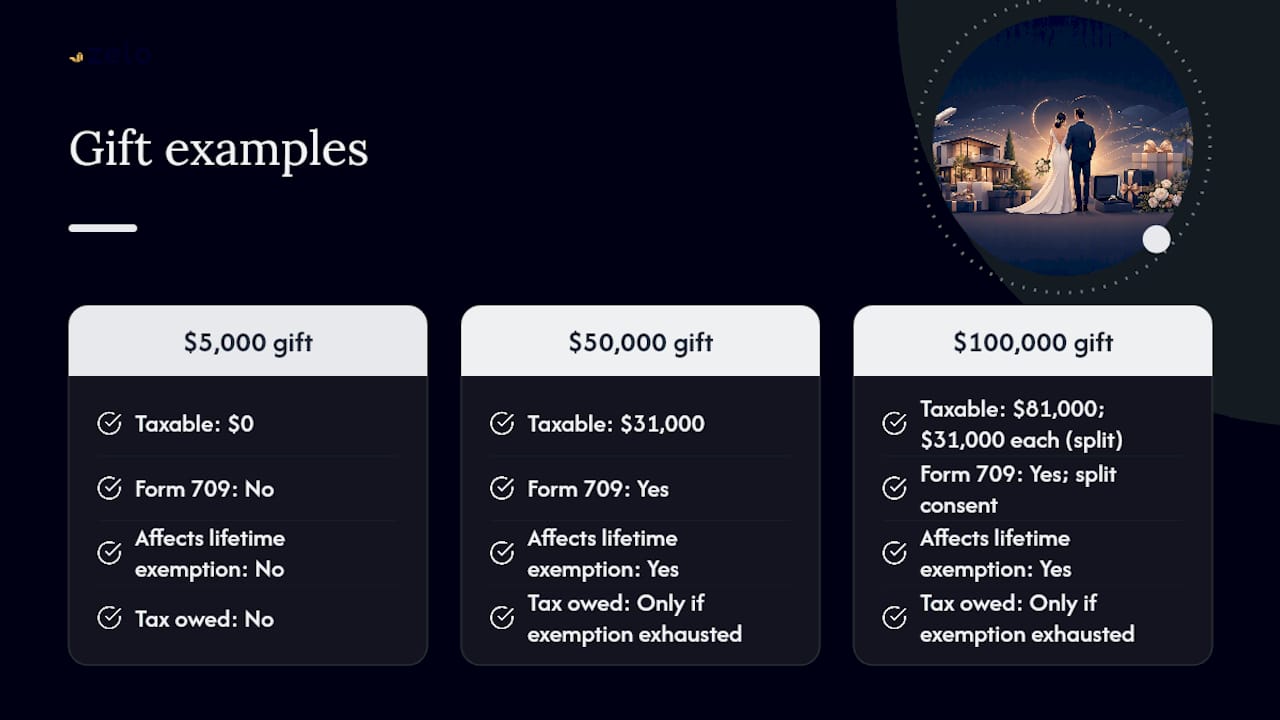
Example 1: $5,000 cash gift. A guest hands the couple a $5,000 check. That amount falls well below the annual exclusion. No Form 709 is required, no lifetime exemption is affected, and no tax is owed. The donor keeps a copy of the check for records.
Example 2: $50,000 gift from one donor. A parent writes a $50,000 check directly to the couple. After subtracting the $19,000 annual exclusion, $31,000 is a taxable gift. The donor files Form 709 and that $31,000 reduces their remaining lifetime exemption. No tax is owed unless the donor has already used most of their lifetime exemption. Documentation to keep: the check, a gift letter, and a copy of the filed Form 709.
Example 3: $100,000 gift, single or married donor. A single donor giving $100,000 reports an $81,000 taxable gift and files Form 709. A married donor who elects gift-splitting can treat the gift as $50,000 from each spouse, reducing each spouse’s taxable gift to $31,000. Tax is only owed when the cumulative lifetime exemption is exhausted, which requires total lifetime gifts well above $15 million for most families. Both spouses must sign the gift-splitting consent and may each need to file Form 709 for that year.
Documentation tips for couples and hosts using cash-gifting platforms
Good records protect both the couple and the donor. They are not about disclosing gift amounts publicly; they are about having a clear paper trail if the IRS ever asks a question.
For hosts (couples receiving gifts):
- Save event page receipts and any platform confirmation emails.
- Export a CSV of all contributions, including guest names, amounts, and dates, immediately after the event. Platforms like Getzelo make this straightforward through the host dashboard.
- Keep screenshots of any gift letters or personal messages that confirm a transfer was a gift.
- Retain bank deposit records showing when funds were received.
For donors:
- Keep the transfer confirmation: a check stub, bank statement, or app receipt.
- Write a brief gift letter for any large transfer and keep a copy.
- For vendor payments, retain the contract showing who signed it, the invoice, and your payment record.
- Note the date and amount alongside the recipient’s name in a simple spreadsheet.
Pro Tip: Export your contribution report from the platform the same week as the event, before details fade. Attach it to a folder with your bank deposit confirmation and any gift letters. That single folder covers most documentation questions a CPA would ask.
The LegalClarity guide on tax-free wedding gifts reinforces that payment method does not change tax status, but a contemporaneous paper trail materially reduces friction if questions arise. For hosts building a cash fund registry, the platform’s export tools do most of the work.
When should you talk to a tax pro or estate attorney?
Most wedding gifts are simple enough to handle with the IRS guidance and the checklist above. A few situations call for professional input before filing anything.
- Gifts that together approach or exceed the lifetime exemption. At that scale, the interaction between gift tax and estate tax planning is complex enough to warrant an estate attorney.
- Vendor payments where control and benefit are ambiguous. If it is genuinely unclear whether a payment is a hosting expense or a gift, a CPA can apply the control-and-benefit test to the specific facts.
- Gifts involving trusts or future interests. These may not qualify for the annual exclusion and require careful drafting.
- Gifts from or to non-U.S. persons. Different reporting rules apply, including potential Form 3520 requirements for large gifts from foreign nationals.
- Any IRS notice or audit related to gift tax. Respond only after consulting a tax professional.
When you do consult a CPA or estate attorney, bring the contracts, payment records, and any prior Form 709 filings. The more complete the documentation, the faster the analysis.
For complex celebrations, Wealthmanagement that the more expensive the event, the more important it is to document who controlled contracts and guest lists so spending can be allocated correctly between hosting costs and gifts.
A practical perspective on what actually trips people up
The two most common mistakes are not documenting vendor payments and assuming the recipient needs to do something. Recipients almost never need to act. The gift tax system places the obligation squarely on the donor, and most donors never owe a dollar because the lifetime exemption is large enough to absorb years of generous giving.
What does create problems is the paper trail gap. A parent pays a caterer directly, no one writes down who signed the contract, and two years later there is no clear answer to whether that was a hosting expense or a $40,000 gift. A single page of notes at the time of the event would have resolved it.
For couples using a cash-gifting platform, the documentation question is largely solved. The platform generates a timestamped record of every contribution. Pair that export with a bank deposit confirmation, and the couple has everything a CPA would ask for. The donor side is equally simple: a bank receipt and a short gift letter cover the intent question cleanly.
Most wedding gifts do not create a tax bill. The filing requirement, when it exists, is mainly a disclosure that reduces a lifetime exemption most people will never exhaust. Understanding that distinction removes most of the anxiety around this topic.
Sources
For current-year dollar amounts and official filing rules, go to the primary IRS pages first. Dollar thresholds adjust for inflation and the IRS publishes updates before each filing season.
- Frequently asked questions on gift taxes | Internal Revenue Service
- Are Wedding Gifts Taxable? | Northwestern Mutual
- Wedding Bells & Tax Questions: When Family Funded Celebrations Become Gifts | Brown Advisory
- Lifetime estate gift tax & annual gift exclusions | Fidelity
Prefer IRS primary pages for any figure you plan to use on an actual return. Third-party explainers are useful for context, but the IRS publishes the authoritative numbers.
This article provides general information about U.S. federal gift tax rules and is not a substitute for professional tax or legal advice. Confirm current-year figures and filing requirements with IRS.gov or a qualified tax professional before filing.
Recommended
Enjoyed the article? Share it!