When couples or hosts set up a cash gift registry, one term comes up repeatedly: “cash out.” The phrase sounds straightforward, but it creates real confusion because it carries very different meanings depending on the context. Some people search for “registry cash out” and land on articles about closing retirement accounts. Others assume it works like a gift card redemption. In reality, registry cash out refers specifically to withdrawing guest-contributed funds from a registry platform and transferring them to a bank account or other payout method. This guide clears up the confusion and walks milestone hosts through exactly how the process works.
Table of Contents
- What does registry cash out mean?
- How does registry cash out work across platforms?
- What fees, delays, and rules should you watch for?
- How to make the most of registry cash out for milestone events
- A host’s perspective: Why the simple cash-out process can still trip up the unprepared
- Ready to set up a registry that makes cash out easy?
- Frequently asked questions
Key Takeaways
| Point | Details |
|---|---|
| Clear cash out definition | Registry cash out means withdrawing contributed funds from an event registry into your chosen account. |
| Platform differences matter | Payout speeds, access methods, and terms can vary greatly by registry provider. |
| Watch transaction fees | Always check who pays platform transaction fees and factor this into your event planning. |
| Match registry to event needs | Choose a registry with cash out features that fit your specific celebration and payout timeline. |
What does registry cash out mean?
Having set the expectation for clarification, let’s define what registry cash out means and what it doesn’t.
In the context of gift registries, “cash out” describes the act of transferring money that guests have contributed through a cash fund registry to the host’s bank account or preferred payout method. Think of it like a digital collection bowl. Guests contribute funds online, those funds accumulate on the platform, and then the host requests a payout or withdrawal. That withdrawal is the “cash out.”

Mechanically, cash-fund registries behave like online checkout experiences, where a guest selects an amount, completes a payment, and the couple accesses the resulting balance. No physical item ships. No gift wrap is needed. The funds simply move through the platform and become available to the host.
Here is what registry cash out covers:
- Guest contributions: Guests visit the registry page and contribute a chosen amount to a specific fund (honeymoon, down payment, birthday experience, etc.)
- Platform balance: Contributions accumulate in the host’s account on the platform
- Payout request: The host initiates a withdrawal to their bank account, debit card, or digital wallet
- Transfer completion: Funds arrive in the host’s account based on the platform’s processing timeline
It is equally important to know what registry cash out does not mean. “Cash out” in financial planning often refers to something very different. For example, cashing out a 401(k) means closing a retirement account and converting invested funds to cash, which typically triggers taxes and penalties. That has absolutely nothing to do with a wedding or birthday registry.
Gift card redemption is another unrelated use of the term. Some states allow consumers to redeem small gift card balances for cash, which is a retail policy, not a registry feature.
“Registry cash out” in the gifting world is simply the transfer of guest contributions from a platform to the host’s account. It is not a financial product, investment, or legal transaction.
Understanding this distinction saves hosts from hours of confusion when researching platforms. It also helps explain why cash gifts are trending as a preferred alternative to traditional gift registries filled with physical products. People want flexibility, and cash funds deliver that directly.
How does registry cash out work across platforms?
Now that you know what cash out means, let’s walk through how it actually works when you use a registry platform.
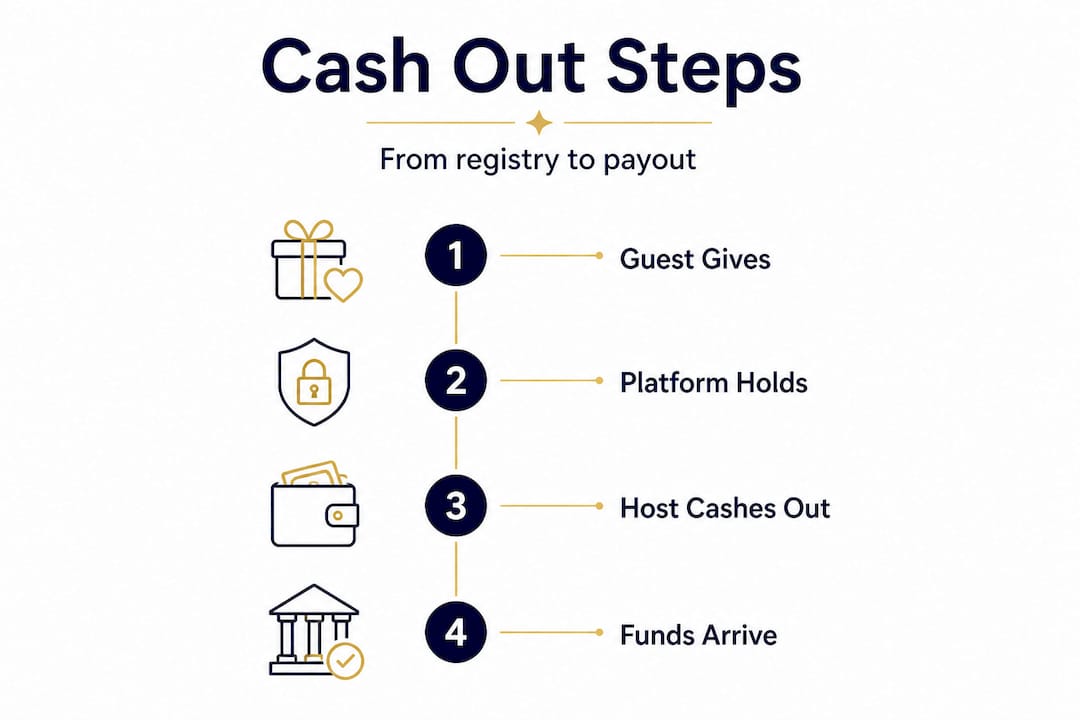
The general flow is consistent across most major registry platforms, but the speed, access method, and notification style can vary significantly. Here is the standard step-by-step process:
- The host creates a cash fund. This could be labeled “Honeymoon Fund,” “Birthday Adventure,” “Baby Nursery,” or any meaningful category tied to the celebration.
- Guests visit the registry page. They choose an amount to contribute and complete a secure checkout.
- The platform processes the payment. Funds are collected via a third-party payment processor and held in the host’s account balance on the platform.
- The host receives a notification. An email confirmation is typically sent to both the guest and the host when a contribution is made.
- The host requests a cash out. This can be done at any time or at set intervals depending on the platform.
- Funds transfer to the host’s preferred method. Bank account, debit card, or digital wallet are the most common options.
Speed is one of the biggest differentiators between platforms. Honeyfund, for instance, markets that couples receive immediate access to contributed funds. Other platforms may process payouts within one to five business days depending on bank processing times.
Here is a comparison of how three popular registry platforms handle cash outs:
| Platform | Payout speed | Access methods | Notification sent? |
|---|---|---|---|
| The Knot Cash Fund | 1 to 5 business days | Bank transfer | Yes, email |
| Honeyfund | Immediate to 1 business day | Bank transfer, wallet | Yes, email |
| Zola | 3 to 5 business days | Bank transfer | Yes, email |
For hosts planning a milestone event, payout speed matters more than it might seem. If a couple wants to use honeymoon funds before their trip, they need to know when those funds will actually arrive. The same applies to a birthday host who wants to book an experience using gifted contributions. Assuming “immediate” access without confirming platform terms is one of the most common planning mistakes.
Building a strong gifting experience also depends on how the registry is structured. Learning from a collaborative gift registry model can help hosts design cash fund categories that feel intentional and meaningful to guests. Similarly, hosts planning annual events can benefit from a birthday party registry guide to understand how to frame cash contributions in a way that resonates with guests.
Pro Tip: Before finalizing your registry platform, test the cash-out flow yourself by going through the full guest checkout experience and reviewing the payout options available in your account settings.
What fees, delays, and rules should you watch for?
Understanding the process is only half the story. Let’s examine the crucial small print: fees, waits, and payout policies.
Fees are the most overlooked aspect of registry cash outs. Many platforms charge a credit card transaction fee, which may be paid by the guest or the couple depending on the platform’s settings or policy. On some platforms, this fee is built into the checkout so guests see a slightly higher total. On others, the fee is deducted from the host’s payout. Neither approach is inherently better, but hosts should know which applies so they can communicate clearly to guests and set accurate funding goals.
Here is a summary of common fee and delay scenarios:
| Fee or delay type | Typical range | Who pays | Notes |
|---|---|---|---|
| Credit card processing fee | 2.9% + $0.30 per transaction | Guest or host | Varies by platform setting |
| Bank transfer fee | $0 to $2 per transfer | Host | Often waived for ACH transfers |
| Payout delay | 1 to 5 business days | N/A | Affected by banking hours |
| Minimum payout amount | $20 to $50 | Host | Check platform terms |
| Identity verification hold | Varies | Host | Required for first payout on most platforms |
Beyond transaction fees, there are several other rules to watch for:
- Bank transfer minimums. Some platforms require a minimum balance before a cash out can be initiated. This can delay access if contributions are small or spread out.
- Identity verification. Most platforms require identity verification before releasing funds. This is a fraud prevention measure, but it can create delays if the host hasn’t completed the process in advance.
- Unclaimed funds policies. Honeyfund’s Terms describe that payments are collected via third-party processors and relate to a Honeyfund Wallet gift-card balance, with specific rules for unclaimed funds handling. If a host doesn’t claim funds within a set period, the platform may issue a gift card balance or process a final payout automatically.
- Currency and international considerations. Hosts expecting contributions from international guests should confirm whether the platform supports non-U.S. payment methods.
For hosts planning a wedding, exploring wedding cash registry best practices can help identify platforms with transparent fee structures and reliable payout schedules. Hosts organizing a baby shower should also review baby shower budget tips to ensure registry fund timing aligns with actual purchase needs.
Pro Tip: Complete your platform’s identity verification process as soon as you create your registry, not when you’re ready to cash out. Waiting until the last minute can delay access to funds you need for time-sensitive event purchases.
How to make the most of registry cash out for milestone events
With the mechanics and fine print in mind, here’s how to actually use registry cash out features to improve your milestone event planning.
The most practical framework for registry cash outs involves three core steps:
- Choose meaningful cash-fund categories. Rather than creating one generic “give us money” fund, break contributions into specific purposes. For a wedding, this might include “Honeymoon Flights,” “First Home Down Payment,” and “Date Night Fund.” For a birthday, it could be “Concert Tickets,” “Cooking Class,” or “Weekend Trip.” Specific categories help guests feel like their contribution matters and increases the likelihood they’ll give.
- Understand who pays any transaction or processing fee. As noted earlier, confirm the fee structure upfront, including who absorbs the cost and how it affects your net payout. If the platform allows you to cover the guest’s fee, consider whether doing so fits your budget and whether it might encourage larger contributions.
- Confirm payout timing and method before your event date. If you plan to use registry funds to pay for an event component (catering, a photographer, an experience), work backward from the payment due date. Know your platform’s processing time and request your cash out with enough lead time to avoid a gap.
Beyond the steps, there are specific mistakes that milestone hosts make repeatedly.
Waiting until after the event to cash out. Some hosts assume they’ll have full access to funds weeks later. Platform policies change, and some funds have expiration windows.
Choosing a platform based on design alone. The registry page might look beautiful, but if the cash-out process is slow or fee-heavy, it will create friction at the worst possible time.
Not communicating cash gift intent to guests. Guests sometimes hesitate to contribute to a cash fund because they’re unsure it’s truly welcomed. A short note on the registry page explaining the purpose of the fund goes a long way in increasing guest participation.
For birthday cash gifts, the categories should reflect the honoree’s actual interests and near-term plans. For baby showers, a baby shower cash registry guide offers a detailed breakdown of how to structure funds around genuine baby-prep needs.
Pro Tip: Double-check that your registry’s payout method matches how you actually plan to use the funds. If you need to pay a vendor via check or ACH, confirm your platform supports a bank transfer and not just a digital wallet that adds another step.
A host’s perspective: Why the simple cash-out process can still trip up the unprepared
Before you move to set up your registry, consider this perspective from hosts who’ve navigated the system firsthand.
Every registry platform markets its cash-out process as simple, and in many cases, it genuinely is. But “simple” often means the basic flow works without friction. What platform marketing rarely prepares hosts for is everything that happens when their situation doesn’t fit the standard scenario.
The phrase “cash out” itself is part of the problem. Overloaded terminology causes confusion not just for hosts but for guests too. A guest who reads “cash fund” might wonder if the couple will literally receive an envelope of bills. Another guest might confuse it with a store credit redemption. These misunderstandings are small but they add up, especially when hosts haven’t included a clear explanation on their registry page.
Hosts who navigate the process smoothly tend to do one thing differently: they verify every assumption before the event, not after. They confirm whether their bank is compatible with the platform’s transfer method. They check whether identity verification is needed and complete it immediately. They read the unclaimed funds clause so they know the window they’re working within.
There is also a guest experience dimension that many hosts underestimate. When a guest contributes to a cash fund and receives only a basic email receipt, the experience can feel transactional rather than meaningful. Platforms that allow hosts to send personalized thank-you messages and show progress toward a goal create a much stronger emotional connection. That connection makes guests more likely to contribute generously, and it reflects well on the host’s celebration overall.
Prioritizing experiences over material things is a growing preference among modern gift-givers, and cash registries align perfectly with that shift. But the registry platform has to support that intention with a cash-out process that is transparent, timely, and actually hassle-free, not just marketed as such.
The extra two minutes spent reading your platform’s payout terms is almost always worth it.
Ready to set up a registry that makes cash out easy?
You’ve got the clarity. Now take the next step toward a meaningful, hassle-free cash gift experience.
Zelo is designed for hosts who want a registry that actually delivers. From birthdays to baby showers to weddings, the platform lets you create personalized event pages where guests contribute with ease and you access funds without unexpected friction.

Whether you’re looking to set up a birthday cash registry or need a complete gift fund solution for a major milestone, Zelo keeps the process transparent from the first contribution to the final payout. No confusing fee structures. No buried payout policies. Just a clean, customizable registry experience that puts your celebration at the center. Start your registry with Zelo and give your guests a simple, meaningful way to contribute toward what actually matters to you.
Frequently asked questions
Can I access wedding registry cash gifts immediately?
Most platforms, including Honeyfund, offer immediate access to funds or very fast processing, but hosts should confirm their specific registry’s payout policy before assuming instant availability.
Who pays the transaction fee on cash-fund registries?
It varies by platform. Transaction fees may be paid by the guest, the couple, or split between both, so reviewing your registry’s settings and terms before launch is essential.
Is cashing out a registry the same as cashing out a retirement plan?
No. Registry cash outs transfer event gift contributions to your account, while retirement cash outs close an investment account and typically trigger taxes, penalties, and long-term financial consequences.
What happens if I don’t cash out my registry funds right away?
Some platforms convert unclaimed funds into a gift card balance or process a final automatic payout after a set time limit, so checking your platform’s unclaimed funds policy as early as possible is strongly recommended.
Recommended
Enjoyed the article? Share it!