The moment your celebration wraps up, move your available balance from the gifting platform into a linked bank account insured by the FDIC or NCUA. Choose a standard transfer if you have a few days to spare, or pay for instant transfer when a vendor deadline is close. Either way, save your reconciliation numbers, gross gifts, platform fee, processor fee, and net payout, before you initiate anything.
TL;DR:
- Always verify your identity and link a bank account with correct routing and account numbers before initiating withdrawals to prevent delays and bouncing transfers.
- Standard bank transfers usually take one to three business days at no cost, while instant transfers arrive within minutes but incur fees, so plan accordingly around vendor deadlines.
- Funds should not remain in a payment app longer than necessary, as balances in nonbank platforms lack full deposit insurance and may carry higher risks.
- Most gift contributions fall under the IRS annual exclusion of $19,000 per donor for 2026, and recipients typically do not owe taxes on personal wedding or shower gifts.
- Maintain detailed records of contributions, fees, and payout confirmations to simplify dispute resolution and meet legal or tax-related requirements.
Table of Contents
- How Do You Withdraw Cash Gifts After Your Event?
- How Long Does a Cash Gift Withdrawal Take?
- Is It Safe to Leave Gift Money on a Payment App?
- Do You Owe Taxes on Wedding or Baby Shower Gifts?
- What If Your Withdrawal Is Pending or Delayed?
- Where Should You Keep Gift Money Before You Withdraw It?
- Are There Legal Limits on How Much You Can Receive as Gifts?
- Can Large Gifts Affect Financial Aid or Benefits?
- What Do You Do If a Withdrawal Has an Error or Dispute?
- Best Practices Hosts Can Make Routine
- Withdraw Your Gifts Through Zelo’s Secure Payout Flow
- Sources
- FAQ
How Do You Withdraw Cash Gifts After Your Event?
Withdrawing gift contributions is not complicated, but skipping a step usually causes the delays hosts complain about most. Follow this order and you will avoid the two most common holdups: unverified identity and mismatched bank details.
- Confirm your identity verification is complete. Most platforms require identity checks before releasing funds to a bank account, so log in and check your account status before assuming you’re ready to withdraw.
- Link and verify your bank account or eligible debit card. Double check routing and account numbers against a voided check or your bank’s app. A single transposed digit is the top reason transfers bounce back.
- Run a reconciliation snapshot. Total your gross contributions, subtract any refunds or disputes, then subtract the platform fee and payment-processor fee to get your net balance. This is the number that should hit your bank account.
- Choose your transfer type and initiate the withdrawal. Standard transfers cost nothing but take longer; instant transfers cost a fee but land in minutes. Pick based on how close you are to needing the money.
- Record your transaction ID and confirmation details. Screenshot the confirmation screen and save any email receipt immediately, not “later.”
- Note the payout date and expected arrival window. Set a calendar reminder to check your bank account rather than repeatedly refreshing the platform.
Pro Tip: Keep a single spreadsheet tab per event with columns for gross contributions, fees, net payout, transaction ID, and arrival date. When a guest asks “did you get my gift?” months later, you’ll have the answer in ten seconds instead of digging through email.
Hosts who treat this like a five-minute afterthought are the ones who end up messaging support asking where their money went. The reconciliation habit pays for itself the first time a guest disputes a charge.
How Long Does a Cash Gift Withdrawal Take?
Standard bank transfers typically take 1 to 3 business days to complete, and banks that batch process overnight transactions can push that closer to three days if you initiate late on a Friday. Instant transfers land in minutes, but they cost you.
- Standard transfers: no fee, 1 to 3 business days, subject to your bank’s own processing calendar.
- Instant transfers: typically a percentage-based or flat minimum fee, funds arrive in minutes rather than days.
- Platform fees on contributions are separate from processor fees charged for instant withdrawal speed. Confirm both before assuming your net payout.
One in three business days can matter enormously when a caterer wants final payment 48 hours before your event. If you know your vendor deadlines in advance, request a standard payout a week ahead rather than paying for speed you didn’t need to pay for. Check the specific instant-transfer fees your platform charges, since these vary and are worth confirming before you click withdraw. For guidance on timing payouts around your event calendar, see this guide to collecting cash gifts.
Is It Safe to Leave Gift Money on a Payment App?
Not for long. The CFPB has warned that balances sitting in nonbank payment apps may not carry the same deposit-insurance protection as money sitting in an FDIC-insured bank or NCUA-insured credit union. A payment app balance can look and feel like a bank balance. It usually is not one.
- Move funds out promptly rather than letting a balance sit for weeks while you plan how to spend it.
- Confirm whether your platform uses pooled bank accounts or pass-through insurance, since coverage details vary by provider and matter if that provider ever has financial trouble.
- Treat the platform as a payout rail, a place gifts pass through, not a savings account.
The CFPB’s consumer advisory puts it plainly: money is at greater risk sitting in a payment app than sitting in an insured account. That guidance applies just as much to wedding gift money as it does to any other balance.
Do You Owe Taxes on Wedding or Baby Shower Gifts?
Generally, no. The IRS places gift-tax reporting responsibility on the donor, not the person receiving the gift. For 2026, a donor can give up to $19,000 per recipient without triggering any filing requirement at all, and most individual wedding or shower contributions fall well under that line.
Recipients are not automatically taxed on personal gifts. That said, a few situations call for a tax professional:
- A single guest contributes an unusually large amount that could approach or exceed the annual exclusion for that donor.
- Funds are directed to a third party rather than the host, which can complicate who reports what.
- You’re running the event page in a way that resembles business income rather than personal celebration gifts.
Donors who do need to report a gift file Form 709, and the IRS supports electronic filing through its Modernized e-File system.
Keep these records regardless: a contribution ledger with guest names and amounts, refund or dispute logs, platform fee statements, and payout confirmations. None of this is complicated paperwork, but it is the paperwork that saves you if a question ever comes up a year later.
What If Your Withdrawal Is Pending or Delayed?
A pending status usually means one of three things: a routine security review, a missing verification step on your account, or your bank’s own batch processing window slowing things down.
- Check your account status first. Confirm identity verification and bank-link details are fully complete before assuming something is broken.
- Resist the urge to retry repeatedly. Multiple withdrawal attempts on the same funds can create duplicate holds or flag your account for additional review, making the delay worse.
- Gather your evidence before contacting support. Have your transaction ID, confirmation screenshot, and the date you initiated the transfer ready.
- Know who to contact. If the platform confirms the transfer was sent, your bank is the next call. If the platform shows no record of initiating it, that’s a platform support ticket.
PayPal’s own transfer guidance notes that most standard transfers resolve within the normal window without intervention. Give it the full window before escalating.
Where Should You Keep Gift Money Before You Withdraw It?
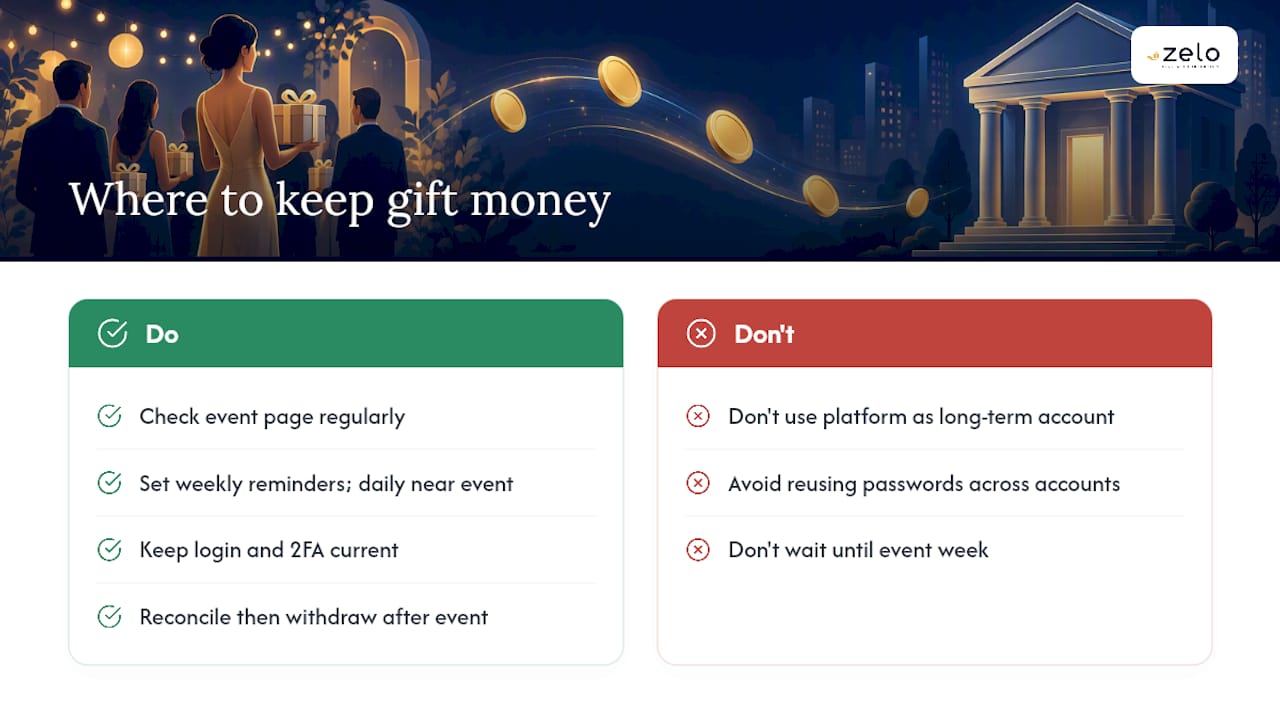
The safest approach is to let contributions accumulate on the platform only until you’re ready to run your reconciliation and initiate a transfer, not to use it as a holding account for weeks. Check your event page regularly rather than waiting until the week of your wedding or shower to look at what’s come in.
A few habits make this easier to manage:
Set a recurring reminder, weekly for a months-long engagement, daily in the final two weeks before an event, to review new contributions. This catches errors early: a guest who accidentally sent double, or a contribution that needs a thank-you note before you forget who sent what.
Keep your platform login credentials and two-factor authentication current. An event page is a financial account in miniature, and it deserves the same password hygiene as your bank login. Avoid using the same password across your gifting platform and other accounts.
Once your event closes, or once you hit a natural milestone like sending thank-you cards, run your reconciliation and withdraw the balance rather than letting it sit indefinitely. The CFPB’s guidance on mobile payment services specifically recommends this pattern: use the app to collect, then move funds to an insured account promptly. Treat “collected” and “settled” as two different states, and don’t confuse the first for the second.
Are There Legal Limits on How Much You Can Receive as Gifts?
There is no cap on how much you, as a recipient, can receive in personal gifts. The dollar limit that matters sits on the donor’s side, not yours. A guest can give you any amount they choose without you owing tax on it.
The figure that generates confusion is the $19,000 annual gift-tax exclusion for 2026. That’s the amount one donor can give one recipient before that donor has to file Form 709. It is not a limit on your total gifts from multiple guests, and it is not a limit that applies to you as the host.
A few clarifications worth keeping straight:
- Reporting requirements, when they exist, apply to the donor, not the recipient of a personal gift.
- Large aggregate totals across many guests do not trigger a filing requirement on your end just because the total is large; each individual gift is what counts against the exclusion.
- Platforms may have their own transaction limits or verification thresholds separate from IRS rules, so check your specific platform’s terms if a single contribution is unusually large.
None of this changes your recordkeeping obligations. Keeping clean records protects you if a question ever arises, even when no tax is owed.
Can Large Gifts Affect Financial Aid or Benefits?
Yes, and this is the subtopic hosts most often overlook. If you or a family member receiving support is applying for need-based financial aid, a large influx of gift money can affect the numbers reported on aid applications, since those forms typically ask about cash, savings, and checking account balances as of a specific date.
Benefits programs with asset limits are a bigger concern. Programs like Supplemental Security Income (SSI) impose strict resource limits, and a lump sum of wedding or graduation gifts sitting in a bank account could push a recipient over that threshold if they or someone in their household receives such benefits.
A few practical points:
- Timing matters. If aid applications or benefit reviews happen on a specific date, a large balance sitting in an account on that date counts differently than money already spent on qualifying expenses.
- Spending gift funds relatively soon after receiving them, on the wedding, the home down payment, the honeymoon, reduces the chance of an asset-limit surprise later.
- If anyone in your household receives means-tested benefits, a conversation with a benefits counselor or tax professional before a large withdrawal is worth the hour it takes.
This is not a reason to avoid collecting gifts. It’s a reason to plan the timing of your withdrawal and spending around any benefit reviews you or your household are subject to.
What Do You Do If a Withdrawal Has an Error or Dispute?
Errors happen: a guest’s payment gets disputed by their card issuer, a contribution shows up twice, or a payout amount doesn’t match what your reconciliation predicted. Handle these calmly and in order.
First, isolate the discrepancy before touching anything else. Compare your reconciliation snapshot, gross contributions, refunds, platform fee, processor fee, against what actually landed in your bank account. Most “errors” turn out to be a fee you forgot to account for, not a platform mistake.
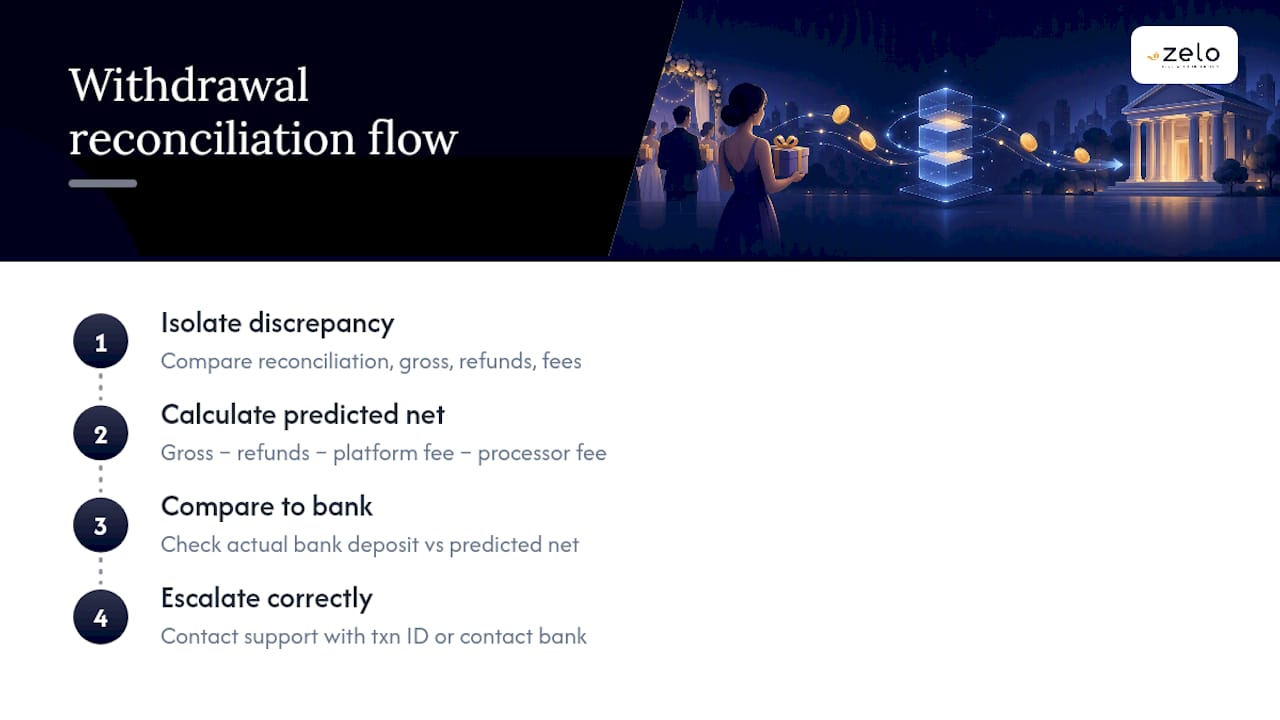
Second, if a guest’s contribution was disputed by their card issuer or bank, that amount typically gets reversed from your available balance rather than pulled from your bank account after the fact, assuming you haven’t already withdrawn it. This is exactly why running your reconciliation before withdrawing, rather than after, matters.
Third, if you spot a genuine platform error, a fee charged incorrectly, a payout that doesn’t match your confirmed transaction, contact support with your transaction ID, confirmation screenshot, and reconciliation numbers ready. Vague messages like “my money is wrong” get slow responses. Specific numbers get fast ones.
Fourth, if the dispute involves your bank rather than the platform, for instance a transfer the platform confirms as sent but that never arrived, your bank’s dispute department is the correct next stop, not the platform’s support team.
Best Practices Hosts Can Make Routine
The hosts who never post frustrated messages about missing payouts share a habit: they verify their payout settings before the event even starts, not after guests begin contributing. That single step, done early, prevents most of the delays described above.
From there, a simple rhythm works: schedule a standard payout once your event officially closes, and reserve instant transfer for genuine last-minute needs, not convenience. Pair every payout with a reconciliation snapshot taken before and after, so your records always explain themselves. This approach draws on patterns seen across event cash-gifting and celebration fundraising, where the hosts with the fewest support tickets are consistently the ones who built reconciliation into their routine rather than treating it as a one-time task. For a broader look at running a cash fund well from the start, see this cash fund registry guide.
— Rodrigo
Withdraw Your Gifts Through Zelo’s Secure Payout Flow
Zelo builds the payout side of event gifting around the same principle this article has walked through: get contributions off the platform and into your bank account without friction. The platform processes guest checkout through PayPal, tracks goal progress in real time, and supports direct withdrawals to linked bank accounts rather than holding funds indefinitely.

If you’re planning a wedding specifically, Zelo’s wedding cash gift page lets you build a personalized wish list alongside your cash fund, so guests can contribute toward specific experiences rather than an anonymous pool. Every contribution runs through Zelo’s platform fee structure, a straightforward percentage on each transaction with no setup or subscription cost tacked on. To get started, verify your identity, link your bank account, and schedule your first payout directly from the Zelo dashboard.
Sources
- CFPB statement on oversight of digital payment apps
- IRS frequently asked questions on gift taxes
- How to withdraw funds from your PayPal account
FAQ
How Do I Withdraw Cash Gifts from My Event Page?
Verify your identity, link a bank account, run a reconciliation snapshot of your gross contributions and fees, then choose standard or instant transfer. Save your confirmation details immediately after initiating.
How Long Does It Take to Withdraw Cash Gifts?
Standard transfers typically take 1 to 3 business days, while instant transfers arrive in minutes for an added fee. Choose based on how close you are to a vendor payment deadline.
Do I Have to Pay Taxes on Gifts I Receive for My Wedding?
Generally no. The IRS places gift-tax reporting responsibility on the donor, not the recipient, and the 2026 annual exclusion is $19,000 per donor per recipient.
Is It Safe to Leave My Gift Money on the Platform for a While?
Not for long. The CFPB warns that balances on nonbank payment apps may lack the deposit insurance that comes standard with an FDIC or NCUA account, so move funds out promptly.
What Does Zelo Charge to Withdraw Gift Contributions?
Zelo charges a 3.89% platform fee on each guest contribution, with no separate setup or subscription cost for hosts. Current details on payout timing are available directly on the platform.
Recommended
Enjoyed the article? Share it!